


Municipal Permit AI: Five Capabilities of a Production-Ready Completeness Platform
Municipal building departments across the U.S. are facing the same bottleneck: incomplete permit submissions that create avoidable rework for city staff and delays for applicants.
Every building department in America is drowning in the same problem: incomplete permit submissions. A contractor uploads a package — missing the mechanical schedule, the egress plan mislabeled, the structural engineer’s stamp absent from one sheet — and the city’s intake staff spend their morning writing rejection letters instead of reviewing permits. The contractor resubmits. The clock resets. The queue grows.
The promise of AI-powered permit completeness checking is straightforward: catch the gaps before the submission ever reaches the city counter, reduce the cycle, improve the applicant experience, and free staff for actual technical review. Most municipalities have heard the pitch. Many have seen the demos. Fewer have seen it work in production — because the market is littered with platforms that look compelling in a slideshow and collapse under the weight of real permit packages, real code requirements, and real public-sector accountability demands.
This is not an indictment of AI. It is an indictment of how AI gets deployed in permitting environments. The gap is not the technology — it is the platform architecture, the deployment model, the compliance posture, and the implementation velocity. The cities that get this right will compress their permitting timelines by double digits within the first year. The cities that get it wrong will spend eighteen months explaining to their City Commission why the pilot never graduated to production.
The Five Dimensions That Define a Production-Ready Permit AI Platform
Permit AI is not a single product. It is an architecture — a set of interdependent capabilities that must function as a unified system or fail individually. The commercial AI market has produced excellent point solutions: document classifiers, OCR engines, chatbots, form builders. None of these, in isolation, solves the permit completeness problem. What municipalities need is a platform that integrates all five dimensions into a coherent, auditable, scalable whole.
| Dimension | What Weak Platforms Deliver | What Production-Ready Looks Like |
|---|---|---|
| Document Intelligence | Keyword detection, file-type checking | Code-grounded analysis: Florida Building Code, ICC, ADA — itemized findings traceable to specific requirements |
| Citizen Portal | Static intake form or file upload page | Configurable, enterprise-grade self-service portal: account management, submission history, automated notifications, WCAG 2.1 AA |
| Data Exchange | Manual handoff or scheduled batch sync | Automated, bi-directional exchange between portal and AI module — zero manual intervention |
| Audit & Compliance Architecture | Basic access logs | Full interaction audit trail: Florida Public Records Law–compliant, FOIA-ready, with mandatory source attribution on every AI finding |
| Deployment Velocity | 3–6 month implementation cycle | Production-ready in 30 days — demonstrated, not just claimed |
The five dimensions are not independently sufficient. A best-in-class AI document analysis engine connected to a fragile portal produces a broken applicant experience. A beautiful portal with no code-grounded AI underneath produces false confidence — applicants submit packages the AI says are complete that city reviewers subsequently reject. The platform must be unified, or the outcome will be fragmented.
The Five Capability Gaps That Actually Matter
Gap 1 — Code-Grounded Document Intelligence — The Difference Between Pattern Matching and Actual Compliance Analysis
The most common failure mode in permit AI is document detection without document comprehension. A system that checks whether a file named “mechanical plan” is present is not performing a completeness review — it is performing a file inventory. The city’s EnerGov system already knows whether files were uploaded. What it cannot do, and what AI is actually needed for, is evaluate whether the uploaded documents satisfy the requirements of the Florida Building Code, applicable ICC standards, ADA, and City-specific amendments.
Code-grounded document intelligence is architecturally different from file detection. It requires the AI system to ingest City-defined requirement sets, map uploaded document elements against those requirements, identify specific deficiencies at the field and drawing level, and produce an itemized Completeness Check output that a contractor can act on without calling the building department. This is Retrieval-Augmented Generation applied to regulatory documents — not a keyword search, not a classification model, but a reasoning system that grounds every finding in a specific code section or requirement.
Without this, applicants receive vague rejection outputs that replicate the problem they already had with manual review. With it, the system tells a contractor: Section 5 of the structural drawings is missing the engineer’s wet stamp required under FBC 107.3.4 — and the contractor knows exactly what to fix. The difference in resubmittal rates is not marginal — it is the difference between a pilot that proves ROI and one that gets quietly cancelled.
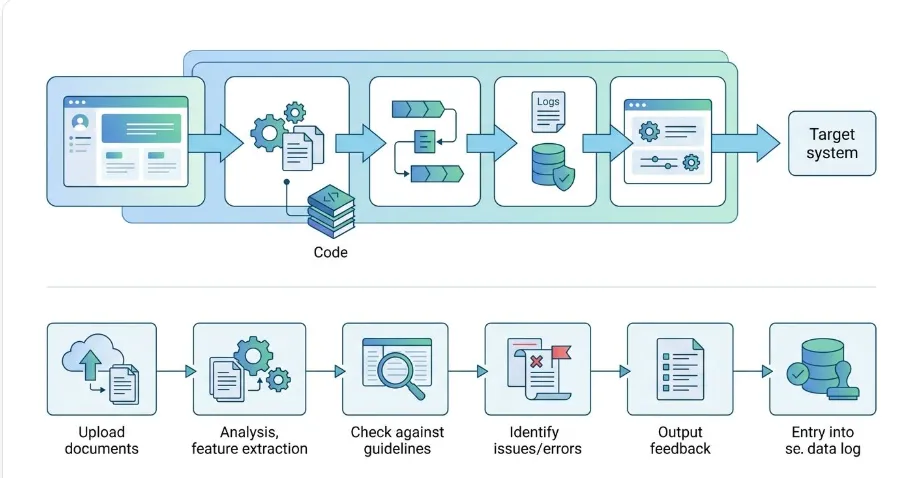 Figure 1: The code-grounded AI completeness review workflow — from applicant document upload through RAG-based regulatory code analysis to itemized, citation-backed deficiency output delivered to the contractor.
Gap 2 — Deployment Velocity — 30 Days Is a Hard Constraint, Not a Guideline
The City of Miami Beach has specified a 30-day pilot window explicitly. This is not unusual for government AI pilots in 2026 — procurement cycles have accelerated, and city leadership is increasingly unwilling to wait six months for a system to demonstrate basic functionality. The problem is that most enterprise software vendors have never shipped a production AI system in 30 days. Their implementation methodologies assume 90-day discovery phases, multi-sprint configuration cycles, and change management programs that outlast the pilot itself.
Production in 30 days requires three things that most vendors cannot provide simultaneously: a pre-built, pre-configured platform (not a bespoke build), a team that has done it before, and a deployment architecture that does not require extended infrastructure provisioning. ASCENDING has demonstrated production deployment of Jarvis AI at CJP LLP in under two weeks. That is the benchmark — and it is achievable because Jarvis is a production platform, not a framework that gets assembled into a platform during implementation. The configuration is rapid; the infrastructure is containerized and cloud-deployable; the integration layer uses pre-built connectors.
Vendors who cannot show a demonstrated production deployment in under 30 days should not be considered for a 30-day pilot. The math does not work.
Gap 3 — Audit Architecture — Florida Public Records Law Is Not Optional
Every AI interaction in a Florida government deployment is a public record. Every completeness check output, every AI finding, every applicant communication — all of it is subject to Chapter 119, Florida Statutes. Most AI vendors have not thought seriously about this. They maintain logs in vendor-controlled environments, accessible only through vendor APIs, with extraction timelines measured in weeks. This is a compliance exposure that no city attorney will accept in a production agreement.
The correct architecture places audit logs within the City’s own cloud environment — accessible directly through the City’s own storage management tools, without waiting for vendor cooperation. Every AI interaction must generate a complete audit record: user identity, timestamp, full query and response text, source documents cited, model used, any content filtering actions applied. This is not a feature — it is a structural requirement of deploying AI in a Florida public agency.
FOIA auditability is also the answer to a question the evaluation committee should be asking but may not yet have articulated: what happens when a contractor disputes an AI finding? The answer, in a properly architected system, is that the City can produce a complete, traceable record of exactly what the AI evaluated, what it found, why it found it, and what source document it cited. That is defensible. A black-box AI output is not.
Gap 4 — Multilingual Citizen Access — Spanish Is a Minimum, Not an Afterthought
Miami Beach’s contractor and developer community is multilingual. The RFQ specifies Spanish as the minimum secondary language — a recognition of the City’s demographic and business reality. This is not a localization checkbox. It is a core accessibility requirement that determines whether the platform serves the actual applicant population or only the subset that operates entirely in English.
Multilingual support in a permit platform requires more than translated interface strings. It requires real-time translation of AI-generated completeness check outputs — outputs that contain regulatory terminology, code section references, and technical construction language. Generic machine translation fails here because it does not understand the difference between a structural drawing and a structural plan, or between egress as a technical term and exit as a common synonym. Domain-aware translation — which understands Florida Building Code terminology and construction industry vocabulary — is the correct posture.
The platform must also meet WCAG 2.1 Level AA across all resident-facing interfaces. This is a legal accessibility standard, not a design preference. Any vendor claiming WCAG compliance should be able to demonstrate it with an accessibility audit report, not just a checkbox in a features matrix.
Gap 5 — Scalable Portal Architecture — The Pilot Is Not the Endpoint
The City has been explicit: commercial interior renovation is the starting point. The intent is to expand to additional permit types, review workflows, and potentially other municipal services. This means the platform selected for the pilot must be capable of supporting that expansion without re-platforming — without the City having to go back through a procurement cycle to add a second permit type.
Platform scalability in this context means two things: technical scalability (the architecture can handle additional permit types, users, and data volumes without fundamental redesign) and configurability (City staff can add new permit types and configure new completeness check requirements without custom development from the vendor). Platforms that require vendor development hours for every new permit type are not scalable in the operational sense — they are just larger dependencies.
The correct test: can a City administrator, without developer involvement, configure the completeness check requirements for a new permit type using the platform’s built-in tools? If the answer requires a change order, the platform is not enterprise-grade.
How Traditional Permit Technology Platforms Compare
The competitive landscape for this RFQ spans three categories: legacy municipal permitting software vendors adding AI features, general-purpose AI document platforms adapted for government use, and purpose-built governed AI platforms with document intelligence capabilities.
| Capability | Legacy ePermit Platforms | General-Purpose AI Doc Tools | Jarvis AI (ASCENDING) |
|---|---|---|---|
| Code-grounded document analysis | ❌ File detection only | ⚠️ Requires custom configuration | ✅ RAG-grounded in City-defined code requirements |
| 30-day production deployment | ❌ 90–180 day implementations | ⚠️ Framework requires assembly | ✅ Demonstrated: under 2 weeks at CJP LLP |
| Florida Public Records Law compliance | ⚠️ Vendor-hosted logs | ❌ Logs in vendor environment | ✅ All data in client’s own cloud environment |
| WCAG 2.1 AA accessibility | ⚠️ Variable by platform | ❌ Not always assessed | ✅ Designed to Section 508 / WCAG 2.1 AA |
| Real-time Spanish translation | ❌ Manual localization | ⚠️ Generic APIs only | ✅ AWS Translate with domain-aware vocabulary |
| EnerGov integration readiness | ✅ Direct | ❌ Custom build required | ✅ RESTful API connectors; integration-ready architecture |
| No-code permit type expansion | ❌ Vendor development required | ❌ Custom configuration | ✅ Configurable by City staff, no code changes |
| Hallucination prevention | N/A | ❌ No grounding guarantee | ✅ Mandatory source attribution; ungrounded findings flagged |
| Full AI interaction audit trail | ⚠️ Basic system logs | ❌ Vendor-controlled | ✅ Complete audit trail in client environment |
| Cyber liability coverage | ⚠️ Varies | ⚠️ Varies | ✅ $1M per occurrence / $2M aggregate — meets RFQ requirements |
The legacy platforms have integration advantages — Tyler Technology’s ecosystem is well-understood by vendors in the permitting space. But integration is a solvable problem for any platform with a mature API layer. Audit posture, deployment velocity, and code-grounded intelligence are architectural characteristics that cannot be bolted on after the fact.
General-purpose AI document tools occupy a dangerous middle ground: sophisticated enough to generate impressive demos, immature enough in government-specific compliance architecture to create real risk in production. The question to ask any vendor in this category is not can your system analyze a permit document but where do the audit logs live, who controls them, and how does a City staff member access them at 10pm on a Friday when the city attorney calls?
Three Failure Modes That Occur in Production
Failure Mode 1 — The Confident Wrong Answer. A vendor deploys an AI completeness check that is trained on general construction documents rather than grounded in the Florida Building Code and City-specific amendments. The system tells a contractor that a commercial interior package is complete. The contractor submits formally. City reviewers reject it for a deficiency the AI missed because it was not in the training data. The contractor is angry. The City is embarrassed. The pilot is in jeopardy. The root cause: AI outputs not grounded in verified, City-defined requirement sets. The fix: RAG architecture with mandatory source attribution — every AI finding traces to a specific code section, and findings not traceable to a verified source are flagged rather than generated.
Failure Mode 2 — The Audit Request That Takes Weeks. Three months into production, a contractor formally disputes an AI finding and requests the underlying audit records under Chapter 119. The City asks the vendor. The vendor’s legal team gets involved. Export takes ten business days. The records are incomplete because the vendor’s logging system captured interactions at the session level rather than the interaction level. The City’s attorney is not satisfied. The root cause: audit logs in vendor-controlled infrastructure rather than the City’s own environment. The fix: client-hosted deployment where all logs are the City’s own data, accessible directly without vendor involvement.
Failure Mode 3 — The Pilot That Can’t Scale. The 30-day pilot succeeds — commercial interior renovation completeness checks work well, applicant satisfaction improves, resubmittal rates drop. The City wants to add residential renovation as the second permit type. The vendor says it will take eight weeks and a change order. The City Manager asks why a $200K AI platform requires a change order to add a permit type. The pilot that proved ROI becomes a procurement conversation. The root cause: platform configurability was never actually enterprise-grade — each permit type required vendor-side configuration work. The fix: a platform where City staff configure new permit types using built-in tools, without code changes or vendor involvement.
The Pre-Submittal Intelligence Layer Concept
The City of Miami Beach’s vision — an AI-driven completeness check that operates in parallel with EnerGov rather than replacing it — is the right architectural instinct. The system of record retains authority. The AI adds a pre-submittal intelligence layer that catches gaps before they enter the formal queue. This is not a replacement strategy; it is an acceleration strategy.
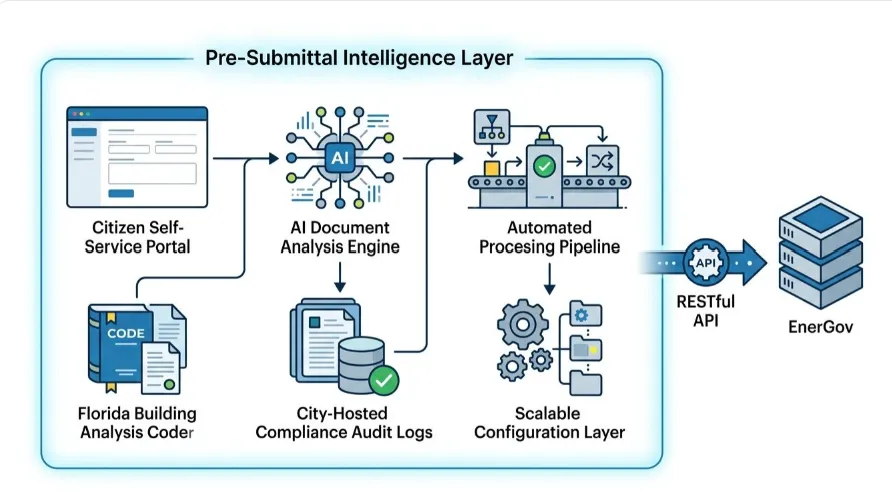
The Pre-Submittal Intelligence Layer has five components:
Citizen Self-Service Portal — A secure, web-based applicant interface with account management, submission history, document upload, and automated notifications. Configurable by City staff without development hours. Branded to City standards. WCAG 2.1 AA accessible with real-time Spanish translation built in.
AI Document Analysis Engine — RAG-grounded analysis of uploaded permit packages against City-defined completeness requirements. Itemized output: specific deficiencies, specific code references, specific elements missing. Not a confidence score — an actionable finding with a traceable source.
Automated Processing Pipeline — Bi-directional data and document exchange between the portal and the AI module without manual intervention. Submitted packages automatically routed to the AI engine; findings returned to the applicant without staff involvement.
Audit and Compliance Architecture — Every AI interaction logged within the City’s own environment. Every finding traceable to a source. Florida Public Records Law compliant from day one. Accessible by City staff directly — no vendor cooperation required.
Scalable Configuration Layer — New permit types added by City staff using the platform’s built-in configuration tools. No vendor development required. No re-platforming when the City is ready to expand beyond commercial interior renovation.
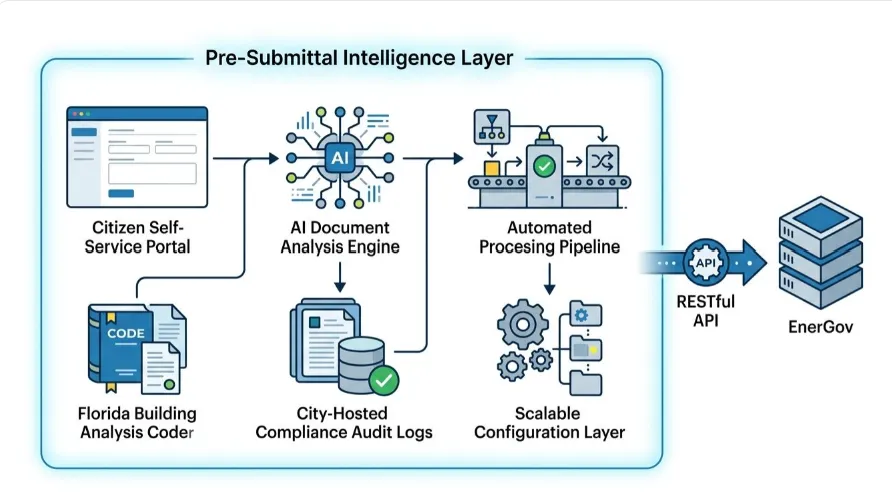 Figure 2: The full Pre-Submittal Intelligence Layer architecture — showing the Citizen Self-Service Portal, AI Document Analysis Engine (RAG-grounded), Automated Processing Pipeline, City-hosted Compliance Audit Logs, Scalable Configuration Layer, and RESTful API integration to EnerGov.
This architecture does not disrupt EnerGov. It adds intelligence upstream — catching the gaps that currently cause EnerGov queues to back up — while leaving all formal permitting authority exactly where it belongs: with the City’s professional reviewers.
Five Questions for Evaluating a Municipal Permit AI Engagement
1. Can you show a production deployment completed in under 30 days? A good answer names a specific client, a specific timeline, and a contact who can verify it. A bad answer describes a pilot environment or a demo instance as “production.” The distinction matters because pilot environments are configured to succeed in demos. Production environments are configured to handle edge cases, user errors, system failures, and audit requests. Miami Beach needs the latter.
2. Where do the audit logs live, and who controls them? A good answer: in the City’s own cloud environment, accessible directly by City administrators without requesting an export from the vendor. A bad answer invokes “enterprise-grade logging” without specifying location or access mechanism. This question reveals more about a vendor’s compliance architecture than any feature matrix will.
3. How does the system prevent AI findings that are not grounded in the Florida Building Code? A good answer describes a specific technical mechanism: RAG grounding, mandatory source citation, flagging of ungrounded findings. A bad answer mentions “hallucination reduction” as a general AI safety claim. The difference is the difference between a system that can be audited and one that cannot.
4. How does a City administrator configure a new permit type — without vendor involvement? Walk the administrator through the actual steps. A good answer shows a configuration interface that any trained City staff member can operate. A bad answer defers to “our implementation team will handle that.” If a change order is required to add a permit type, the platform is not enterprise-grade — it is a professional services engagement wrapped in platform language.
5. How does the multilingual output handle technical construction terminology — not just common vocabulary? Ask for a live demonstration: submit a permit completeness output and request it in Spanish. Evaluate whether the translation preserves technical terms accurately. Domain-aware translation — trained on construction and regulatory vocabulary — will produce output a contractor can act on. Generic machine translation will not.
The ASCENDING Approach for the City of Miami Beach
The permit completeness problem is, at its core, a document intelligence problem grounded in regulatory authority — exactly the domain for which we built Jarvis AI.
ASCENDING brings the City of Miami Beach a production-ready, enterprise-grade platform with demonstrated government delivery experience. Our active client portfolio includes the City of Phoenix Water Services Division, Maryland Department of Health, Metropolitan Washington Airports Authority, Virginia Housing Development Authority, Florida Department of Management Services, and the Texas Department of Information Resources — active government delivery across the state and local landscape. We operate as a Virginia-certified Minority-Owned Small Business (Cert No. 812635), an AWS Advanced Consulting Partner with AWS GenAI Competency designation, and an Anthropic Partner.
The Jarvis AI team proposed for Miami Beach is led by Ryo Hang, President and Chief AI Architect — the original creator of the Jarvis platform — supported by Gloria Zhang, VP of Operations and PMP-certified Program Manager, Kelvin Yu, Jarvis co-creator and Technical Lead with NIST 800-53 aligned development experience, and Alexander Groman, AI & Automation Developer and former Google Site Reliability Engineer who has maintained 99.9%+ uptime on production systems at enterprise scale. Tommy Tao, our AI Ethics & Governance Specialist, ensures every Jarvis deployment meets NIST AI RMF standards and carries the audit infrastructure required for public-sector accountability. Caleb Mabry, Agentic AI Solutions Architect with computer vision and OCR experience from Capital One, rounds out the document intelligence capability.
We have demonstrated production deployment in under two weeks at CJP LLP, generating $300,000+ per month in documented productivity value. We maintain full audit logs in client environments. We support WCAG 2.1 AA and real-time Spanish translation natively via AWS Translate. We are ready for the 30-day pilot on day one of contract execution — not because we claim to be, but because we have done it. Learn more at ascendingdc.com.
Closing
The platforms that serve municipal permitting today were not designed for AI. Tyler Technology’s EnerGov is an excellent system of record — it tracks permit applications, manages reviewer queues, enforces workflow steps, and produces the audit trail that building departments depend on. No one is arguing it should be replaced. The argument is that it was never designed to read a 200-page plan set and tell a contractor what is missing before the submission enters the formal queue. That capability requires a different layer of intelligence — and EnerGov will benefit from the volume reduction that a well-deployed pre-submittal layer creates.
The cities that win at permit AI in the next two years will be the ones that deploy the intelligence layer correctly — grounded in their actual code requirements, compliant with their state’s public records obligations, accessible to their multilingual applicant communities, and scalable beyond the pilot permit type without a re-procurement cycle. These are not aspirational capabilities. They are achievable today with a platform that is designed for this purpose rather than adapted to it.
The gap is not between AI and permitting. The gap is between real AI platforms and the vendors who have learned to speak the language without building the architecture. Miami Beach deserves the former.
References
| Source | Link |
|---|---|
| City of Miami Beach RFQ 2026-174-WG | https://www.miamibeachfl.gov/city-hall/procurement/ |
| Florida Building Code — Florida Building Commission | https://floridabuilding.org |
| Tyler Technologies EnerGov | https://www.tylertech.com/products/energov |
| NIST AI Risk Management Framework | https://www.nist.gov/system/files/documents/2023/01/26/AI%20RMF%201.0.pdf |
| Florida Chapter 119 — Public Records Law | http://www.leg.state.fl.us/statutes/index.cfm?App_mode=Display_Statute&URL=0100-0199/0119/0119.htm |
| WCAG 2.1 Level AA — W3C | https://www.w3.org/TR/WCAG21/ |
| ICC International Building Code | https://www.iccsafe.org/codes-tech-support/codes/2021-i-codes/ibc/ |
| ASCENDING Inc. | https://ascendingdc.com |