

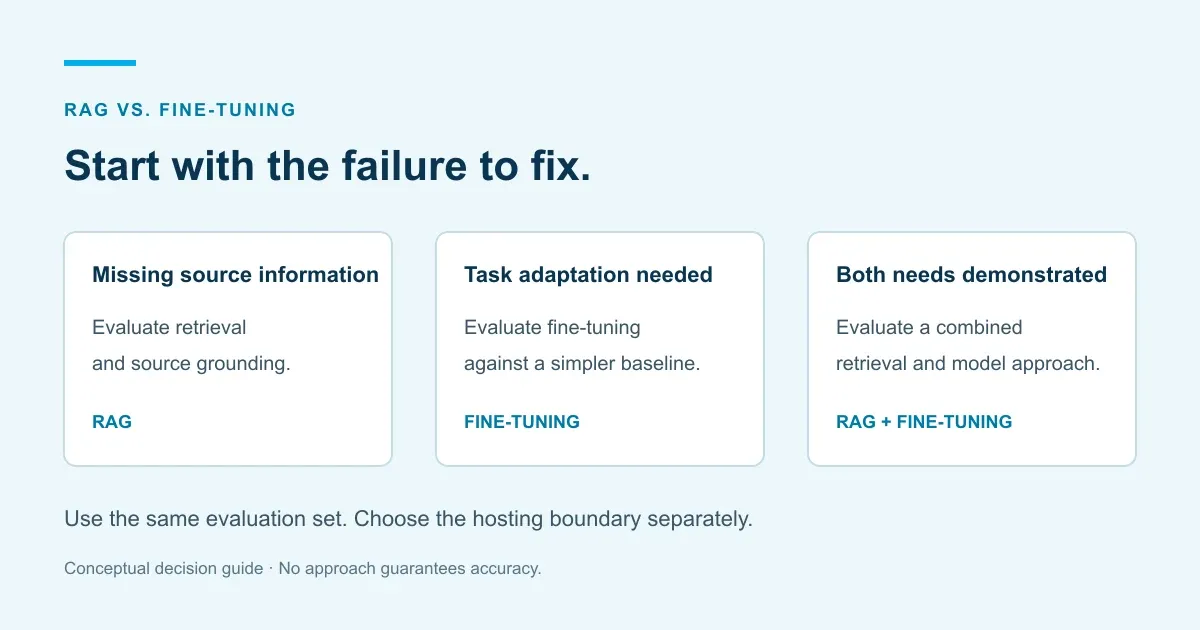
The RAG versus fine-tuning decision starts with the failure you need to fix. Does the model lack the right company information, struggle to perform a repeatable task, or both? Choosing a more complex model before answering that question can add cost without solving the business problem.
For a private LLM project, keep three decisions separate: how the system finds information, how the model is adapted, and where the components run. Retrieval-augmented generation (RAG), fine-tuning, and private deployment address different parts of that design.
Start with a real example that fails
Collect representative requests and the answers your team considers acceptable. Label why each current answer fails: missing facts, poor retrieval, wrong format, inaccurate reasoning, unauthorized data access, or an unsupported conclusion.
Try a clearer prompt and an appropriate base model first. Then assess whether retrieval or model adaptation addresses the remaining failure. Do not train a model merely because a project has been called “domain-specific.”
Choose retrieval for information the model needs to reference
RAG retrieves relevant information from a source and supplies it to a model as context. It is a useful starting point for questions about current policies, product documents, or customer records where the answer should be grounded in identifiable sources.
Amazon Bedrock Knowledge Bases documentation describes this retrieval process and support for source citations. A citation is useful evidence, but it still needs to point to material that actually supports the answer.
For a buyer, the important tests are whether the system retrieves the right material, respects the user’s permissions, handles updated documents, and declines to answer when evidence is missing. If the right passage never reaches the model, changing the model alone may not address the failure.
ASCENDING’s Jarvis Knowledge Base is the relevant product area when the primary need is enterprise retrieval and grounded answers.
Choose fine-tuning for a measured task-adaptation need
Fine-tuning adapts model parameters using training examples. Consider it when a repeatable task still misses the required quality after simpler approaches have been tested, and suitable training data is available.
Examples might include producing a consistent domain-specific summary or extracting a required output structure from recurring inputs. These are candidates to evaluate, not a promise that fine-tuning is always necessary.
AWS’s RAG and fine-tuning comparison distinguishes retrieval over custom documents from model adaptation and notes the maintenance trade-off when documents change frequently. Fine-tuning is not a substitute for a retrieval system when the response must reference current source records.
Before selecting a provider, ask how examples will be prepared, which data is held out for testing, whether the model’s license permits the intended use, and what would count as an improvement worth deploying.
Use both only when both solve a demonstrated problem
A combined system can retrieve current information and use an adapted model to complete the task. That adds components to evaluate and maintain, so test the combined design against the simpler alternatives.
ASCENDING’s D2 Nova project is a concrete example. It used more than 8,000 transcript-summary pairs for domain-specific fine-tuning and a hybrid RAG pipeline for customer-level historical retrieval. Those components addressed different needs within the call-intelligence workflow.
That dataset size is a case-study fact, not a universal minimum. Your task, model, data quality, and acceptance criteria determine what evidence is needed.
Compare approaches with the same evaluation set
Ask the implementation partner to propose a baseline and run the relevant alternatives against the same held-out examples. AWS’s evaluation guidance covers both model and retrieval evaluation, including custom datasets and human review.
A useful scorecard includes:
- Task quality: Does the output satisfy the business requirement, including required fields or summary content?
- Evidence: Are important claims supported, and are citations correct when sources are expected?
- Permissions: Can one user retrieve or infer information reserved for another?
- Failure handling: What happens when inputs are unfamiliar, conflicting, incomplete, or unanswerable?
- Operating cost: What are the latency, inference, retrieval, evaluation, and maintenance costs for the same workload?
Agree which failures require human review before deployment. A good average score should not hide a small set of unacceptable mistakes.
Decide the hosting boundary independently
Either approach can involve several services: a model endpoint, data store, embedding model, retrieval layer, logs, and evaluation tools. Map where each component runs and which data it receives.
Customer-hosted application code does not prove that inference happens in the customer’s environment. Equally, a managed model is not automatically equivalent to a public chatbot. Bedrock’s data-protection documentation, for example, describes specific controls and responsibilities that need to be evaluated in the proposed design.
The private LLM deployment buyer guide covers these boundary and ownership questions. Private hosting itself does not guarantee accurate answers or regulatory compliance.
Scope the smallest useful next step
Bring one workload, examples of good and bad outputs, the available source or training data, and the deployment constraints. Ask for a comparison that explains which change is expected to improve which failure, and how that improvement will be measured.
Review custom LLM development when model adaptation is justified. Plan the MLOps workflow when the team needs a repeatable process for evaluating and releasing future model versions.
Discuss your workload with ASCENDING before committing to a training or deployment approach.
References
- Amazon Bedrock Knowledge Bases
- AWS comparison of RAG and fine-tuning
- Amazon Bedrock model and retrieval evaluation
- Amazon Bedrock data protection
RAG and Fine-Tuning Buyer Questions
Can a private LLM use RAG and fine-tuning together?
Yes. Retrieval can supply relevant source material while a fine-tuned model handles the task. Test whether the combined approach improves the chosen business metrics.
Does fine-tuning eliminate hallucinations?
No. Fine-tuned models can still produce unsupported answers. Evaluate difficult inputs, define acceptable failure handling, and monitor the deployed system.
Which approach is better for frequently changing documents?
Start by evaluating retrieval. It can supply updated source material without retraining the model, although ingestion, permissions, and retrieval quality still need testing.
Is RAG an alternative to private hosting?
No. RAG describes how information reaches a model. Hosting describes where components run. A retrieval pipeline can use privately hosted or managed model endpoints.
What should we request before paying for fine-tuning?
Request a baseline evaluation, a review of usable training data, measurable acceptance criteria, and a comparison against simpler prompting or retrieval changes.