

Private LLM deployment is not one architecture. It can mean an AI application in your cloud, a privately connected managed model service, or model inference running on infrastructure you operate. Those choices have different data boundaries and operating responsibilities.
Before comparing providers, ask one question: what must remain under our control, and how will the proposed design prove it? The answer should cover inference, training data, retrieval, logs, administrator access, and ongoing operations, not just the chat interface.
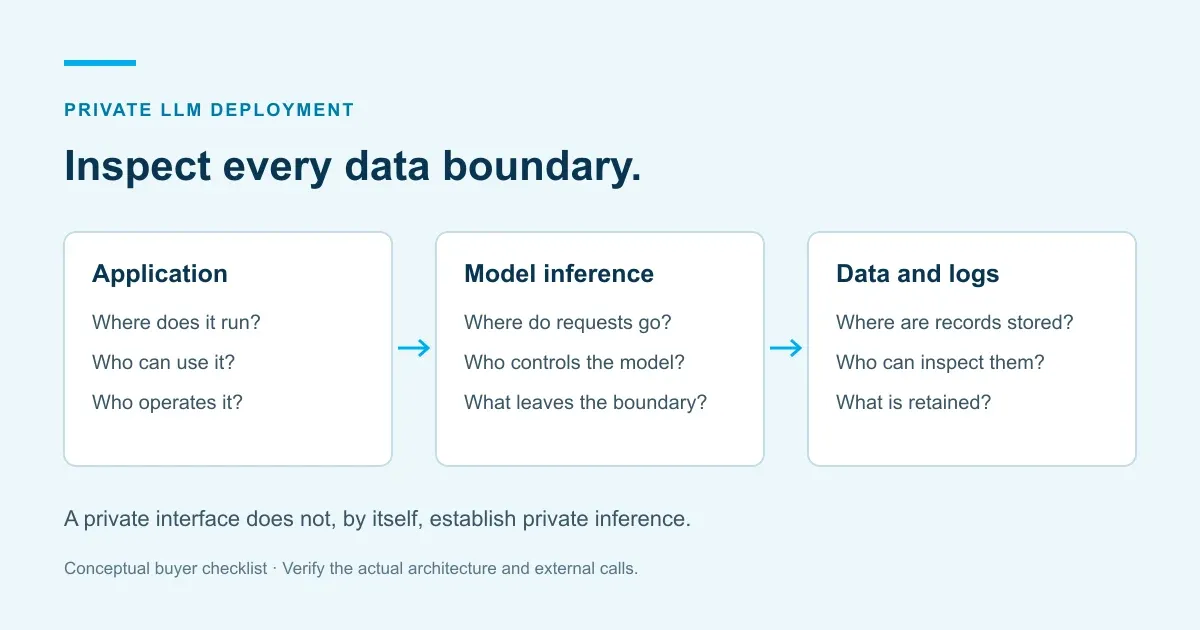
Separate the application, the model, and the network
A customer-hosted application does not necessarily include customer-hosted model weights. Its prompts may still go to a configured model service. A private network connection also does not move that service into infrastructure your team operates.
For example, AWS PrivateLink connects a VPC privately to Amazon Bedrock. That is different from running inference on your own servers. AWS also documents that model providers cannot access Bedrock deployment accounts, logs, or customer prompts and completions. Buyers should assess the actual service, configuration, and terms rather than treating every managed model as a public consumer chatbot.
If a requirement specifically calls for model weights and inference under your operational control, put that requirement in the scope. “Private AI” alone is too ambiguous.
Compare three deployment options
A managed model service with private connectivity
Consider this when the priority is a controlled connection and an acceptable managed-service data policy, without operating the inference hardware yourself. Verify region, retention, permissions, supported models, and any external integrations. Private connectivity is not an air gap.
A model deployed in your cloud environment
Consider this when you need more control over model selection and the serving configuration. Clarify which parts use managed infrastructure and which your team operates. For example, SageMaker model containers can connect to resources in a private VPC, but network access and permissions still require deliberate configuration.
A model deployed on premises
Consider this when the workload has a specific local-processing or disconnected-operation requirement. Assess hardware capacity, availability, model licensing, patching, backups, and who will operate the service. A model installed locally can still have external dependencies elsewhere in its workflow.
Choose the least complex design that satisfies the actual workload and security requirements.
Ask for a deployment and ownership checklist
Have each shortlisted partner fill in the same fields. These are procurement questions, not assumptions about what a particular service includes.
- Model and license: Which model and version will run? What rights cover use, modification, and redistribution of the resulting artifacts?
- Inference: Where does each request execute? Which endpoints receive prompts, retrieved context, and responses?
- Training and retrieval data: Where are datasets, embeddings, indexes, and backups stored? How are access and deletion handled?
- Logs and support: What is recorded, how long is it retained, and who can inspect it? Can diagnostic access be time-limited and audited?
- External calls: Does the workflow contact model APIs, embedding services, telemetry, package repositories, or business tools outside the agreed boundary?
- Release and recovery: Who approves a new model version? How is a failed release rolled back, and has recovery been tested?
- Handoff: Which code, configurations, model artifacts, and runbooks will the customer receive? Who handles incidents and future changes?
Ask for evidence: an architecture diagram, a sample access policy, a data-retention configuration, and a trace of a representative request. A feature checklist without an observable test leaves important questions open.
In healthcare, an insurance eligibility workflow may still reach an external transaction provider even when its model is privately hosted. Adding voice AI for payer calls can introduce another service handling identifiers and call evidence. Map those paths separately so the deployment decision reflects the whole workflow rather than only the model endpoint.
Estimate operating cost from the workload
Employee count alone is not a capacity plan. Request an estimate based on concurrent users, request volume, context length, response length, availability, and acceptable latency. Separate initial implementation, inference, storage, evaluation, and ongoing operations.
Compare candidate configurations using the same representative requests. Bedrock evaluations support custom datasets and human review; the wider principle is to test against the business task, not a generic leaderboard. Include difficult inputs and examples where the system should refuse or escalate.
What relevant delivery evidence looks like
ASCENDING’s D2 Nova call-intelligence project combined model evaluation in Bedrock, domain-specific fine-tuning, SageMaker inference endpoints, and hybrid retrieval. It demonstrates an AWS-based delivery pattern, not an air-gapped deployment.
For the operating lifecycle, the Light Robotics case study describes repeatable model training workflows using SageMaker Pipelines and Experiments. Ask an implementation partner for similarly specific evidence that matches your proposed architecture.
Bring a defined workload to the first discussion
Prepare one target workflow, a permitted sample of its data, the required deployment boundary, and the person who will own operations. That is enough to begin comparing an existing model, custom LLM development, and the MLOps workflow needed after rollout.
If model quality is the main uncertainty, use the RAG versus fine-tuning decision guide before choosing an adaptation method. Hosting and model adaptation are separate decisions.
Talk to ASCENDING about your deployment requirements.
References
- Amazon Bedrock private connectivity
- Amazon Bedrock data protection
- SageMaker hosted endpoints and VPC access
- Amazon Bedrock model and retrieval evaluation
Private LLM Deployment Questions
Does a customer-hosted AI application mean the model is hosted there too?
No. An application can run in your cloud while calling a model hosted elsewhere. Verify the inference endpoint and every external data flow separately.
Does an on-premises LLM automatically work without internet access?
No. Model downloads, authentication, telemetry, updates, and connected tools can create dependencies. Disconnected operation needs its own design and testing.
How much GPU capacity does a private LLM need?
Size it against the model, context length, concurrent requests, and latency target. Ask for a workload benchmark rather than a generic hardware estimate.
Does private hosting remove the need for access controls?
No. Users still need appropriate permissions to data, tools, and logs. Hosting location does not decide which records an individual may access.
Who operates a private LLM after deployment?
The agreed operating model should name owners for monitoring, updates, incident response, backups, and model changes. Deployment alone does not define ongoing support.