

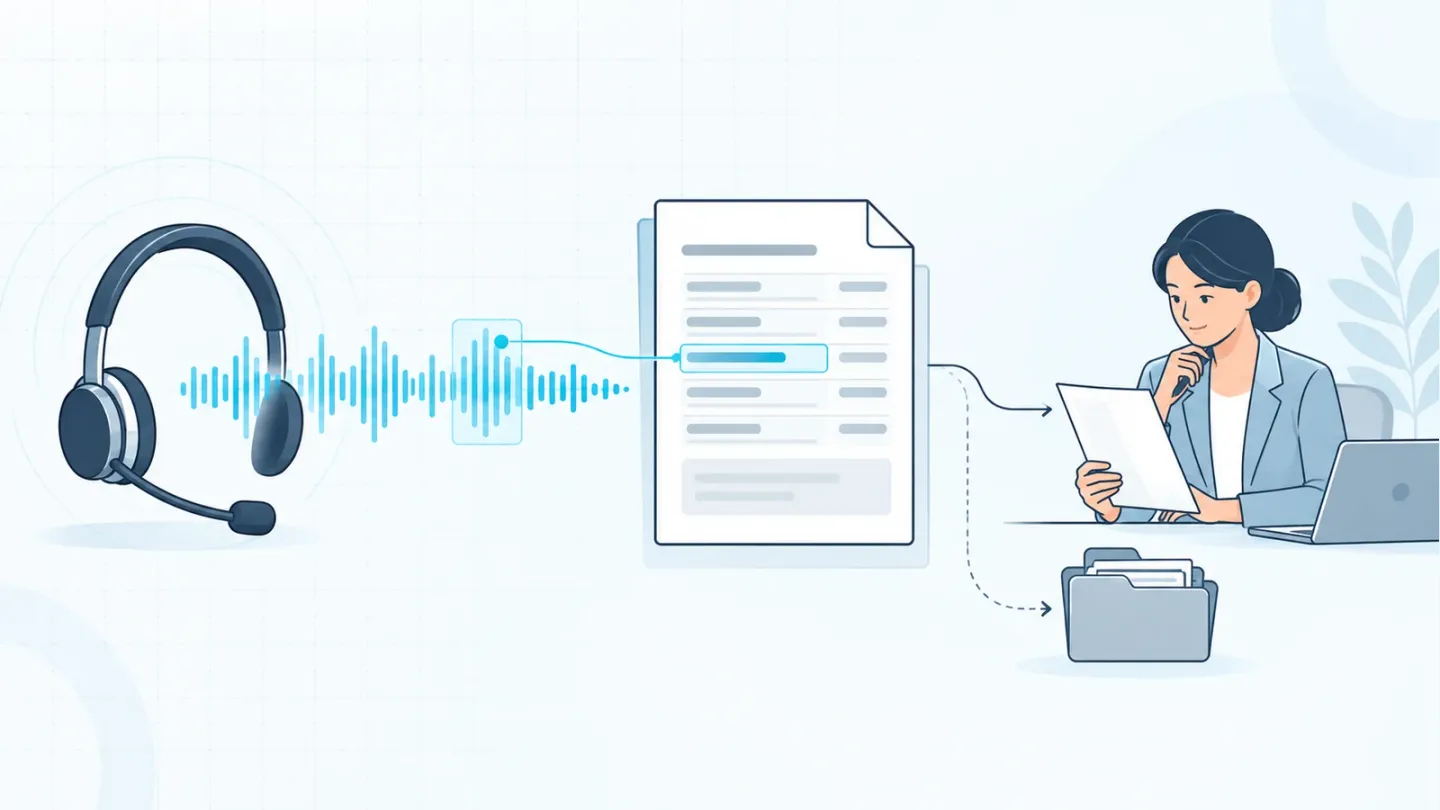
Voice AI for payer calls uses artificial intelligence (AI) to take on the phone work behind insurance verification: reaching the payer, navigating the interactive voice response (IVR) menu, and collecting answers from a representative. The buying decision comes down to whether those answers become reliable, usable benefits records.
For a revenue cycle team evaluating voice AI insurance verification, start with one defined queue and a required output schema. Compare vendors on payer coverage, field accuracy, evidence, and exception handling. A convincing conversation is only one part of the workflow.
This guide provides a procurement shortlist and an evaluation method. Product scope below reflects public vendor pages reviewed in September 2026; it is not a hands-on performance ranking.
When a payer call belongs in the workflow
First identify which questions still require a call. The Centers for Medicare & Medicaid Services (CMS) describes eligibility and benefit inquiries as standardized electronic transactions, including the X12 270 request and 271 response. Voice should address an unresolved question after an appropriate electronic check, rather than repeat information already available.
For example, a work item might request clarification of a benefit limitation for a specific service and date. Pass the existing response and the missing question to the calling service. Keep eligibility status, benefit details, and authorization status in distinct fields; one answer should not silently populate another.
Our AI insurance eligibility verification guide covers the broader workflow. Here, the purchasing scope is the call and the evidence it returns.
Voice AI platforms for benefits verification: a shortlist
Two vendors offer relevant starting points for a payer-call evaluation. Infinitus lists benefit verification, insurance eligibility confirmation, and prior authorization status among its provider workflows. SuperDial describes eligibility and benefits agents that use phone calls, payer portals, and structured channels, returning fields with source information.
| Platform | Publicly described scope | Evidence to request for your workflow |
|---|---|---|
| Infinitus | Benefit verification and eligibility confirmation; agent configuration and integration support | Demonstration on your payer mix, exact required fields, escalation ownership, exported evidence, and the proposed system integration |
| SuperDial | Payer calls and IVR navigation, portal checks, EDI/API connectivity, and structured eligibility results | Channel selection rules, evidence links for returned fields, failed-call handling, write-back behavior, and retry charges |
These descriptions establish relevance. They do not establish that either platform supports every payer, specialty, or plan variation you encounter. Ask vendors to mark each requirement as available, configurable, custom development, or unsupported in the proposed contract.
The best automated voice tool for payer eligibility checks is the one that meets your acceptance criteria on representative cases. Request the same demonstration script from each vendor, including a missing answer and a failed transfer. Keep quoted capabilities separate from capabilities your team has tested.
Measure field accuracy separately from call completion
Define three measures for the payer-call verification pilot before it starts:
- Call completion: the share of attempted calls that reach the agreed conversational endpoint, with retry rules disclosed.
- Field accuracy: the share of populated fields that match reviewed source evidence, reported separately for each field.
- Accepted verification: the share of eligible work items that satisfy all required fields and review rules, with human-assisted cases identified.
Also measure the missing-field rate. Otherwise, a system can appear accurate by returning only easy answers. A correct copay cannot compensate for an incorrect benefit limit in an aggregate score.
Build the review set across your payer mix, service types, and known exceptions. Have staff independently review the evidence, then adjudicate disagreements. Separate faithful extraction of what a representative said from confirmation that the response applies to the requested patient, service, and date. An accurate transcript can still capture an ambiguous answer.
Treat downstream denials as a separate outcome to investigate. They are influenced by factors beyond a verification call and cannot, by themselves, diagnose extraction quality.
Require an evidence package with every result
The useful deliverable is a structured record a reviewer can trace to its source. Define that record before connecting a vendor to your practice management or revenue cycle system.
| Required capability | What to inspect during evaluation |
|---|---|
| Request context | Work-item ID, payer, requested service/date, and authorized identifiers |
| Field provenance | Value, answered/unanswered status, source timestamp, and supporting excerpt or approved artifact |
| Call history | Attempts, transfers, final disposition, and payer reference number when provided |
| Review status | Exception reason, assigned owner, reviewer decision, and correction history |
| Delivery control | Target record, proposed changes, write-back result, and duplicate prevention |
Agree on which artifacts may be captured and retained. Where recordings or transcripts are permitted, make them accessible to authorized reviewers under the approved retention policy. Where they are unavailable, require an explicit evidence limitation and a defined review path.
Preserve original evidence when a reviewer corrects a field. That makes it possible to distinguish a transcription error, a mapping error, and a conflicting payer response. Archive teams can apply related document classification and indexing patterns to supporting faxbacks or documents, while retaining their source relationships.
Make human handoff an acceptance test
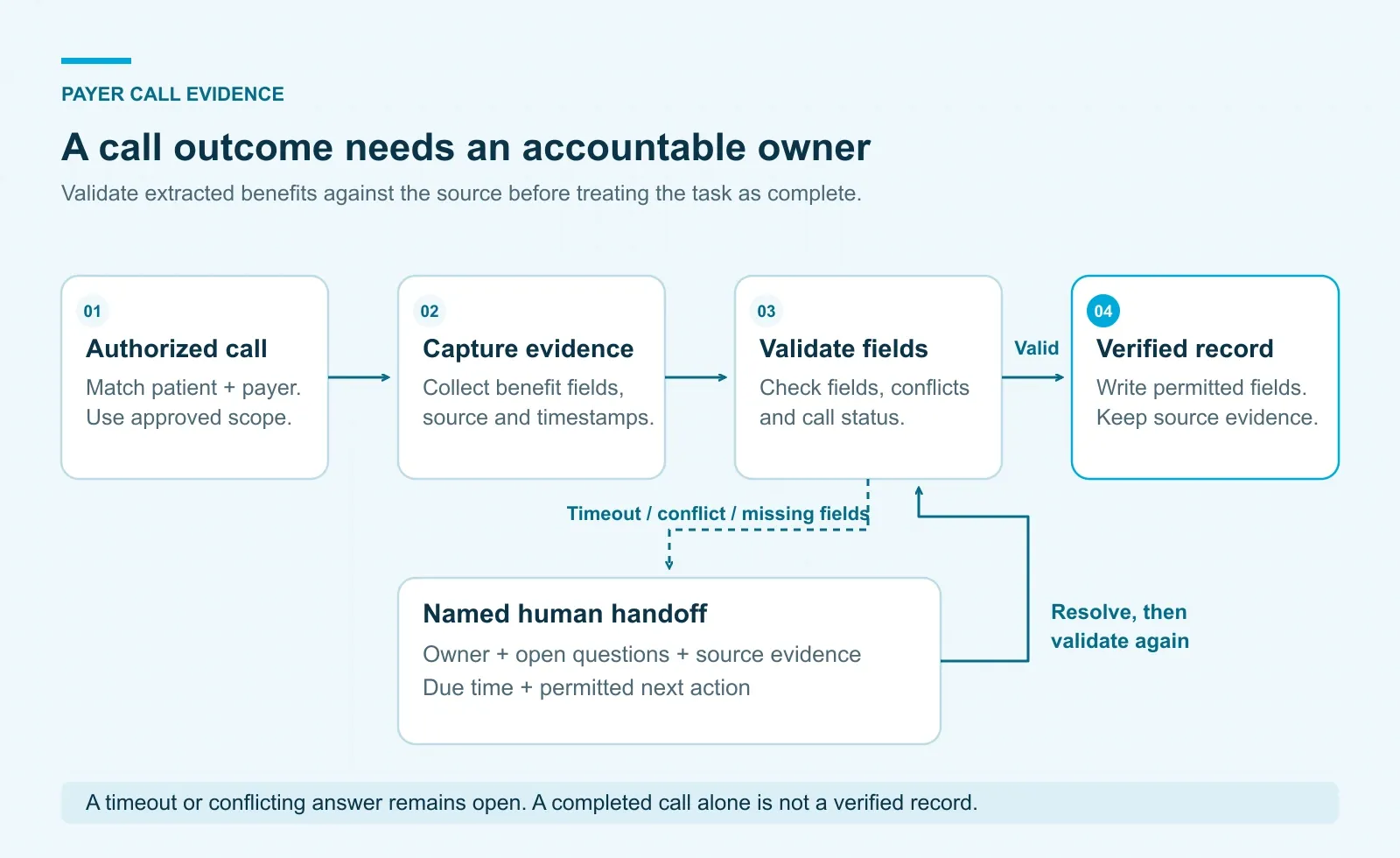
A payer-call handoff needs an owner, context, and a next action. Test identity verification failure, conflicting benefit answers, unsupported questions, missing required fields, and a representative requesting a person.
For each case, verify whether the service transfers a live call, schedules a callback, or creates a review task. These are different operating models with different staffing requirements. Test what happens when the reviewer is unavailable and when a deadline passes.
The receiving employee should get the work-item context, questions already answered, unresolved issue, and available evidence. Define the point at which the system must stop making changes. Use an AI agent human approval checklist to verify that a rejected or expired approval blocks the intended write-back.
Review data handling and the commercial model
Map where identifiers, audio, transcripts, and extracted fields travel, including subcontractors and human review teams. Department of Health and Human Services (HHS) business associate guidance explains the obligations and agreements that apply when vendors perform covered functions involving protected health information. Have the organization’s privacy and security owners assess that relationship and the proposed data flows before sending production protected health information (PHI).
Request clear terms for permitted data use, access, retention, deletion, incident reporting, and evidence export. Separately confirm the caller identification, disclosure, and recording requirements applicable to the deployment. Product certifications or a signed agreement do not establish field accuracy.
Price the entire accepted verification: subscription, integration, attempts, hold time, retries, vendor review, and your staff’s exception work. Ask how abandoned calls and partial results are billed. Evaluate the costs and tradeoffs of voice AI for payer calls within the full verification workflow, including electronic checks and staff review.
Where Jarvis AI fits around a voice service
Jarvis AI is ASCENDING’s customer-hosted enterprise AI platform, with workflow automation, governed tool access, and audit capabilities. Its public platform description is not a claim of a ready-made payer-calling product or a prebuilt integration with the vendors above.
For this use case, our proposed architecture would connect a separately selected voice service through scoped custom integrations. Jarvis could help coordinate approved requests, route returned evidence for review, and govern downstream actions. The calling service would remain responsible for its contracted voice workflow. Each integration, permission boundary, and handoff would need validation.
Bring a sample verification queue, required fields, payer mix, and destination system to an ASCENDING scoping session. Those inputs turn a general interest in healthcare voice AI into a concrete pilot with acceptance criteria and accountable owners.
References
- CMS: Health Plan Eligibility Benefit Inquiry and Response
- Infinitus: Provider Solutions
- SuperDial: Eligibility and Benefits Verification
- HHS: Business Associates
- ASCENDING: Jarvis AI Platform
Questions about voice AI for payer calls
What does voice AI insurance verification automate?
A voice service can contact a payer and collect benefit information. Scope varies; verify supported payers, fields, escalation, and write-back in a pilot.
What is the best automated voice tool for payer eligibility checks?
Choose by payer coverage, field accuracy, usable evidence, human handoff, and integration fit. A shortlist is a starting point, not a universal ranking.
Is call completion the same as accurate benefits verification?
No. A completed payer call can contain missing or incorrect benefit fields. Score extraction accuracy, unanswered questions, and accepted records separately.
Does Jarvis AI make insurance verification calls?
The architecture proposed here uses a separately selected voice service. Jarvis provides a potential governance layer through scoped custom integrations.
When should a payer call go to a human?
Route identity failures, conflicting answers, unsupported questions, and unresolved required fields to a named reviewer with the available evidence.