

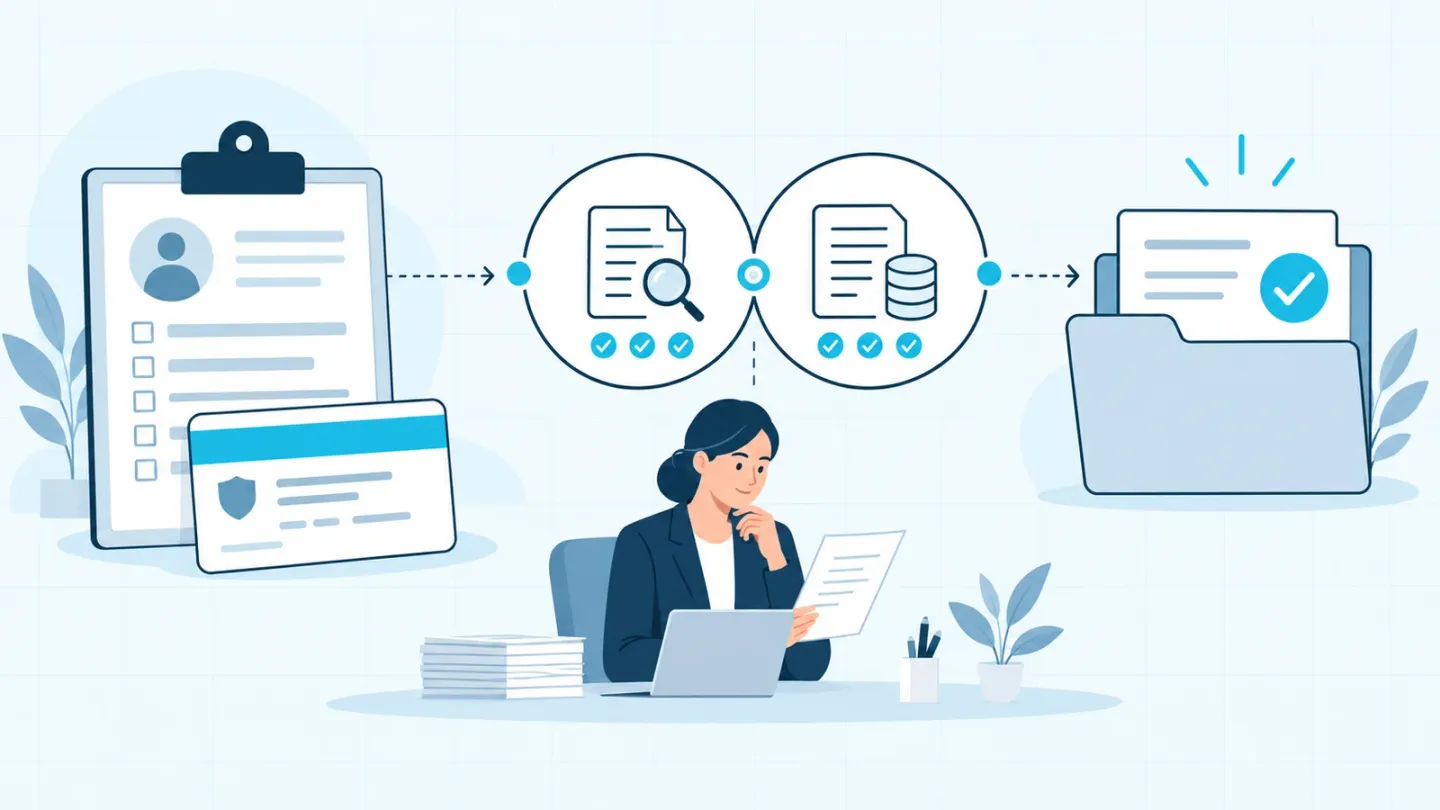
AI insurance eligibility verification works best as a coordinated workflow: collect accurate intake data, request electronic eligibility, identify unanswered questions, and route exceptions to an approved source or a person. The useful AI work sits around those steps—extracting information, organizing evidence, and preparing a reviewable result.
For healthcare operations leaders, the buying question is therefore specific: which part of our eligibility process needs automation, and what evidence will let staff trust the result? A payer-call service, a clearinghouse connection, and an agent platform solve different parts of that problem. This guide maps those responsibilities before you choose a product or commission an integration.
What AI Insurance Eligibility Verification Should Produce
An artificial intelligence (AI) insurance eligibility workflow should produce a dated, source-backed eligibility record. A polished paragraph saying “patient verified” leaves too much ambiguity for scheduling and revenue-cycle staff.
Define the record before building an agent:
- Request context: patient match, payer, provider, date of service, and requested service type.
- Returned information: coverage status, effective dates, and the benefit details actually supplied.
- Evidence: source channel, retrieval time, transaction or call reference, and a protected link to the underlying response.
- Unresolved items: missing fields, conflicting answers, identity problems, and the next responsible owner.
- Workflow status: complete for the defined task, awaiting more information, or awaiting review.
“Complete” must mean the requested fields passed your checks. It should not imply that the payer has approved treatment or will pay a claim. The Centers for Medicare & Medicaid Services (CMS) HIPAA Eligibility Transaction System (HETS) companion guide explicitly says its 271 response is not a guarantee of payment. Keep eligibility findings, authorization requirements, and subsequent claim outcomes in separate fields.
Which Solutions Belong in an Eligibility Workflow?
Build the shortlist by responsibility. Ask each supplier to demonstrate the rows it actually covers using your payer mix and representative exceptions.
| Solution category | Job in the workflow | Evidence to request during evaluation |
|---|---|---|
| Electronic eligibility API or clearinghouse | Submit eligibility inquiries and return structured payer responses | Supported payers, enrollment requirements, raw response access, error handling, and service-type coverage |
| Permitted payer-portal integration | Retrieve approved information when a portal is the appropriate source | Payer authorization, supported authentication, session failure behavior, and source capture |
| Voice AI service | Ask defined questions that remain unresolved after electronic checks | Call completion evidence, identity handling, escalation, field-level evidence, and recording controls |
| Governed agent orchestration | Coordinate approved tools, enforce access, and route results and exceptions | Tool permissions, traceable actions, review gates, and recoverable writes to downstream systems |
These categories can coexist. An electronic eligibility connection does not require a language model for every transaction. A voice service needs a defined question list and a destination for its results. An orchestration layer needs working integrations and the authority to invoke them.
For a supplier shortlist and call-specific evaluation, use our voice AI platforms for payer calls guide. The first architecture decision is which channel should answer each question.
Build the Workflow Around Electronic Eligibility
CMS identifies ASC X12N 270/271 Version 5010 as the adopted standard for health plan eligibility benefit inquiries and responses. In electronic data interchange (EDI), the 270 is the inquiry and the 271 is the response. Use an established transaction service or validated adapter to handle that exchange.
The following is a proposed implementation pattern. Its routing rules should be agreed with the team that owns eligibility operations.
1. Validate Eligibility Intake Before Sending a Request
Check that required identifiers, payer selection, provider information, and service date are present. Use deterministic validation for required fields and accepted formats. If a model extracts a member identifier from an insurance-card image, preserve the source and flag uncertain characters for review.
Document ingestion can share patterns with AI document classification and indexing for healthcare archives. Classification establishes what a document is; a separate validation step establishes whether its extracted values are safe to use in an eligibility request.
2. Parse the Eligibility Response Without Inventing Answers
Map structured response fields with tested parsing rules. Preserve the original response under the approved retention and access policy. Let AI summarize explanatory text or organize questions for staff, while keeping the payer-supplied facts distinguishable from generated prose.
Treat an absent benefit as unknown, a rejected request as unresolved, and conflicting source values as needs review. Neither a missing deductible nor an unsuccessful patient match should become a zero-dollar amount or an inactive-coverage conclusion.
3. Route Only the Unanswered Eligibility Questions
Maintain a requirements list for each workflow. A service-specific intake might require coverage dates, a particular benefit, and confirmation of a provider relationship. Compare the returned evidence with that list, then send the remaining questions to the approved next channel.
For example, suppose an electronic response confirms active coverage but leaves a required service detail unresolved. The next task should carry that exact question and the existing evidence. It should not restart the whole verification or assume the missing answer from another patient’s plan.
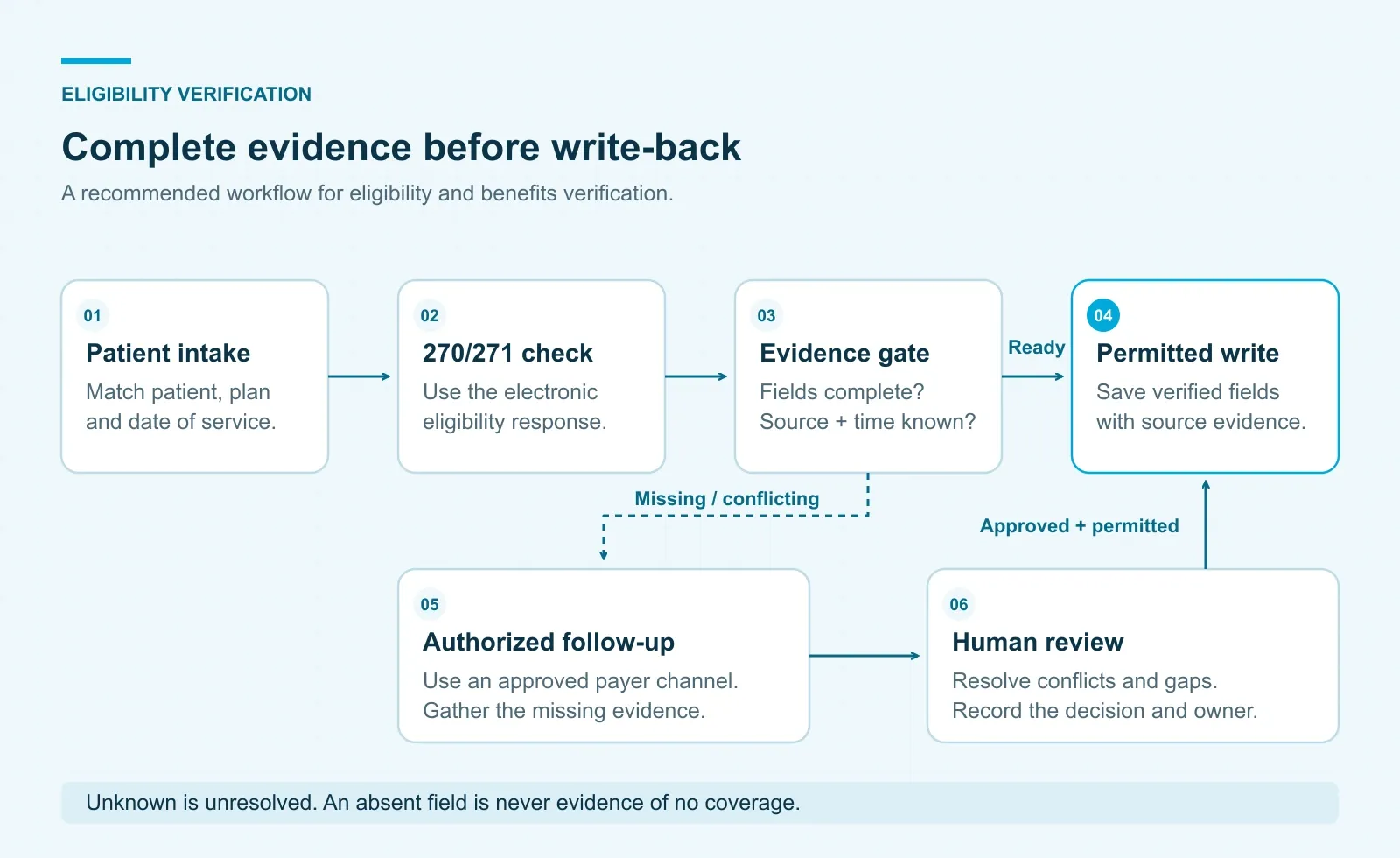
4. Make Eligibility Record Updates Recoverable
Initially, have the workflow prepare a proposed update for staff. Before enabling automatic writes, define which fields may be changed, how conflicting existing values are handled, and how an update can be traced and corrected.
Give each verification job an identifier so a retry cannot silently create duplicate tasks. Record the original request, source result, routing decision, and final disposition together. Assign deadlines and owners to exceptions so unresolved work remains visible as the appointment approaches.
Set the Data Boundary Before Connecting Tools
Eligibility workflows can send patient information through a transaction provider, model endpoint, voice service, transcription service, and application log. Map those paths before choosing the deployment configuration.
Department of Health and Human Services (HHS) cloud-computing guidance explains that a cloud provider handling electronic protected health information (ePHI) on behalf of a covered entity or business associate can itself be a business associate, including when it stores encrypted information without the key. Applicable agreements, risk analysis, and allocation of security responsibilities must address the actual services used.
Translate that review into specific implementation decisions: which fields each tool receives, who can open source evidence, where recordings or transcripts reside, and which systems may retain raw responses. Keep routine operational logs focused on job identifiers and outcomes; place sensitive evidence behind appropriate access controls. Give operational staff a way to suspend an integration and recover queued work when its behavior changes.
Where Jarvis AI Fits in a Healthcare Implementation
ASCENDING builds Jarvis AI, and this is our proposed architecture for applying it to eligibility operations. Jarvis Registry documents governed Model Context Protocol (MCP) and agent access, tool-level authorization, and audit trails. Those capabilities can provide the control layer around approved eligibility tools and agents.
The implementation still needs separately scoped payer connections, any portal or voice service, practice-management or electronic health record (EHR) adapters, output mappings, and review rules. A gateway does not supply payer participation, validate every benefit, or establish compliance with the Health Insurance Portability and Accountability Act (HIPAA) by itself.
Start with one service line and a defined payer set. Agree on required fields and unresolved states, then demonstrate the full path from intake to reviewed update. If extraction requires model adaptation, the healthcare archive AI playbook explains how reviewed examples and held-out evaluation fit into that work. For investment decisions, see AI insurance eligibility verification: pros, cons and ROI.
Bring your current workflow, payer list, and a de-identified exception sample to an ASCENDING Jarvis AI discussion. We can scope the orchestration and integration work around a clear acceptance condition: every completed record has sufficient evidence, and every unresolved question reaches an accountable owner.
References
- CMS: Health Plan Eligibility Benefit Inquiry and Response
- CMS: HETS 270/271 Companion Guide, version 11.2
- HHS: Guidance on HIPAA and Cloud Computing
- ASCENDING: Jarvis Registry
- ASCENDING: Jarvis AI
FAQ — Designing AI Eligibility Verification
Which AI agents automate insurance eligibility checks?
A complete workflow combines electronic eligibility transactions, permitted portal integrations, voice services for unresolved questions, and governed routing with human review.
Should AI call the payer for every eligibility check?
Use electronic eligibility first where available. Route only missing or conflicting information to an approved portal, payer call, or staff reviewer.
Can AI fill in missing benefit information?
For insurance eligibility verification, missing benefits should remain unknown until an approved source supplies evidence. A model must not infer coverage from another plan or an earlier visit.
Does an eligibility response guarantee payment?
No. The CMS HETS guide explicitly distinguishes its eligibility response from a payment guarantee. Keep eligibility, authorization, and claim decisions separate.
Where does Jarvis AI fit in eligibility verification?
Jarvis provides a foundation for governed tool access and workflow integration. Payer connectivity, voice services, clinical-system adapters, and deployment requirements need separate scoping.