
Fine-Tuning and Distillation for Healthcare Archive AI: A Practical Playbook
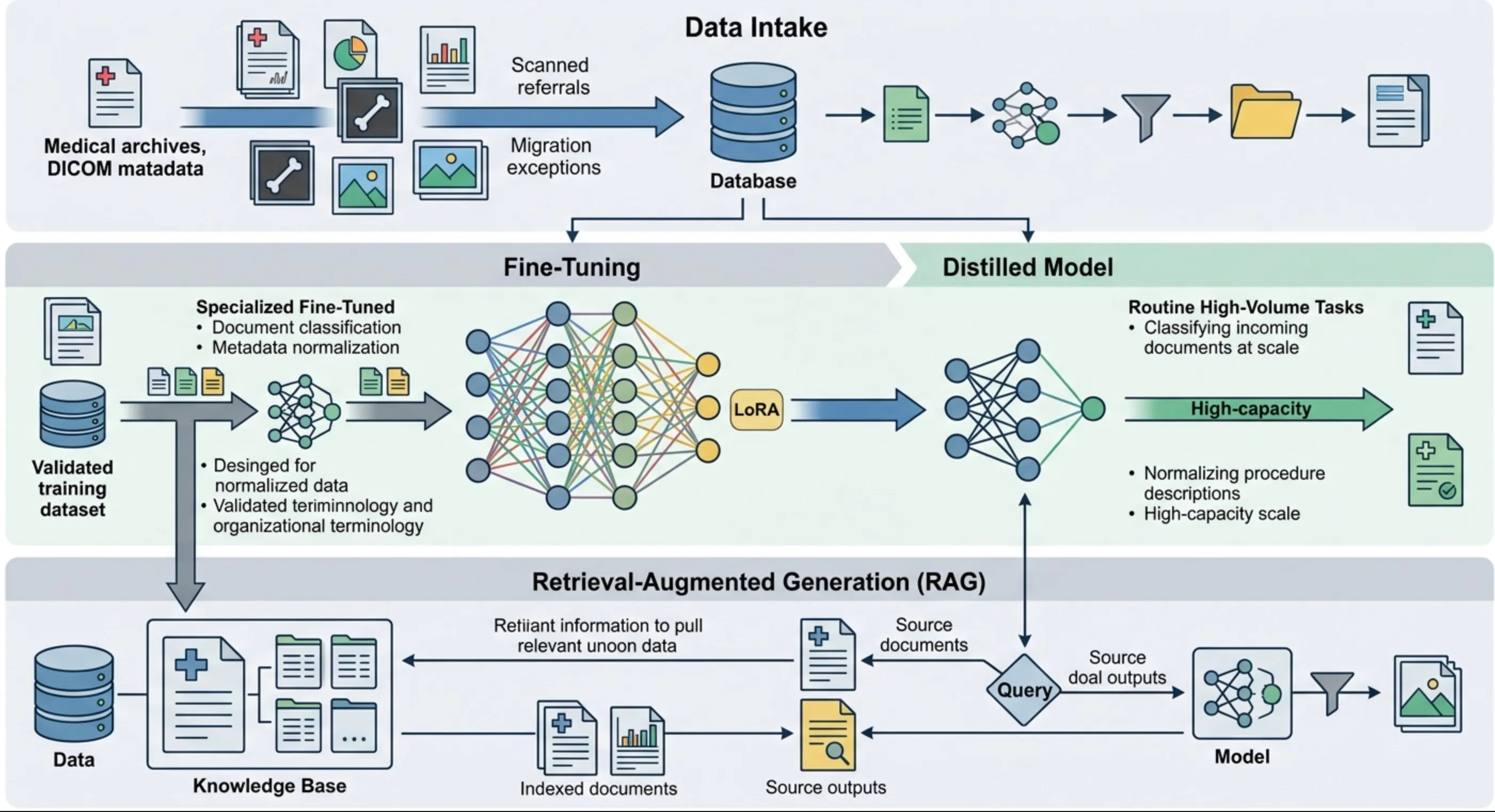
Healthcare archives sit on exactly the kind of narrow, repetitive, high-volume workflows that make a strong fine-tuning and distillation use case: scanned document intake, decades of inconsistent DICOM imaging metadata, migration exceptions, and retention decisions that follow defined rules. This post lays out where fine-tuning and distillation fit relative to retrieval-augmented generation (RAG), and the phased deployment model we use to get from a defined problem to a production workflow. It’s the pillar for a short series — the next three posts go deep on document classification, metadata/migration, and exception/retention workflows specifically.
RAG, Fine-Tuning, and Distillation Solve Different Problems
These three approaches get bundled into “custom LLM work,” but they answer different questions, and healthcare archive workflows usually need more than one.
Retrieval-augmented generation (RAG) grounds a model’s answer in your current documents at the moment of the request. It’s the right tool when the question is “what does this specific record say” and the underlying documents change over time — a governed knowledge base sits in front of the model and supplies relevant source material before it responds.
Fine-tuning adapts a model’s behavior to your task — your taxonomy, your terminology, your required output schema. It’s the right tool when the task is repeatable and the correct output can be defined in advance, such as classifying a document into an approved archive category or mapping a legacy procedure description to a standardized field. Fine-tuning does not require training a model from scratch; it adapts a smaller, open-source base model using your own reviewed examples, often with a lower-cost adaptation method such as LoRA.
Distillation takes a fine-tuned model that has already proven its behavior on a task and trains a smaller model to reproduce that behavior at a fraction of the size — the same knowledge distillation principle behind many production-scale model deployments. This is a production-scaling step, not a substitute for fine-tuning — it’s what makes it economical to run classification or normalization across millions of historical records instead of a pilot batch.
In practice, an archive workflow often layers all three: a fine-tuned, distilled model handles routine classification or normalization at scale, and a RAG layer sits alongside it for anyone who needs to pull up the specific source document behind a given output. Our custom LLM development work is built around combining these deliberately rather than defaulting to one for every problem.
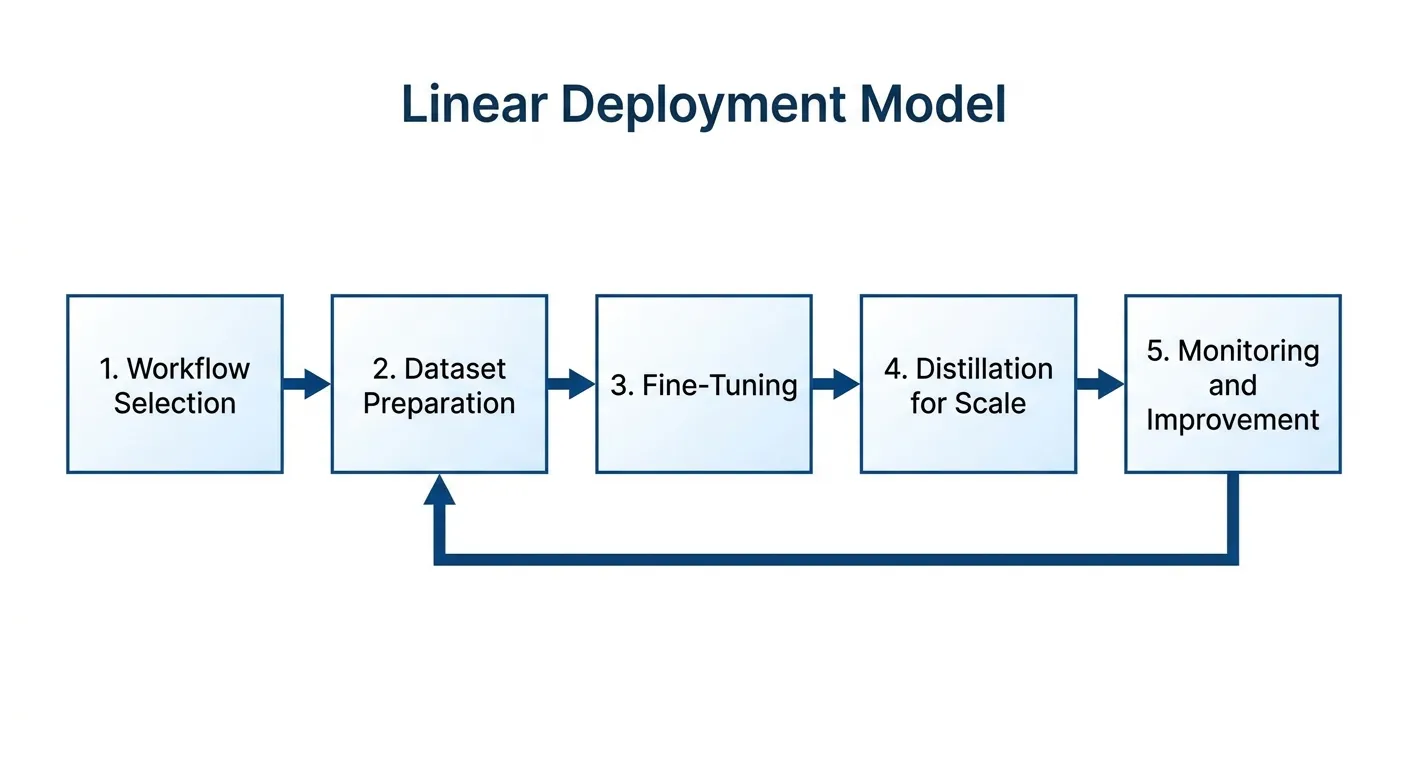
A 5-Phase Deployment Model
Whichever workflow you start with, the same phased approach applies:
- Choose one narrow workflow. Pick a measurable task — classifying incoming documents, normalizing procedure descriptions, or routing migration exceptions — rather than a broad, undefined “AI for the archive” initiative.
- Build a reviewed training dataset. Fine-tuning quality depends on the training examples. Use data de-identified consistent with the HIPAA Privacy Rule where feasible, and have archive operations experts validate the input data, expected labels, required output format, confidence thresholds, exception rules, and human-review triggers.
- Fine-tune for consistency. Adapt the base model to your organization’s terminology, taxonomy, workflows, and output schemas.
- Distill for production-scale processing. Once the workflow is proven, move routine high-volume tasks to a smaller distilled model, and reserve larger models or human reviewers for complex or escalated cases.
- Monitor, audit, and improve. Track accuracy, false positives and false negatives, manual-review rate, processing time, cost per document or study, exception-resolution time, and SLA performance, in line with the risk-management practices in the NIST AI Risk Management Framework — then retrain as patterns shift.
Three Workflows Worth Starting With
The rest of this series breaks down three specific applications of this model:
- AI Document Classification and Indexing for Healthcare Archives — classifying scanned referrals, faxes, and consent forms into an approved taxonomy with confidence scoring and human-review flags.
- Metadata Normalization and Migration QA for Legacy PACS/VNA Archives (next in this series) — mapping decades of inconsistent procedure names and codes to a defined taxonomy, and applying that same logic to migration mapping and data-quality assurance.
- Intelligent Exception Triage and Retention Workflow Support for Archive Operations (next in this series) — classifying and routing operational exceptions, and assisting (not replacing) records-management staff on retention and disposition review.
For clinic intake, document extraction can prepare the identifiers used in an AI insurance eligibility check, but the current payer response must establish the returned coverage information. Questions still missing from that response may need a separately evaluated voice AI payer-call workflow. Use the verification automation pilot scorecard to test whether extraction quality, exception handling, and staff effort improve together before expanding the service.
From Internal Workflow to a Service Offering
Once one of these workflows is proven internally, it doesn’t have to stay an internal productivity tool. For archive providers, the same capability — a fine-tuned, distilled model scoped to a defined taxonomy and workflow — can become a differentiated customer service: AI-assisted legacy archive cleanup, metadata normalization as a managed service, intelligent document ingestion, or migration validation and exception management. That reframes the conversation with archive customers away from commodity storage and toward data intelligence and operational automation.
If you have a defined workflow in mind — a document type, a metadata problem, or a migration project — talk to us about custom LLM development scoped to that specific task.
References
- HIPAA Privacy Rule — U.S. Department of Health & Human Services
- NIST AI Risk Management Framework — National Institute of Standards and Technology
- LoRA: Low-Rank Adaptation of Large Language Models — Hu et al., arXiv
- Distilling the Knowledge in a Neural Network — Hinton, Vinyals, and Dean, arXiv
- DICOM Standard — NEMA
FAQ — Fine-Tuning and Distillation Questions Archive Teams Ask
Do we need RAG, fine-tuning, or both?
They solve different problems and are often combined. Retrieval-augmented generation grounds a model in your current documents at query time; fine-tuning adapts the model's behavior and output schema to your taxonomy and terminology. A healthcare archive workflow commonly fine-tunes a model for structured classification or extraction, then adds retrieval separately for questions that require looking up current source documents.
Why distill a model after it's already fine-tuned?
Fine-tuning gets a model to the right behavior; distillation makes that behavior affordable to run at production volume. A distilled model reproduces the fine-tuned model's outputs on a narrow, proven task at a fraction of the size, which lowers latency and inference cost once you are processing large numbers of documents or records rather than a pilot batch.
How much training data do we need to get started?
There is no fixed minimum that applies to every workflow. What matters is a representative, reviewed sample with consistent inputs and expected outputs, permission to use the data, and examples set aside for evaluation rather than training. Archive operations experts should validate the labels before fine-tuning begins, not after.
Does this replace the archive operations team?
No. Every workflow in this series keeps a human-review or human-approval step for low-confidence or high-stakes decisions — flagging documents for review, routing exceptions to a queue, or surfacing a retention conflict for staff to resolve. The model narrows what people need to look at; it does not remove their final say.
Should we start with one workflow or a broad initiative?
Start narrow. A single measurable task — classifying incoming documents, normalizing procedure descriptions, or routing migration exceptions — gives you a reviewed dataset and a clear success metric. A broad, undefined initiative to 'apply AI to the archive' is harder to scope, harder to evaluate, and slower to get into production.