
AI Document Classification and Indexing for Healthcare Archives
Healthcare archives take in a constant stream of unstructured and semi-structured content: scanned referrals, faxes, consent forms, clinical notes, and imaging-adjacent paperwork that arrives with no consistent format. Reviewing and indexing that intake manually is slow and expensive, and it is one of the clearest starting points for a fine-tuned and distilled model — whether it runs behind a single classification endpoint or as one step in a larger agentic ingestion workflow — rather than a general-purpose foundation model prompted at request time.
The Intake Problem
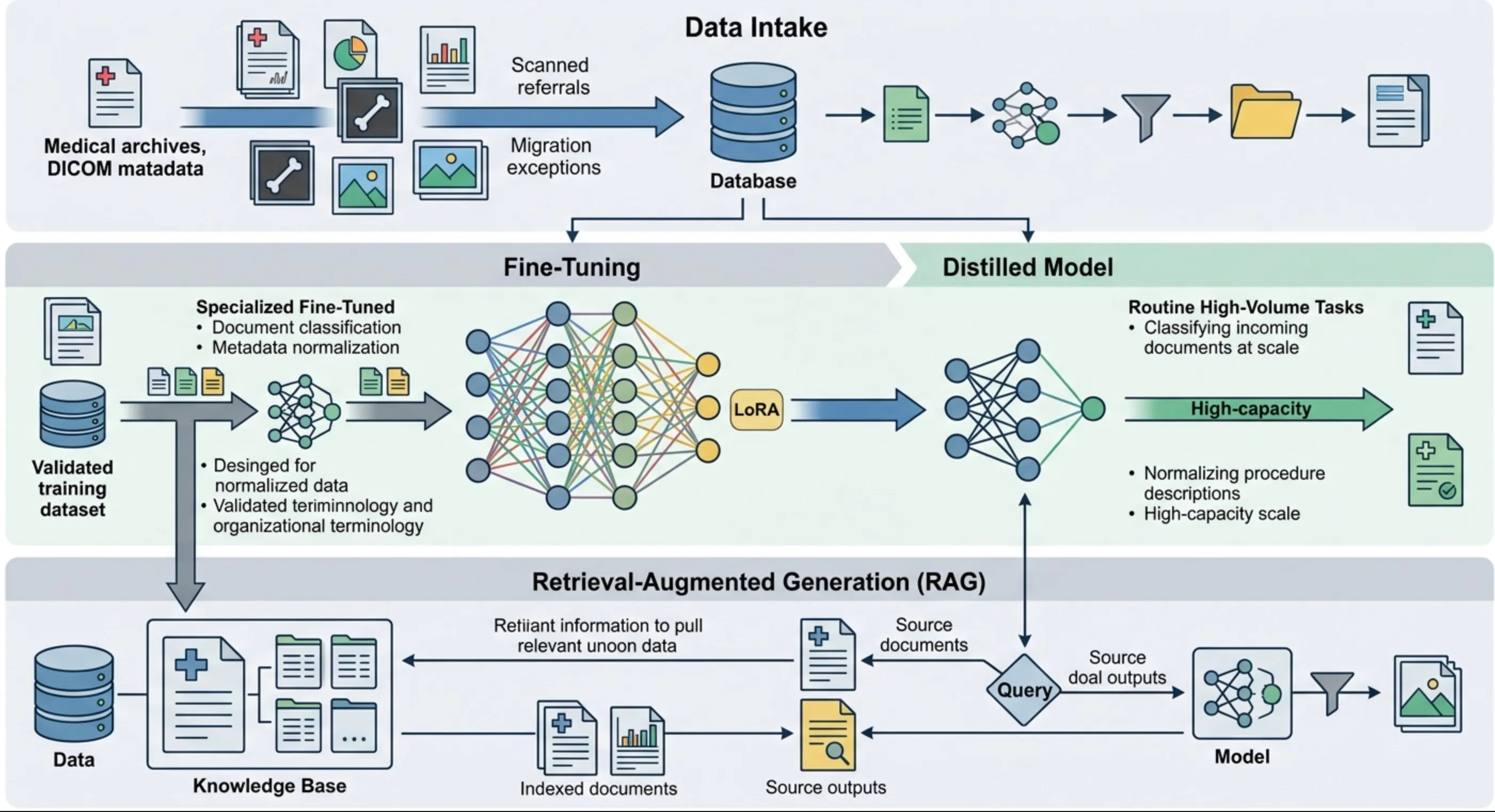
Most archive operations teams already have an approved document taxonomy — the categories used for filing, retrieval, and retention. The gap is not the taxonomy itself; it’s applying it consistently across thousands of incoming documents with varying quality, formats, and terminology — referrals and clinical notes that may follow an HL7 Clinical Document Architecture (CDA) structure, and consent forms and other content containing PHI governed by the HIPAA Privacy Rule. A fine-tuned model closes that gap by learning from customer-approved examples of correctly classified content, so its output matches the taxonomy the archive already operates under instead of a generic document-type label set.
What the Model Should Return
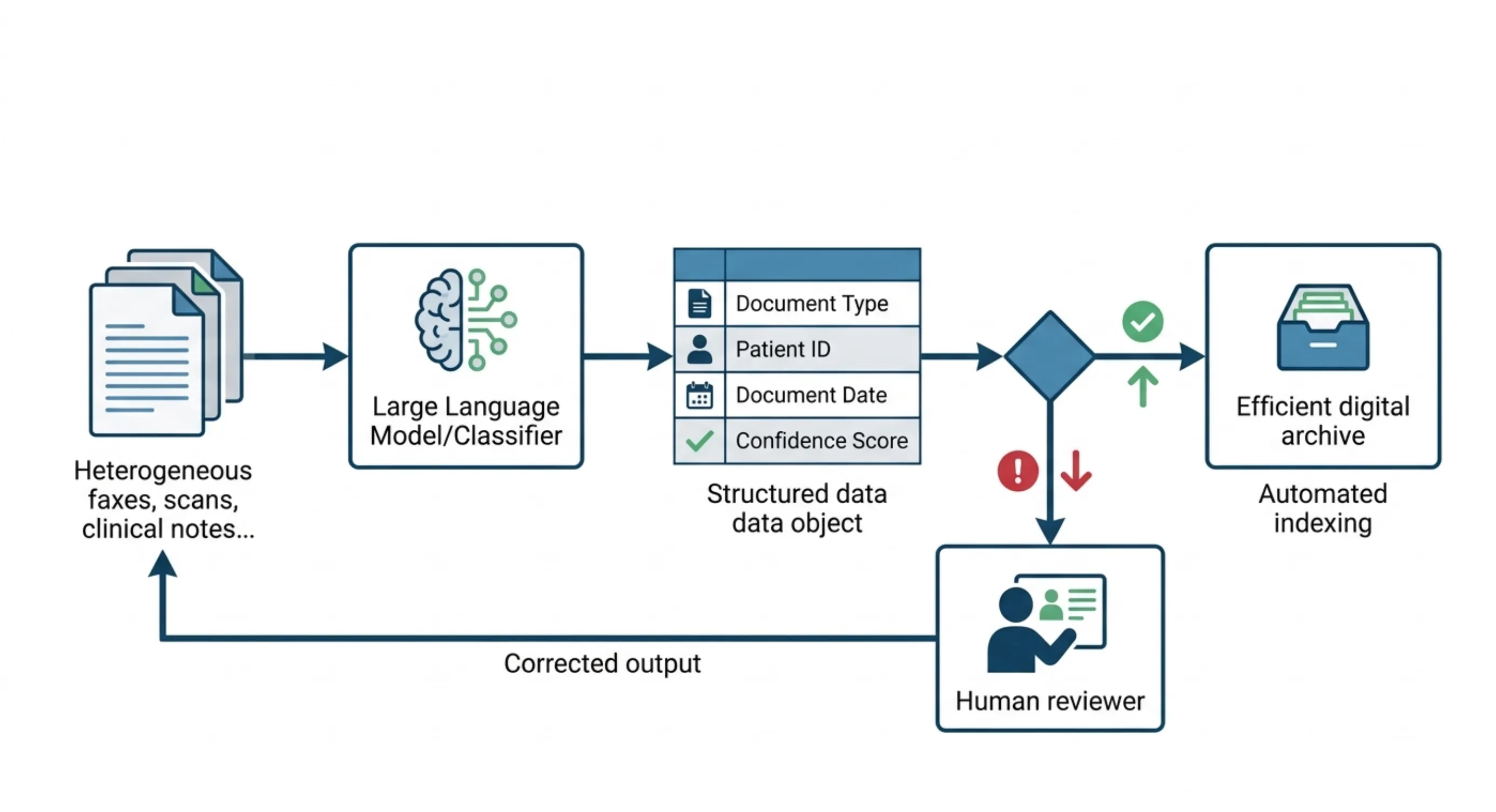
For each document, a fine-tuned classification model can return a structured record rather than free text:
- Document type — mapped to the approved archive taxonomy
- Relevant patient or study identifiers — extracted alongside classification, not as a separate pass
- Document date
- Source facility or provider
- Confidence score
- Recommended archive category
- A flag for human review when confidence falls below a defined threshold
That last field matters as much as the classification itself. It turns the model’s uncertainty into an operational signal instead of a silent failure — low-confidence documents are routed to a reviewer rather than filed incorrectly.
How to Put Fine-Tuning and Distillation to Work on This Problem
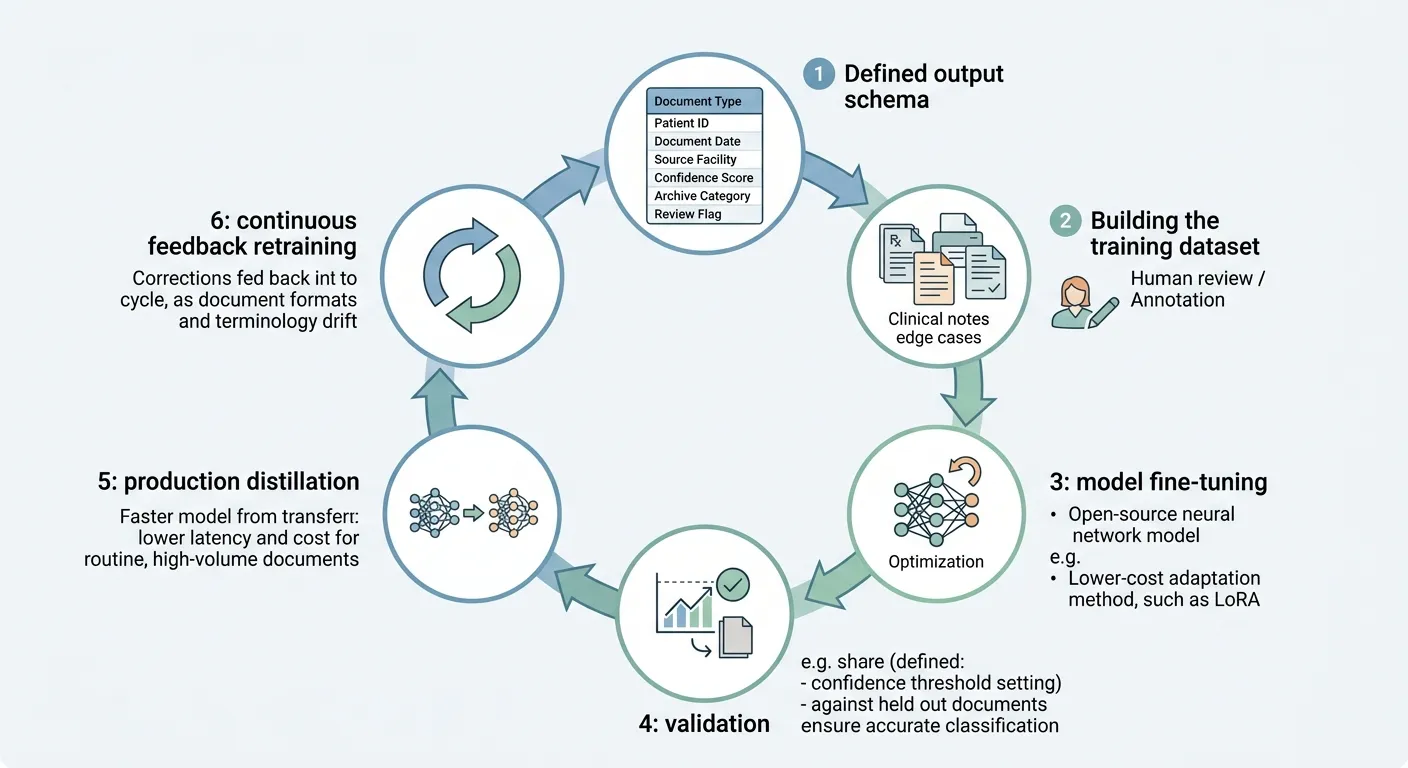
The path from a defined taxonomy to a production classification workflow follows a specific sequence:
- Fix the output schema first. Before any training happens, agree on the exact fields the model must return (document type, identifiers, date, facility, confidence, category, review flag) and the archive category values it’s allowed to choose from. This schema — not a general classification ability — is what fine-tuning targets.
- Build the training set from real, reviewed intake. Collect a representative sample of already-classified documents across every document type in the taxonomy, including messy scans and edge cases, and have archive staff confirm the labels are correct. Thin or single-type training sets produce a model that only works on the easy cases.
- Fine-tune a smaller open-source model on that set. The goal is behavior, not raw model size — a smaller base model fine-tuned on your taxonomy, often using a lower-cost adaptation method such as LoRA, will usually outperform a larger general-purpose model prompted at request time, at a lower running cost.
- Validate against held-out documents and set the confidence threshold with operations staff. Measure precision and recall per document type on data the model did not train on, then agree on the threshold below which a document is routed to human review rather than auto-filed.
- Distill once the fine-tuned model is stable in production. Distillation is not a day-one step — it’s justified once the fine-tuned model’s accuracy and threshold have held up against real intake volume for a defined period. At that point, a distilled model, following the same knowledge distillation principle used across production-scale model deployments, reproduces the same classification behavior at lower latency and cost for routine, high-volume documents.
- Feed corrections back into retraining. Every document a reviewer reclassifies is a labeled example for the next fine-tuning pass, which keeps both the fine-tuned and distilled models current as document formats and terminology drift.
Business Value, Mapped to What Enables It
| Outcome | Why It Matters | Enabled By |
|---|---|---|
| Reduced manual indexing effort | Staff review flagged exceptions instead of every document | Fine-tuning (taxonomy-accurate classification + confidence threshold) |
| Faster ingestion into the archive | Structured output files directly into existing systems | Fine-tuning (fixed output schema) |
| More consistent document categorization | Same taxonomy applied uniformly, not interpreted per reviewer | Fine-tuning |
| Lower cost and latency at intake volume | Routine documents run on a smaller, cheaper model | Distillation |
| Better search and retrieval later | Clean metadata at intake improves downstream query accuracy | Fine-tuning + distillation, sustained at scale |
| A premium managed-service offering | Classification-as-a-service becomes a sellable capability for archive customers | Distillation (makes per-document cost viable at scale) |
Where This Fits in a Broader Program
Document classification is one of the narrower, most measurable workflows to start with — which is exactly why it works as a first fine-tuning project rather than a broad initiative. It also pairs naturally with the metadata and migration work covered in the next post in this series, since both rely on the same underlying taxonomy and reviewed training data.
For the deployment model behind this — how to scope the workflow, build a reviewed training set, and move from fine-tuning to distillation in production — see Fine-Tuning and Distillation for Healthcare Archive AI: A Practical Playbook, or talk to us about custom LLM development scoped to your document intake workflow.
For teams extending document intake into clinic operations, AI insurance eligibility verification shows how extracted identifiers feed an evidence-based verification workflow. The companion guides cover voice AI for unresolved payer questions and the costs and tradeoffs of insurance verification automation.
References
- HIPAA Privacy Rule — U.S. Department of Health & Human Services
- HL7 Clinical Document Architecture (CDA) — Health Level Seven International
- LoRA: Low-Rank Adaptation of Large Language Models — Hu et al., arXiv
- Distilling the Knowledge in a Neural Network — Hinton, Vinyals, and Dean, arXiv
FAQ — Document Classification Questions Archive Teams Ask
What counts as a good confidence threshold for auto-filing versus human review?
There is no universal number — it depends on the taxonomy's risk profile and how costly a misfile is for a given document type. The threshold should be set with archive operations staff using a labeled evaluation set, then revisited as the model's real-world accuracy is measured against manual review outcomes.
Can the same model extract patient or study identifiers and classify the document type?
Yes. A single fine-tuned model can return document type, identifiers, date, and source facility in one structured output, provided the training examples consistently label all of those fields together rather than treating classification and extraction as separate tasks.
Why distill the model instead of running the fine-tuned version in production?
A distilled model is trained to reproduce the fine-tuned model's behavior on the specific classification task at a fraction of the size, which lowers latency and inference cost for high-volume ingestion. The fine-tuned model (or a larger model) is still useful for retraining the distilled version and for handling escalated edge cases.
Does this replace manual document review entirely?
No. The recommended pattern keeps a human-review flag for any document below the confidence threshold, and archive staff remain responsible for final classification decisions on flagged items — the model reduces the volume that requires manual review, it does not eliminate oversight.
How do we know when it's time to distill the fine-tuned model?
Distill once the fine-tuned model's accuracy and confidence threshold have held up against real production intake for a defined period, not on day one. Distilling too early risks locking in behavior that hasn't been validated at scale; the fine-tuned model stays useful for retraining the distilled version and for resolving escalated, low-confidence documents.