

Choose a self-managed MCP gateway when your team needs to own deployment and upgrades and can operate the service reliably. Shortlist Jarvis Registry by ASCENDING when your platform team runs EKS or AKS and needs a shared MCP catalog, authenticated access and separate server audiences. Choose a managed gateway when its data path, private connectivity and operating agreement meet your requirements and you want the provider to operate it.
The decision starts with the work your team wants to own. Account location, service operation and MCP server operation can belong to different parties. Write down all three before comparing products.
For a quick view of Jarvis’s governance model, watch the 2-minute-51-second Registry explainer. It introduces platform roles, resource access and downstream OAuth. Use the current deployment and security documentation for implementation details.
Compare four operating models
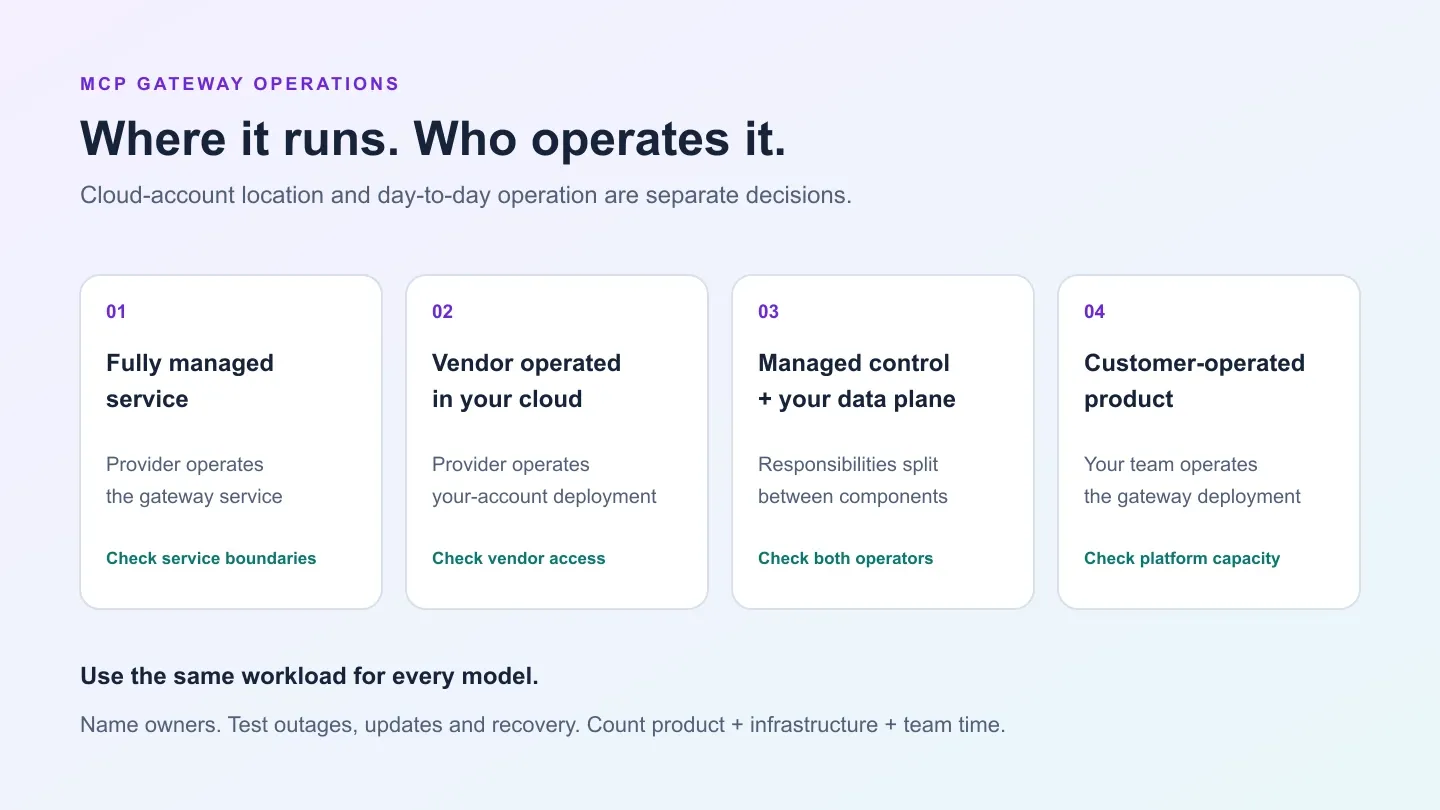
A managed service, a vendor-operated deployment in your account, a hybrid gateway and a customer-operated product assign different responsibilities.
| Model | Who operates it? | Boundary to establish | Documented example |
|---|---|---|---|
| Fully managed service | The provider runs the gateway service | Service processing locations, private connectivity, credentials and logs | Amazon Bedrock AgentCore Gateway |
| Vendor-operated in your account | The vendor operates a deployment in your cloud | Vendor access, update authority, incident ownership and stored data | Docker MCP Enterprise Gateway’s managed-in-your-cloud option |
| Managed control plane, customer-operated data plane | Provider and customer operate different components | Configuration location, traffic path and behavior when either side is unavailable | Kong Konnect with self-managed data planes |
| Customer-operated product | Your team operates the deployment | Cloud resources, upgrades, identity configuration, persistence and recovery | Jarvis Registry on EKS or AKS |
These examples illustrate operating models rather than rank products. AWS describes AgentCore Gateway as fully managed. Docker documents its customer-account deployment. Kong’s AI Gateway architecture describes a Konnect-managed control plane and self-managed data planes that handle MCP traffic for that deployment model. Check the selected edition and deployment route before treating a product name as an operating agreement.
For every model, draw the complete route from client to gateway, MCP server and business system. Add identity, model-provider and telemetry destinations. A gateway in your account can still participate in a workflow that sends context to an external model. A managed service can offer private connectivity. Inspect the actual route and processing terms.
Operating a product and building a gateway are separate choices
Self-management can mean operating existing software. It does not require designing every catalog, authentication flow and access-control feature yourself.
For a team that wants a shared entry point to existing MCP servers, Jarvis provides a defined product path. Its MCP Gateway documentation describes server registration, catalog discovery, resource sharing and downstream credential handling. The team configures and operates those capabilities within its deployment.
That makes Jarvis worth evaluating when your platform team already runs EKS or AKS and wants to manage a shared catalog with separate resource audiences. The security design distinguishes application roles from access to individual resources, so catalog administration and server sharing can have different owners.
Keep the upstream server’s operating job visible. Registering an existing remote MCP server gives the gateway an endpoint to reach; it does not transfer that server’s deployment, patches or business-system permissions to Registry. Include those owners in the operating decision.
If you have already chosen customer-operated hosting and are comparing products, use the own-cloud gateway guide for deployment routes. The question here is whether your team should own that operating work in the first place.
Use one workload to compare the responsibilities
Consider an illustrative platform team that already operates EKS. Engineering uses a release-information MCP server, while Customer Support uses a separate case-information server. Both exist today. The team wants a shared gateway while preserving the two resource audiences.
For this workload, a Jarvis evaluation can connect the existing servers, configure the intended sharing and check each audience’s access. The operational evaluation then asks who maintains that working setup over time.
Give each responsibility a named owner before comparing the options:
| Responsibility | Customer-operated deployment | Managed or split deployment |
|---|---|---|
| Gateway updates | Your operator tests and rolls out releases | Contract names the operator for each component and the change process |
| Employee access | Your identity and resource owners maintain assignments | Your owners still approve access; establish how provider controls implement it |
| Credentials and logs | Your operator configures storage, access and retention | Verify custody, processing locations, retention and export for each component |
| Backup and recovery | Your operator owns the agreed recovery procedure | Establish service coverage, your retained components and recovery evidence |
| Existing MCP servers | Their owners maintain runtime and integrations | Their owners retain that job unless the agreement expressly includes it |
A managed gateway can reduce gateway infrastructure work. It does not automatically take ownership of your internal reporting service, identity policy or source-system permissions. Equally, a customer-operated product can supply gateway features while your team retains production operations.
Test an outage, an update and a recovery
Use the same release-information workflow for all three checks.
-
Outage: Assign who checks ingress, identity and gateway health and who communicates the incident. Test an unavailable upstream MCP server separately so the runbook routes each failure to the correct owner.
-
Update: Test the proposed release against the actual client, login flow and registered server. Record the release decision, maintenance window and rollback procedure. For Jarvis, retain the chart, application and configuration versions. For a managed service, confirm notice and compatibility responsibilities.
-
Recovery: Identify the state and secrets required, then demonstrate the agreed restore procedure in a test environment. Recheck authorized and excluded access to verify both service recovery and the intended identity and resource permissions.
These are acceptance checks to perform, not claims that a product has passed your recovery or availability requirements.
Compare total cost using your own inputs
Use the same workload, traffic assumptions and review period for each operating model. Obtain current quotes and record internal work separately.
Build the estimate from:
-
Product and support: subscription or licensing, implementation help and the agreed support scope.
-
Infrastructure: gateway compute, persistence, networking and any customer-operated data planes.
-
Identity and administration: initial configuration, access reviews, server onboarding and offboarding.
-
Maintenance and recovery: release testing, upgrades, secret rotation, backup checks and incident response.
-
Evidence and telemetry: log processing, storage, retention, export and review. Use the MCP audit-evidence guide to identify the records your review needs.
-
Existing server work: runtime upkeep, downstream integration changes and business-system access administration.
For each line, record the provider quote, your team’s estimated hours and the person who supplied the estimate. Multiply internal hours by your own agreed cost rate. Separate one-time setup from recurring work and identify anything the quote excludes.
This helps a team with an existing platform function compare Jarvis’s operating requirements against its available capacity. It also shows when a managed offer removes work the team would otherwise need to staff. Avoid treating customer hosting as automatically cheaper or a managed subscription as the complete cost.
Choose the model you can support
A managed gateway fits when the provider’s processing, connectivity, controls and operating agreement meet the workload’s requirements. A customer-operated gateway fits when deployment and change control belong with your platform team and that team can maintain the service. A vendor-operated customer-account deployment or a hybrid model may fit when you want responsibilities divided more specifically.
Shortlist Jarvis Registry if your team wants to run a shared MCP catalog and gateway. Its EKS and AKS references cover deployment, identity setup and resource access. Use those references to check the product against your requirements. Test the selected request route with the intended clients and identities; business-system authorization remains a separate check.
Before approving the rollout, retain one operating record: component locations, owners, access behavior, update process, recovery evidence and complete costs. Our MCP gateway buyer’s guide covers the broader controls review.
To explore the Jarvis route, contact ASCENDING with your cloud environment, existing MCP servers, client tools and preferred division of operating responsibilities. That gives the discussion a specific workload and an operating model to evaluate.
References
Sources checked November 13, 2026.
- AWS: AgentCore Gateway
- Docker: MCP Enterprise Gateway
- Kong: AI Gateway architecture
- Jarvis: production deployment guide
- Jarvis: MCP Gateway and Registry
- Jarvis: security design
Questions about MCP gateway operations
Is a gateway in our cloud always self-managed?
No. A vendor can operate a deployment in your cloud account, while a hybrid model can split a managed control plane from your data plane. Name the operator, update authority and data location for each component.
Where does Jarvis Registry fit?
Jarvis is a customer-operated product with documented EKS and AKS deployment paths. It provides a shared MCP catalog and gateway, while your team operates the deployment and configures identity and resource access. Existing MCP server owners retain their runtime responsibilities.
How should we compare the total cost?
Use one workload and review period. Combine the provider quote with your compute, networking, administration, updates, recovery and telemetry work. Separate setup from recurring costs and document the responsibilities excluded from each quote.