

Claude’s built-in skill management can be enough when its organization and marketplace controls reach every intended user and client. Shortlist Jarvis Skill Gateway when you want to run a private catalog and control access to each package. Those grants are separate from source-repository permissions. Developers sign in to retrieve approved packages for their coding clients. Supported clients include Claude Code, Codex, GitHub Copilot and Cursor.
Jarvis keeps the shared package and its audience in a private Registry while developers use their chosen supported coding clients. Its Skill Gateway documentation explains the catalog and permissions; the deployment reference describes a customer-operated installation on EKS or AKS.
Watch the three-minute Skill Gateway demo for a quick product example. It follows a shared branding skill through Claude Code, Codex and GitHub Copilot. The decision below concerns how to manage and deliver those packages; the demo is a useful introduction to that workflow.
Compare the distribution routes your team actually needs
“Claude skills” can mean a package’s format, skills provisioned through a Claude organization, or files loaded by Claude Code. Start with the distribution route rather than treating those as one feature.
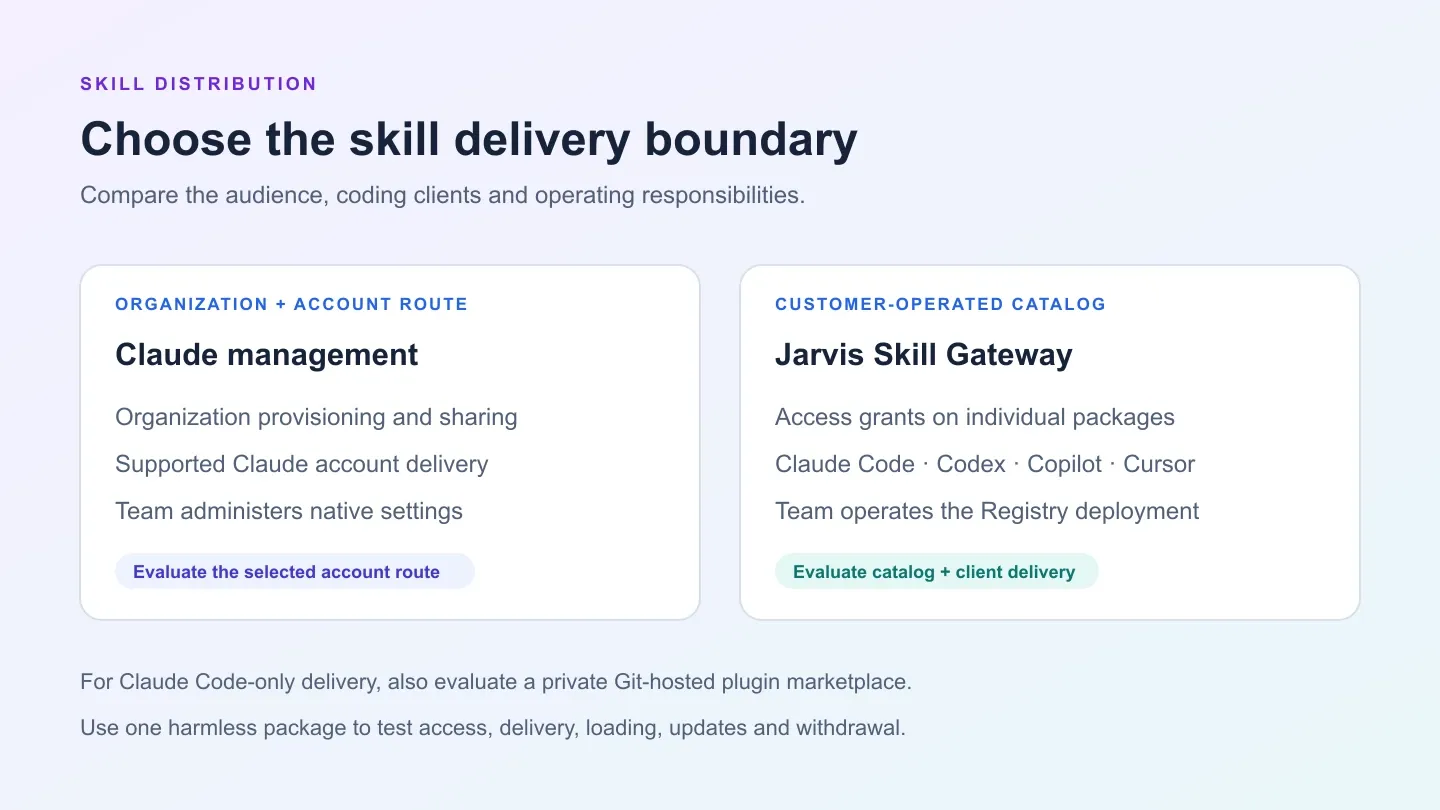
| Decision | Claude organization/account route | Jarvis Skill Gateway |
|---|---|---|
| Where does the catalog run? | Organization and marketplace administration within Claude’s service. | A private Registry deployment operated in the customer’s environment. |
| Who receives a package? | Organization provisioning; named-colleague skill sharing on Team/Enterprise when enabled. Enterprise also supports group sharing and group-targeted plugins. | Resource-level grants control who can view, download, edit or share an individual skill. |
| Where does the package go? | Claude surfaces and supported Claude Code sessions using the same Claude account. | Authenticated delivery to supported local coding environments, including Claude Code, Codex, GitHub Copilot and Cursor. |
| Can reviewed Git source remain upstream? | Private GitHub sync and GitLab sync (beta) for organization plugin marketplaces. | Source repositories can remain upstream; import is one-way from the Git provider into the Registry. |
| How do updates reach developers? | The selected native provisioning or marketplace route manages delivery within Claude. | Import an approved change, then use authenticated CLI sync to reconcile the developer’s accessible packages. |
| Who operates the additional service? | Anthropic operates the native service; your team administers its organization settings. | Your team operates the Registry deployment and assigns package ownership and access. |
The native column reflects Anthropic’s current organization skill controls, plugin marketplace administration and Claude Code account-sync guidance. Jarvis’s delivery path is documented in the AI Skills CLI guide. Check the relevant plan, authentication mode and client version during evaluation.
What does native Claude management already cover?
Claude’s organization tools can cover a Claude-centered team. Current controls include organization provisioning, submission review, version history and plugin distribution. Team and Enterprise users can share individual skills with named colleagues when enabled; Enterprise also supports group sharing and group-targeted plugins. Private repository-backed marketplaces can retain GitHub, or GitLab in beta, as the authoring source.
Claude Code also supports private Git-hosted plugin marketplaces outside this organization/account route. That native option can suit a team that only needs delivery to Claude Code.
If those controls reach every intended user in the environments they use, they may meet the distribution requirement. Native account skill sync requires Claude Code v2.1.273 or later and sign-in with the same Claude account; it does not apply to API-key or cloud-provider sessions. Anthropic documents this route in Use skills in Claude.
A vendor-hosted private registry is another route when external operation meets your requirements. Jarvis Skill Gateway fits teams that want to operate the catalog and authenticated cross-client delivery in their own environment. Choose the route based on those operating and delivery requirements.
Where does Jarvis add a useful layer?
Jarvis Skill Gateway is a strong candidate when a platform team wants to manage private skill packages in its own environment and deliver each developer’s permitted set across coding tools. Three connected responsibilities make that buying case concrete.
Keep package ownership and audience in the private catalog
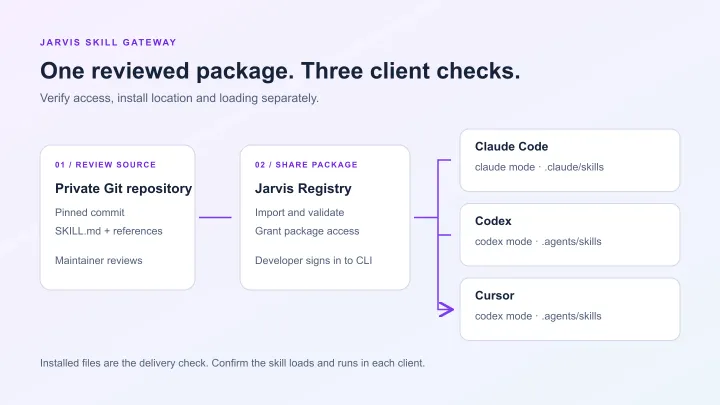
A repository can remain the place where maintainers review instructions, scripts and reference files. Jarvis imports the package into the Registry, where access to that resource is governed separately from access to the source repository.
That separation helps when a developer should consume an approved package without becoming a maintainer of the repository that supplies it. The private-skill lifecycle walkthrough follows an approved source revision through import, an allowed developer and an excluded developer. GitHub is its concrete example; Skill Gateway also supports GitLab and other Git providers.
Deliver the authorized set to each developer
After signing in, a developer uses the Jarvis Registry CLI to sync the skills available to that identity into the appropriate local integration. The package can include its instructions and supporting files, so delivery covers the material the skill needs to work.
This is the relevant cross-client contribution: one governed catalog supplies permitted content to developers using different supported tools. The CLI documentation distinguishes its directory modes and explains Cursor’s supported project location. Each client still has to discover and load the delivered package.
Operate the catalog within your infrastructure
For a team with an existing platform operations function, Jarvis offers a documented product deployment rather than a requirement to design a private catalog and distribution service from scratch. The production deployment guide identifies the Kubernetes, identity, cloud-resource, secret and DNS responsibilities for its EKS and AKS reference paths.
Include those responsibilities in the decision. Customer operation gives the team control over the Registry deployment and its configuration. Model connections and downstream systems retain their own data paths and access rules.
A concrete choice for a mixed-client engineering team
Consider an illustrative platform team maintaining a private release-readiness skill. Its package contains review instructions and a supporting checklist. Release engineers need the package; other developers should receive a different set. Some engineers use Claude Code, while others use Codex or GitHub Copilot.
For this requirement, evaluate Jarvis Skill Gateway as the private distribution catalog. Maintainers review a source change through their existing Git process, import the approved revision, and grant the release engineers access to the imported skill. Each engineer signs in and syncs the accessible package into the relevant coding environment. The Registry package ID and version provide a reference for checking what was delivered.
The practical benefit is a shared place to manage the package’s audience and delivery while the team retains its reviewed source and preferred clients. An additional Claude organization library can serve a separate Claude-only audience if needed; define that publication route and owner explicitly.
The same package files can be reused across compatible clients, but each client’s loading, available tools and execution policies shape its behavior. Evaluate both delivery and actual use. Our shared skill-library guide provides more background on the client side.
Validate the decision with one private package
Use a harmless package in a new disposable project to check the requirement that led you to Jarvis:
-
Audience: an authorized developer can retrieve the intended package, while a successfully authenticated developer outside its audience cannot.
-
Complete delivery: the instructions and supporting files arrive in the expected client location, with the intended Registry package ID and version.
-
Actual use: each selected client discovers the skill and can explicitly invoke it for the test task.
-
Change delivery: an approved source update is imported and reaches the intended clients through the chosen sync process.
-
Access withdrawal: future Registry retrieval is denied after the effective grant is removed; a successful subsequent sync reconciles the managed local copy. Account for independent copies and already-loaded sessions in the rollout process.
The documented lifecycle exercise supplies detailed acceptance steps. These are checks to run in your environment, rather than reported results from a completed deployment. Package permissions govern distribution; configure client execution permissions and access to business tools separately.
Which route should you choose?
Keep native Claude management when its organization, marketplace and account-delivery routes meet the team’s needs. Shortlist Jarvis Skill Gateway when you need a customer-operated catalog that controls access to private packages and delivers them across supported coding clients.
Make the decision using one real package, its intended developer audiences and the clients they use. To discuss that fit, contact ASCENDING with those requirements. The conversation can then focus on the catalog, identity and delivery responsibilities your team needs to put in place.
References
Sources checked November 13, 2026.
- Anthropic: provision and manage organization skills
- Anthropic: manage organization plugins
- Anthropic: use skills in Claude
- Claude Code: plugin marketplaces
- Jarvis: Skill Gateway
- Jarvis: AI Skills CLI
- Jarvis: private-skill lifecycle walkthrough
Questions about Claude and private skill registries
Do we need a private skill registry if we only use Claude?
Not necessarily. Claude organization controls, skill sharing and plugin marketplaces may cover a Claude-centered team. Check the users, clients and authentication modes that the selected route reaches before adding another service.
When should a team evaluate Jarvis Skill Gateway?
Evaluate Jarvis when the team needs a customer-operated private catalog, permissions on individual skill packages and authenticated delivery across supported coding clients. Your team operates the Registry deployment and keeps client execution and business-system permissions separate.
Does removing skill access delete every existing copy?
No. Removing the effective Registry grant denies future retrieval, and a successful later sync reconciles the managed local copy. Independent copies and content already loaded by a client need their own handling.