
What Is a Private Skill Marketplace? A Definition for Enterprise Teams
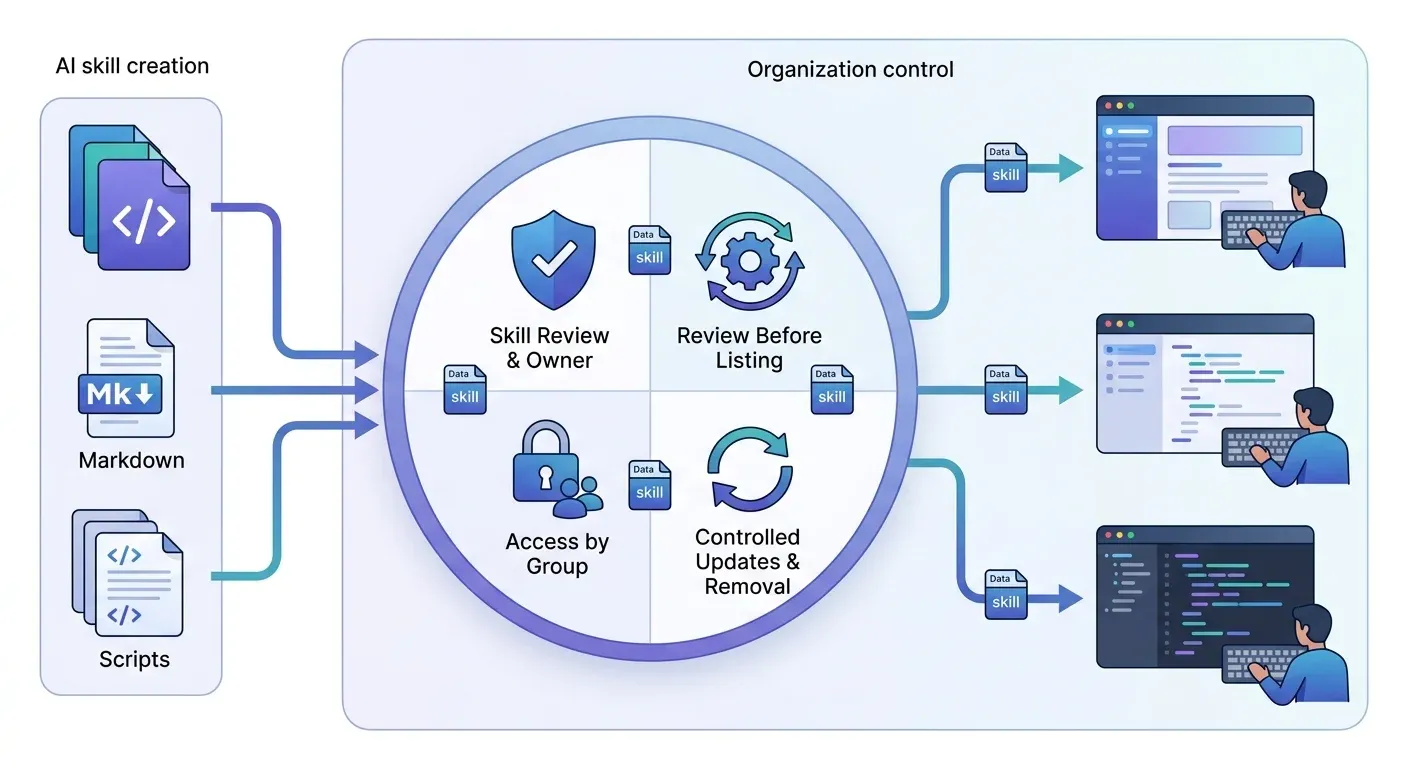
A private skill marketplace is an organization-controlled catalog of AI agent skills. Teams publish reviewed skills in one place, set who can find, edit and install them, and deliver them to supported coding tools. Unlike a public marketplace, the organization decides what is listed, who can access it, and what gets distributed.
Most teams reach this question the same way. A useful skill gets copied between repositories, a second version appears, and nobody can say which one is maintained or who approved it.
We build a product in this category. Skill Gateway is part of Jarvis Registry, so read our examples with that in mind. The definition applies to any product that meets it.
Key Takeaways
- A skill is a
SKILL.mdfile plus optional scripts and references. A marketplace is the catalog, access control and install path around those skills.- “Private” means your organization controls listing, access and updates.
- Public skill directories carry measured risk. Snyk, a developer-security company, found critical issues in 13.4% of the 3,984 skills it scanned.
- A private git repo can be enough for a small team on one tool. The case for a marketplace grows with tools, teams and audit needs.
- Skills carry instructions, not authorization. Live tool access still needs gateway and downstream permissions.
What is a private skill marketplace?
It’s a managed catalog with three parts: the skills themselves, rules about who can see and change them, and a way to get them onto developers’ machines.
A skill, in the Agent Skills format, is a SKILL.md file with optional scripts, references and assets. That last part matters. A skill can contain executable material, so “reviewed” has to mean the whole package, not just the prose.
The marketplace adds what a folder of files can’t: an owner for each skill, a listing step, per-group access and a repeatable install path. “Private” means those decisions belong to your organization, not to a public directory.
How is it different from a public skill marketplace?
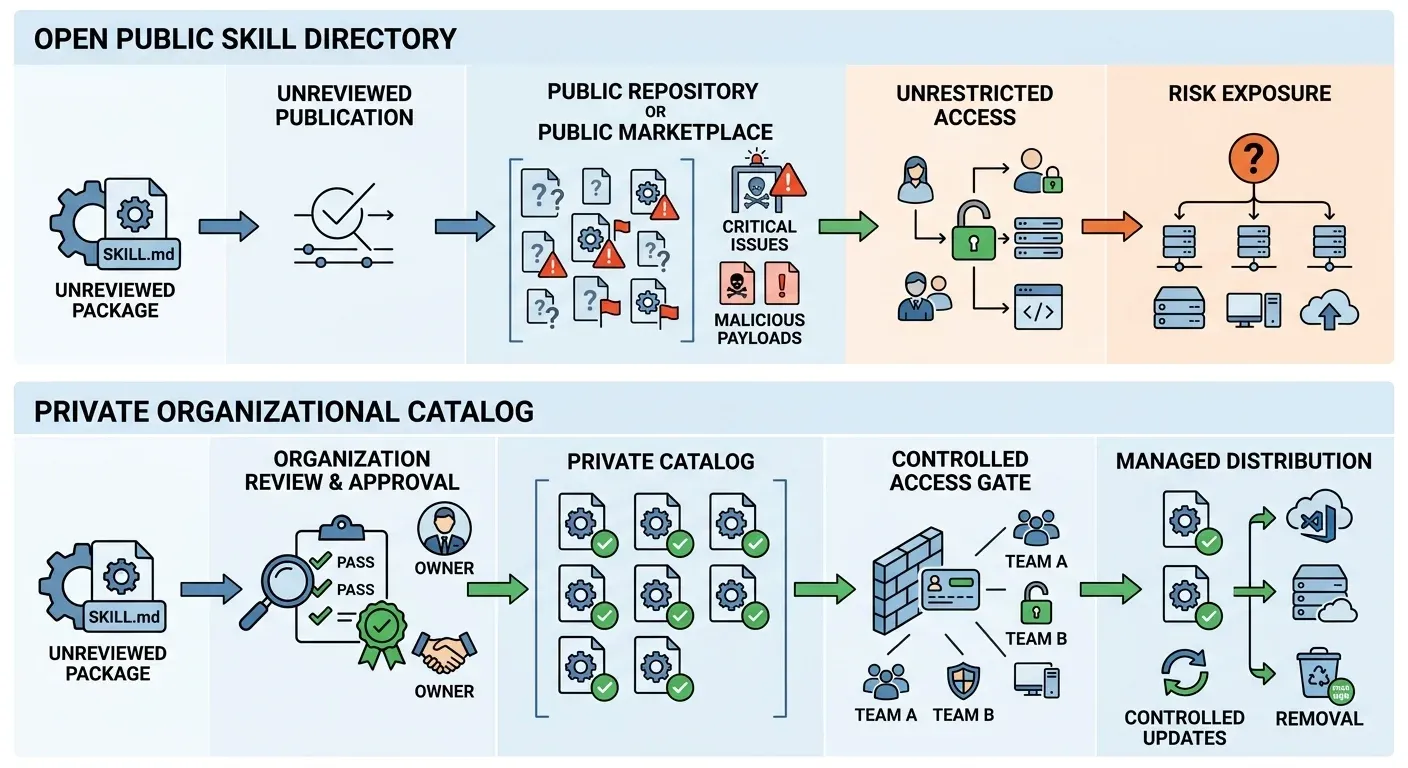
A public marketplace optimizes for discovery by anyone. A private one optimizes for control. That changes who can publish, who can install and who answers for what’s in the catalog.
The public side has a measured problem. In a study published on February 5, 2026, the security team at developer-security company Snyk scanned 3,984 skills from two public registries. It found 534 skills (13.4%) with at least one critical-level issue and 76 confirmed malicious payloads. Eight of those were still publicly installable at publication. Separately, Palo Alto Networks’ Unit 42 reported on June 23, 2026 that it found five malicious skills still unblocked on ClawHub between February and May 2026, including two macOS infostealers. The two studies measure different registries and methods, so treat the figures as evidence of a pattern, not a rate.
A private marketplace moves that review inside your organization. It doesn’t do the review for you. Someone still has to read the skill, including any scripts, before it’s listed.
| Public directory | Private git repo (Claude Code marketplace) | Skill Gateway | |
|---|---|---|---|
| Deployment model | Third-party site | Repository on your git host | Jarvis Registry, which can run in your own account |
| Supported AI tools | Whatever the listing targets | Claude Code | Mainstream IDEs and coding assistants, including Claude Code, Codex, GitHub Copilot and Cursor |
| Auth and access control | Open to anyone who can reach it | Repository permissions; an admin can require the marketplace | Resource permissions for viewing, editing, deleting and sharing |
| Audit | Varies by directory | Git history records catalog changes | Not covered in this post; confirm what is recorded for skill changes in your demo |
| MCP support | Separate concern | Separate concern | Pairs with MCP Gateway, which governs live tool calls separately |
| Hosting | Operated by the directory | Your git host | You choose where Registry runs |
Why do enterprises want one?
Because skills behave like software packages. Teams need to know where a skill came from, who approved it and which version a developer is using. Four things follow from that.
- One maintained source. A single copy replaces folders passed between repositories.
- Access by group. Access follows your people and groups, not whoever has the link.
- Review before listing. An owner approves a skill before anyone can install it.
- Controlled updates and removal. Teams decide when a revision reaches developers and what happens when access ends.
Private hosting has limits, and we’d rather state them. It doesn’t decide where a connected model sends the content it reads. Removing access doesn’t recall a file someone already copied. And secrets don’t belong in skills at all. Our post on private AI skill management walks through how to test each of these.
How do you share skills across Claude Code, Codex, Cursor and other tools?
A skill is a package: a SKILL.md file plus the reference files, scripts and assets it relies on. The package has to arrive intact. Each tool also looks for skills in its own location, so a marketplace needs a delivery step, not just storage.
Skill Gateway handles that step for mainstream IDEs and coding assistants, including Claude Code, Codex, GitHub Copilot and Cursor. Developers authenticate, and the AI Skills CLI syncs the skills they’re allowed to use into their personal or project environment. The tool-specific layout is handled for them.
You can create skills directly in Registry or import them from GitHub. The import runs one way, from GitHub into Registry. Registry edits aren’t written back, so decide where each skill is maintained and review changes there before importing.
Do you need one, or is a private repo enough?
A small team on a single tool can often start with a private git repo. A marketplace earns its place as tools, teams and audit needs grow.
Claude Code makes the repo route easy. Its marketplace documentation describes a marketplace as a directory or repository with a .claude-plugin/marketplace.json file. The repository can be private, and an administrator can require it on every machine. For one team using one tool, that may be all you need.
Treat the table below as a rule of thumb, not a benchmark.
| Your situation | A reasonable starting point |
|---|---|
| One team, one tool, a few skills | A private repo with that tool’s own marketplace support |
| Several teams or several coding tools sharing skills | A private skill marketplace with one maintained source |
| Different groups need different skills | A marketplace with per-group access |
| Audit or controlled removal is a requirement | A marketplace, with the audit trail confirmed in a demo |
The signal to move is usually friction. If you’re hand-copying skills between tools, or you can’t say who has which version, you’ve outgrown the repo.
What a skill marketplace doesn’t govern
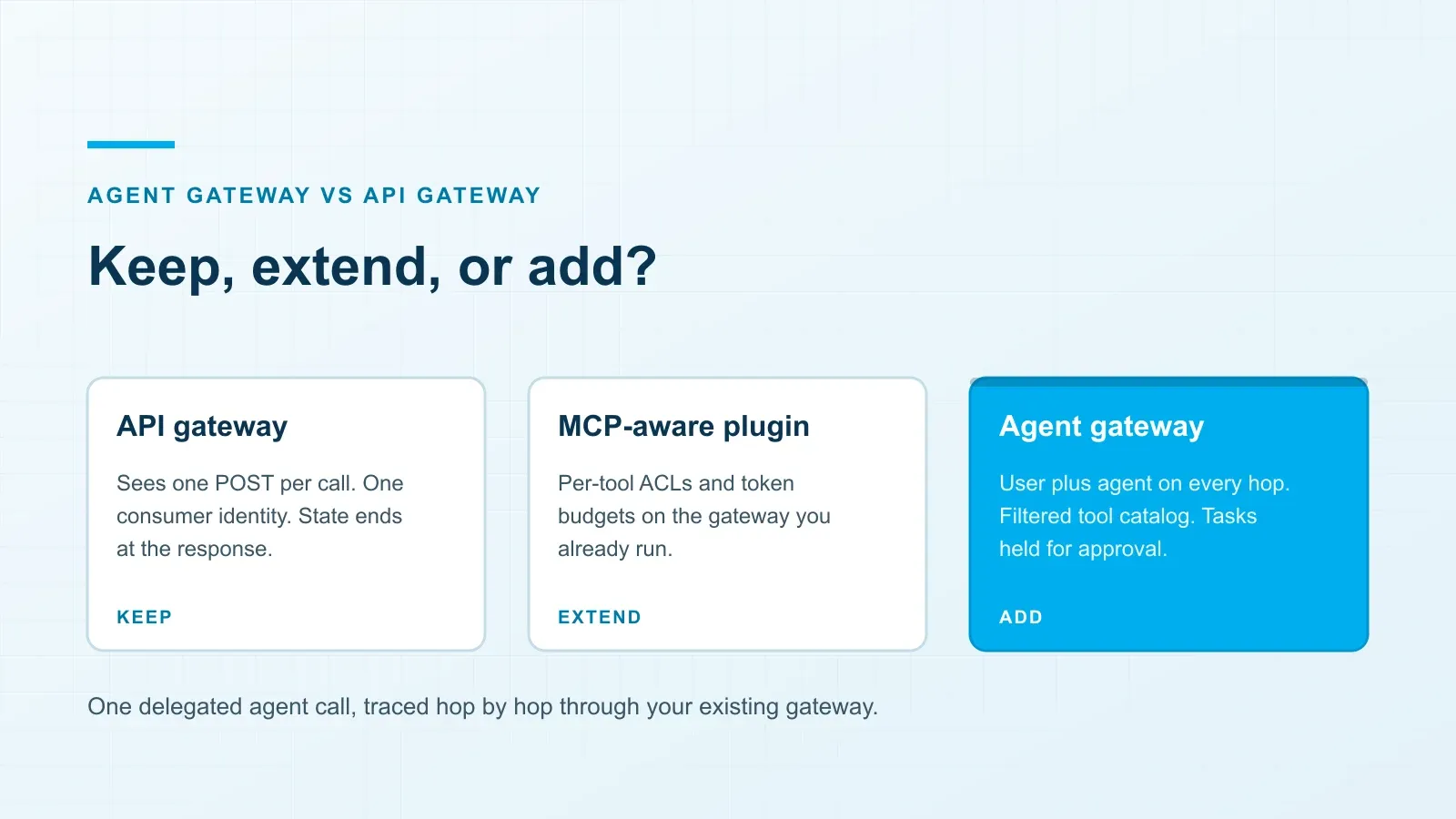
A skill carries instructions, not authorization. An approved skill that mentions a ticketing system doesn’t give the agent permission to use it.
Live operations are a different layer. MCP tools run through a gateway with its own identity and policy, and the downstream system still decides what each user can touch. We cover that boundary in AI skills vs MCP tools and in the MCP gateway buyer’s guide.
The same split explains why a skill registry isn’t an MCP registry. One catalogs instructions for how to work. The other catalogs the tools an agent can call. Our enterprise MCP registry architecture post covers the second.
What to check before you adopt one
Test one skill with two accounts before you roll anything out.
- Name an owner. Every shared skill needs a person accountable for it.
- Review before listing. Read the whole package, including scripts and references.
- Use two test accounts. One has access and one doesn’t. Confirm each sees what you expect, and that only maintainers can edit or share.
- Test an update and a removal. Change the source, sync again, then remove access and sync once more. Separate blocked access from files already copied locally.
- Confirm your tools. Check the exact tools and versions your developers use, in your own configuration.
A good demo shows all five with a skill your team actually uses. Request a Jarvis demo and bring one skill, two roles and the coding tools you run today.
Last verified: October 8, 2026, against the Snyk report, the Unit 42 report and the Claude Code marketplace documentation cited above.
References
- Agent Skills format overview
- Snyk, Exploring the Threat Landscape of Agent Skills
- Palo Alto Networks Unit 42, OpenClaw and ClawHub supply chain risk
- Claude Code documentation, Create a marketplace
- Jarvis Skill Gateway
- AI Skills CLI documentation
Private skill marketplace questions
What is a private skill marketplace?
A private skill marketplace is an organization-controlled catalog of AI agent skills. Teams publish reviewed skills in one place, set who can find, edit and install them, and deliver them to supported coding tools. Unlike a public marketplace, the organization decides what is listed, who can access it, and what gets distributed.
How do I share skills across Claude Code, Codex and Cursor in a company?
A skill is a package, not just a SKILL.md file: it can also include reference files, scripts and other assets. Each tool reads skills from its own location. A private skill marketplace keeps one maintained copy of the whole package and delivers it to each tool. Skill Gateway does this for mainstream IDEs and coding assistants, including Claude Code, Codex, GitHub Copilot and Cursor, using group-based access.
Is a private skill marketplace the same as an MCP registry?
No. A skill is a set of instructions and supporting files. An MCP tool is a live operation the agent can call. A skill marketplace governs the first, while an MCP registry and gateway govern the second. See AI skills vs MCP tools for the distinction.
Does a private marketplace make skills safe?
No. Private hosting moves review and access control inside your organization, but it doesn't perform the review. Skills can include scripts, so teams still need an owner, a review step before listing, and runtime permissions for any tool a skill mentions.