

An enterprise MCP registry should answer more than “which servers exist?” It should help a team decide which servers and tools are approved, who owns them, who can discover them, which identities may invoke them, which version is active, and what happened during every production call.
That requires a registry and a gateway working as separate but connected control points. The registry holds governed metadata and lifecycle state. The gateway uses that state when an AI client or agent invokes a tool.
The Short Architecture
A production design has six responsibilities:
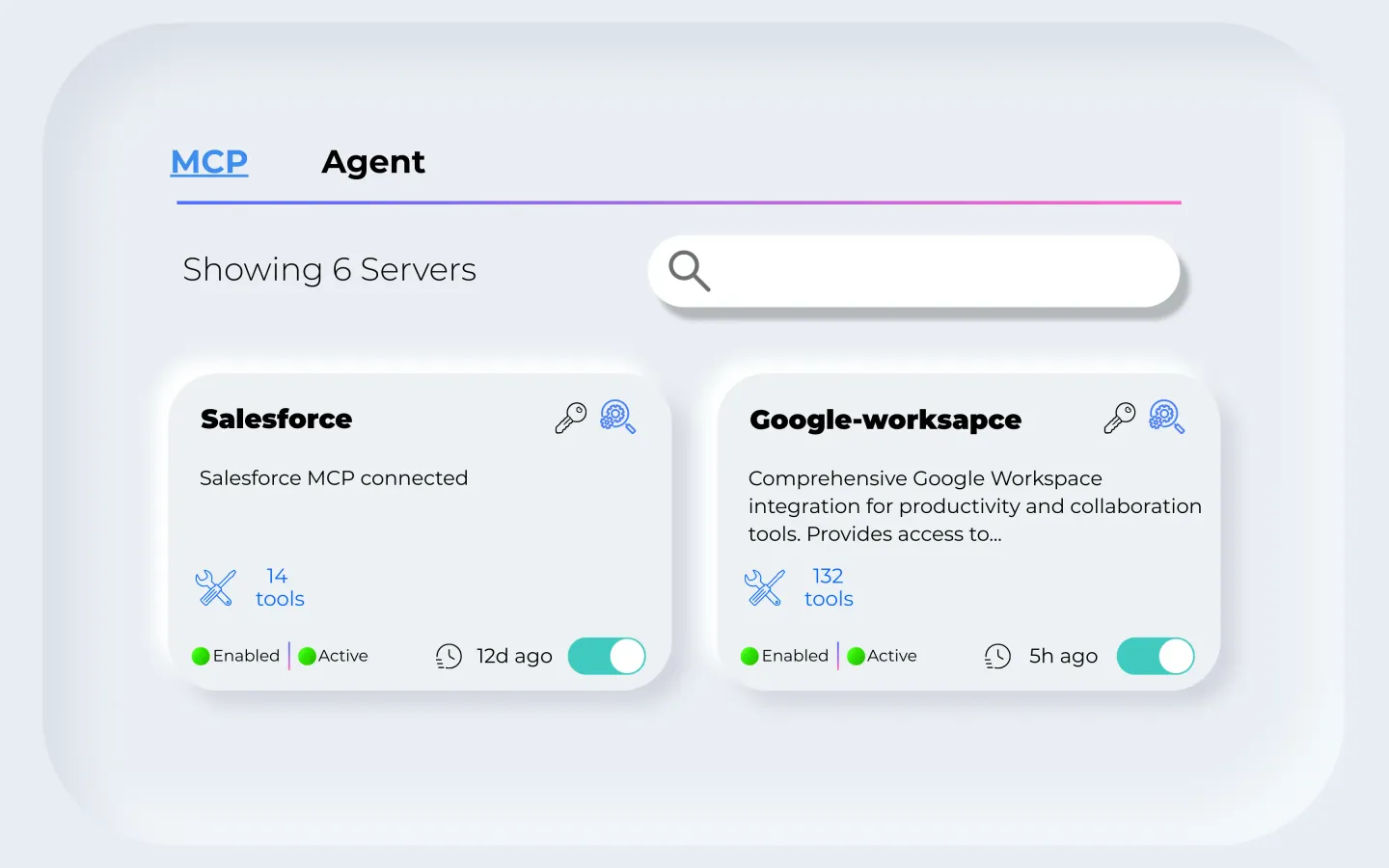
- Inventory and discovery: Catalog MCP servers, tools, owners, environments, versions, and approval state.
- Identity: Preserve the identity of the user, workload, or agent requesting access.
- Policy: Decide which identities can discover and invoke each server or tool.
- Runtime enforcement: Apply that decision at a gateway before the downstream call runs.
- Lifecycle: Approve, update, deprecate, roll back, and retire capabilities without leaving stale routes.
- Observability and audit: Record the caller, tool, policy decision, result, latency, and failure path in a system the organization can query.
The official MCP Registry is a public catalog for publicly available servers. Its documentation recommends hosting a private registry for private servers. That is the starting point for enterprise architecture, not the complete governance system.
Registry and Gateway Are Different Jobs
An MCP registry is the system of record. It describes capabilities and their status. An MCP gateway is the runtime enforcement point between MCP clients and servers.
| Control point | What it stores or does | Example decision |
|---|---|---|
| Private MCP registry | Server and tool metadata, owner, environment, approval, version, and lifecycle state | “This Jira server is approved for production and owned by Platform Engineering.” |
| MCP gateway | Authentication, authorization, routing, credential handling, and tool-call telemetry | “This user may invoke search_issues, but not delete_issue.” |
| Agent registry | Agent identity, owner, version, approval, and deprecation state | “Version 4 of the support agent is approved; version 3 is retired.” |
| Agent gateway | Runtime policy and routing for agent-to-agent calls | “This workflow may invoke the approved finance agent in Azure.” |
AWS describes MCP gateways as centralized proxies between clients and servers that orchestrate access to registered servers in its MCP hosting guidance. Microsoft similarly treats server inventory and runtime governance as related but distinct concerns through Azure API Center inventory and AI Gateway controls.
Keeping the responsibilities explicit prevents a common evaluation mistake: comparing a public catalog, an API gateway extension, a private registry, and a full MCP runtime gateway as though they offer the same control surface.
Layer 1: Governed Discovery
Discovery should start with a machine-readable server record and end with a permission-filtered view for the caller.
A useful record normally includes:
- server name and description;
- owner and support contact;
- environment and endpoint;
- tools and input schemas;
- authentication method;
- risk or review status;
- approved version and deprecation state;
- policy references;
- last validation time.
The catalog should not expose every approved tool to every user. Discovery itself can reveal sensitive capabilities, so the response should be filtered by identity and policy before an AI client builds its available tool list.
This is where a private registry can reduce shadow MCP usage. Teams get one place to find approved servers, while unapproved endpoints stay outside the sanctioned catalog and can be blocked at the runtime layer.
Layer 2: Identity Through the Full Call Chain
The identity model must cover more than the person who opened the chat interface. Enterprise calls may involve a user, an AI client, an orchestrating agent, a gateway, and one or more downstream tools.
The architecture should define:
- how the user or workload authenticates;
- whether the original identity is preserved or exchanged;
- which service receives which credential;
- how short-lived tokens are issued and refreshed;
- how access is revoked when a role or employment status changes;
- how the audit trail correlates every hop.
OAuth resource indicators in RFC 8707 are relevant because they allow a client to identify the protected resource for which it requests authorization. The exact OAuth and identity flow still needs to be tested against each MCP client, server, and enterprise identity provider.
Layer 3: Policy That Reaches the Tool
Server-level access is often too broad. A team may be allowed to search a ticket system without being allowed to delete a ticket, change an assignee, or export an attachment.
An enterprise policy model should be able to combine:
- roles and groups;
- individual or workload identity;
- environment;
- server and tool;
- data classification;
- approval state;
- time or session context;
- downstream authorization.
The gateway should make the decision close to invocation and record the policy version used. That gives security and engineering teams a direct answer when they ask why a call was allowed or denied.
Zero-trust guidance from NIST SP 800-207 is a useful architectural reference: access should be evaluated around resources and identities rather than assumed from network location alone.
Layer 4: Runtime Enforcement and Credential Boundaries
The gateway is where the design becomes operational. It should authenticate the caller, resolve the server and tool, evaluate policy, obtain or exchange the required downstream credential, forward the request, and capture the outcome.
Do not use “customer-hosted” as a substitute for a data-flow review. The registry and gateway may run in the customer’s environment while a configured model provider or external SaaS tool still receives part of a request. A production diagram should show every egress path, credential boundary, and retention point.
Useful proof tests include:
- Invoke an allowed tool as an approved user.
- Invoke a blocked tool using the same identity.
- Revoke access and repeat the call.
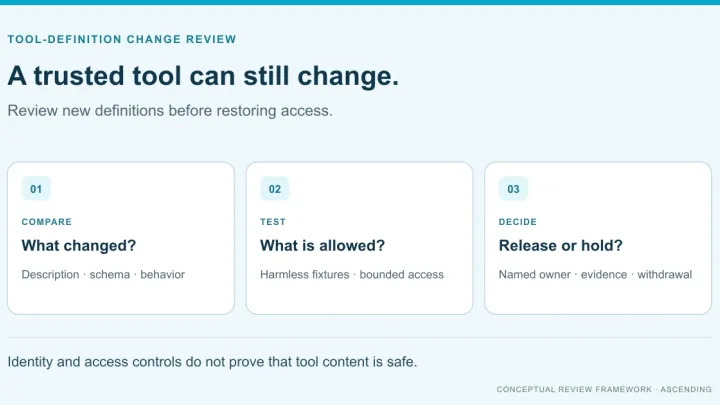
- Update or deprecate the server version and observe propagation.
- Trace the full call in the organization’s monitoring system.
If a vendor cannot demonstrate those scenarios with the buyer’s identity and tool stack, a feature checklist is not enough.
Layer 5: Lifecycle and Change Control
Registries become operationally valuable when they govern change, not only initial publication.
For every server, tool, or agent, define:
- who can submit it;
- who reviews security and ownership;
- how versions are promoted;
- which clients receive the new version;
- how a change is rolled back;
- what deprecation means for active workflows;
- when credentials and routes are removed.
AWS’s Agent Registry documentation highlights governance and curation through approval workflows. The same principle applies to an organization operating its own cross-cloud registry: discovery should reflect the approved lifecycle state, not merely whatever endpoint was most recently added.
Layer 6: Observability and Audit
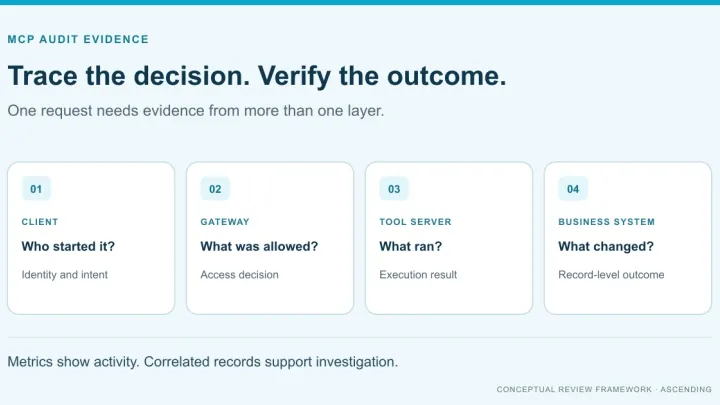
An MCP audit record should let a reviewer reconstruct a call without reading application logs from five systems.
At minimum, correlate:
- initiating user, workload, or agent;
- client and session;
- selected server and tool;
- policy decision and policy version;
- credential or authorization method without logging secrets;
- request and response status;
- latency, retries, and failure reason;
- downstream agent or tool hops.
OpenTelemetry provides vendor-neutral traces, metrics, and logs, but instrumentation is only the transport. Teams still need a stable naming and correlation model for identities, policies, servers, tools, and agents.
These are design requirements, not fields every registry emits. Jarvis observability documentation distinguishes platform metrics from agent LLM traces; it doesn’t establish a complete per-call audit schema. Use the MCP audit evidence tests to map available records, missing instrumentation and destination outcomes before relying on this layer.
Multi-Cloud Does Not Mean One Giant Catalog
A multi-cloud registry can federate metadata from cloud-native services while keeping execution where it already runs. The goal is a governed view and consistent access policy, not necessarily moving every server or agent into one runtime.
For example, an organization may keep AWS-hosted agents in AgentCore, Azure-hosted agents in AI Foundry, and internal MCP servers in its Kubernetes platform. A registry can synchronize approved metadata, while gateways enforce policy at the required boundaries.
The key design questions are:
- Which system is authoritative for ownership and lifecycle?
- How quickly do updates and revocations propagate?
- Which cloud identity is exchanged at each boundary?
- Does the audit trail correlate calls across clouds?
- Can a client discover only what its identity may use?
ASCENDING documents its implementation of this pattern on the Jarvis AWS and Azure federation page.
To exercise these controls on a healthcare workflow, use insurance eligibility verification as a scoped lookup-and-update scenario. Keep the tools that retrieve payer evidence separate from the tools that write the operational record. A payer-call evidence handoff adds a useful asynchronous test: the returned result must retain its job identity and reach a reviewer with the right permissions.
An Enterprise MCP Registry Implementation Checklist
Before selecting a platform or approving an internal build, require a written answer for each item:
- Scope: MCP servers only, or tools, agents, skills, and workflows too?
- Hosting: Managed, customer-hosted, hybrid, or cloud-specific?
- Inventory: How are capabilities registered, synchronized, and removed?
- Identity: Which IdPs, clients, users, and workloads are supported?
- Policy: Server-level, tool-level, agent-level, and environment-level controls?
- Secrets: Where are credentials stored, exchanged, rotated, and revoked?
- Runtime: Where is policy evaluated and how are failures handled?
- Lifecycle: Approval, versioning, deprecation, rollback, and retirement?
- Telemetry: Which traces, logs, and metrics are emitted and where can they be exported?
- Operations: Who owns upgrades, incidents, protocol changes, and support?
For a vendor-selection framework, use the enterprise MCP gateway comparison. For Jarvis product detail, review the MCP Gateway, Agent Registry, and Agent Gateway pages separately. For the program around the registry, covering owners, risk tiers, approval and review, use the MCP governance checklist.
The Practical Next Step
Choose one real workflow and map it end to end: client, identity, registry record, policy, gateway, downstream tool, external service, and audit destination. Then run the same allowed, denied, revoked, and failed scenarios against every architecture you are considering.
If you are evaluating a customer-hosted governance layer across AWS and Azure, Jarvis Registry brings MCP discovery, runtime gateway controls, agent lifecycle, and implementation support into one evaluation path.
References
- Model Context Protocol. “MCP Registry”.
- AWS. “MCP Hosting Strategy”.
- Microsoft Learn. “Register and discover MCP servers in Azure API Center”.
- Microsoft Learn. “AI Gateway governance controls”.
- IETF. “RFC 8707: Resource Indicators for OAuth 2.0”.
- NIST. “SP 800-207: Zero Trust Architecture”.
- AWS. “Bedrock AgentCore Registry”.
- OpenTelemetry. “What is OpenTelemetry?”.
FAQ - Enterprise MCP Registry Architecture
What is an enterprise MCP registry?
An enterprise MCP registry is a private, governed catalog of MCP servers and tools. It records metadata such as ownership, environment, approval state, version, authentication method, and policy references so teams and AI clients can discover approved capabilities.
What is the difference between an MCP registry and an MCP gateway?
The registry is the system of record for discovery and lifecycle state. The gateway is the runtime enforcement point that authenticates, authorizes, routes, and observes MCP tool calls. An enterprise architecture often connects both.
Can an existing API gateway replace an MCP registry and gateway?
An API gateway can continue to govern application APIs, but the team should verify whether it also handles MCP discovery, client and workload identity, tool-level policy, protocol-specific authorization, lifecycle state, and tool-call traces. Custom extensions may be required when those jobs are not native.
How does a private MCP registry help control shadow MCP servers?
A private registry gives teams a sanctioned place to discover reviewed servers and tools. When runtime gateways and endpoint controls use the same approval state, unapproved servers can remain undiscoverable and their calls can be blocked.