

Ask whether your investigative AI platform is “court-ready,” and the honest answer is almost always: it depends on which output. A search result, a link chart, a generated case summary and a crime forecast are four different kinds of claims. A defense attorney will treat each one differently.
Records management systems, data lakehouses and link-analysis tools are not the problem. They were built to store, query and visualize records, and they do that well. But a platform that draws conclusions across incident reports, crash data, dispatch logs, license plate reads and third-party intelligence creates a new obligation: every conclusion has to be explainable to a judge.
One state law-enforcement solicitation we reviewed (not named here; the figures below are illustrative) made this explicit. Alongside entity resolution and generative briefs, it required a vendor expert witness, disclosure of the AI’s known failure modes, and a hallucination ceiling of 2%. We call the missing piece the evidentiary AI layer: a governance layer that makes every AI output carry its own proof.
Key Takeaways
- Search is mostly solved. Entity resolution, generated summaries and predictions are where defense counsel will push, because the system stops retrieving facts and starts asserting them.
- Five gaps matter: proof packets, correctable matches, reactive versus predictive labeling, measured accuracy, and a disclosure-ready record.
- An evidentiary layer sits between data and outputs, so no conclusion leaves the platform without its proof.
The Four Flows That Define Investigative AI
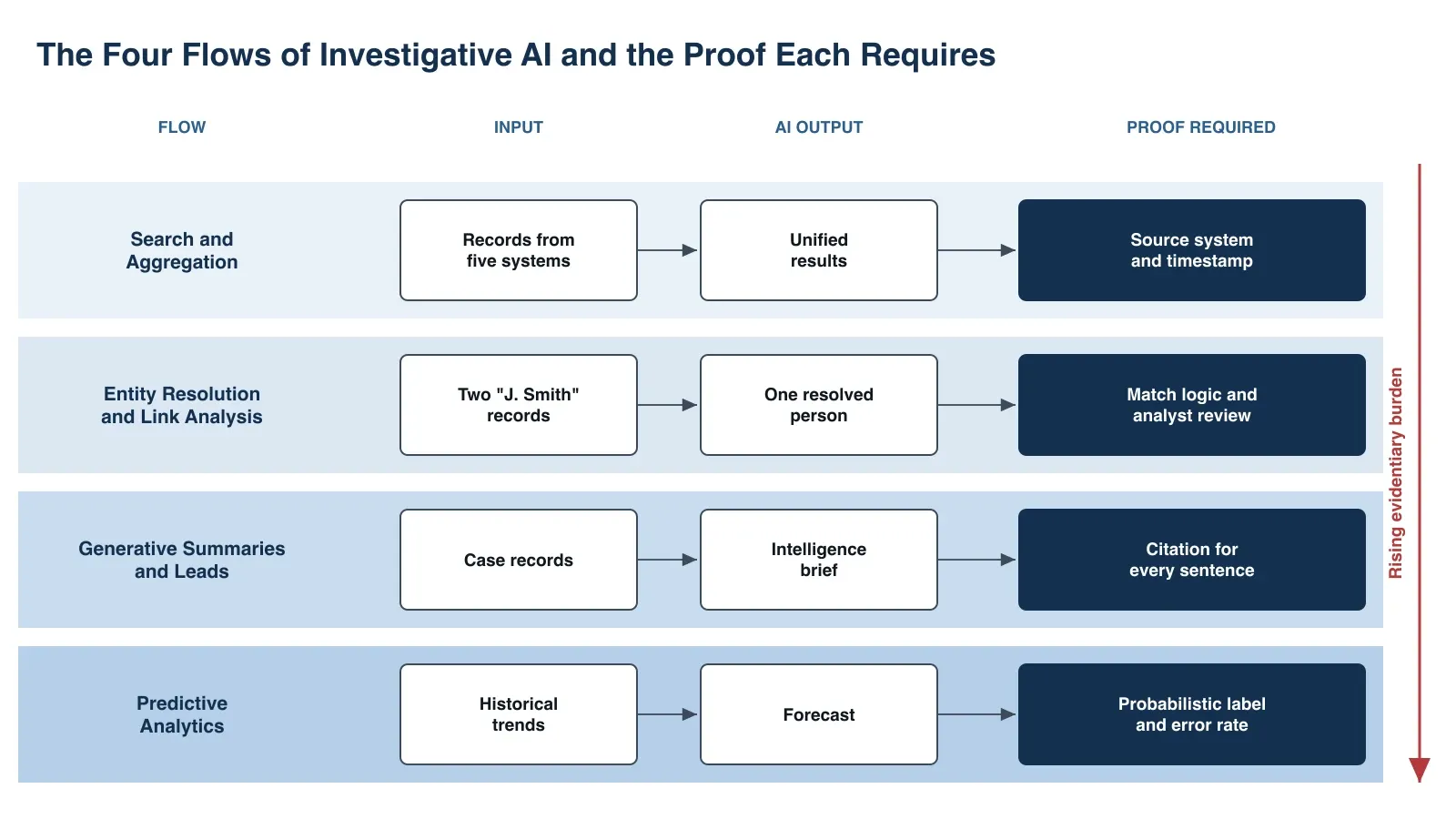
Investigative platforms move information through four flows, and each creates a different evidentiary burden:
| Flow | Concrete example | What the platform must do |
|---|---|---|
| Search and aggregation | Every record tied to a plate number across five systems | Return source records with system of origin and timestamps |
| Entity resolution and link analysis | Two records for “J. Smith” merged into one person | Show the match logic and let an analyst split a bad merge |
| Generative summaries and leads | An intelligence brief recommending an investigative direction | Cite the exact records behind every sentence |
| Predictive analytics | A drug-trend forecast driving patrol allocation | Label output as probabilistic, with known error rates |
The first flow is mostly solved. The last three are where courts, auditors and defense counsel will push hardest.
The Five Capability Gaps That Actually Matter
Gap 1: Proof packets for every output
A generated brief that says two suspects share an address is only as good as the records behind it. The platform must attach a proof packet: the source records, the systems they came from and when they were pulled. Without one, an analyst can’t verify the claim and a prosecutor can’t disclose it.
Gap 2: Correctable entity resolution
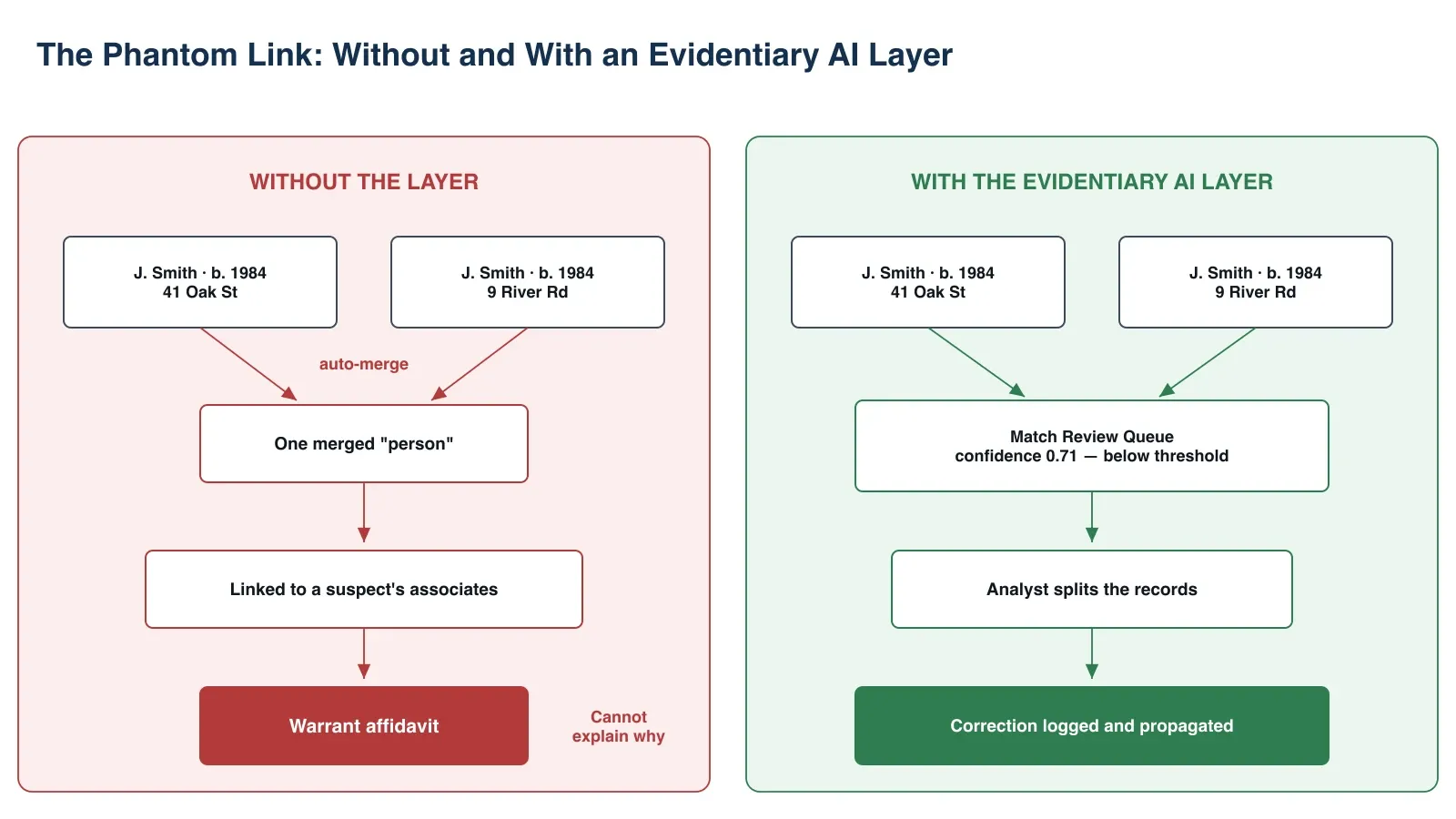
Entity resolution is probabilistic. Common names, transposed birthdates and shared addresses produce false merges. Investigators need to see why records were linked, split a wrong match themselves, and have that correction logged and carried into every downstream graph and summary.
Gap 3: Reactive versus predictive separation
A historical count of incidents and a forecast of future incidents are different kinds of evidence. The solicitation required the expert witness to distinguish them “to ensure judicial clarity.” That only works if the platform labels every output by type when it is generated, not after a motion to suppress.
Gap 4: Measured accuracy against a gold set
“Accurate AI-driven insights” is not a measurable requirement. Precision, recall and hallucination rate against a human-verified gold set are. In the solicitation we reviewed, information extraction had to exceed 98% precision, risk detection 95% recall, and generated text had to stay under a 2% hallucination rate, with the agency blind-testing 50 of its own records every quarter. Treat these as illustrative thresholds from one agency, not an industry standard. The platform has to be built to be graded.
Gap 5: A disclosure-ready record
Prosecutors have disclosure obligations, and AI does not suspend them. Known limitations, prior disputed outputs, bias testing and the logs needed to reconstruct what the system did on a given day must be producible on request, without a vendor engineering project. The same solicitation required three years of logs sufficient to reconstruct system behavior, and barred the vendor from using trade-secret claims to block a court-ordered disclosure.
How Traditional Investigative Platforms Compare
| Capability | Records management system | Lakehouse + BI | Link-analysis tools | Evidentiary AI layer |
|---|---|---|---|---|
| Cross-source search | Own records only | Yes | Yes | Yes |
| Proof packet per output | Yes, native records | Query-level | Manual export | Yes, per assertion |
| Analyst-correctable matches | No | No | Varies | Yes, logged |
| Output labeled by type | N/A | No | No | Yes |
| Gold-set accuracy metrics | N/A | No | No | Yes |
The ratings above are ASCENDING’s assessment of typical product categories, not results from testing specific products. Traditional tools don’t generate conclusions, so none were designed to label them. That was a reasonable boundary until AI started writing the briefs. Proof is native until AI enters: a records system is the source, and the evidentiary problem appears only once a model synthesizes across sources.
What the Gaps Mean in Practice
These three scenarios are illustrative, not drawn from a specific case.
Failure mode 1: The phantom link. Imagine two people share a name and birth year. The platform merges them, the link chart connects an uninvolved person to a suspect’s associates, and the lead reaches a warrant affidavit. Nobody can show why the merge happened, because the match logic was a similarity threshold no one on the case had ever seen.
Failure mode 2: The unsourced sentence. A generated brief states that a vehicle was seen at a scene. No record says so; the model inferred it from a nearby plate read. The sentence is copied into a report and surfaces in discovery.
Failure mode 3: The forecast mistaken for evidence. A hotspot forecast informs a stop, and the report reads as if the forecast were an observed fact. Under cross-examination, the officer can’t explain the model or its error rate.
The Evidentiary AI Layer Concept
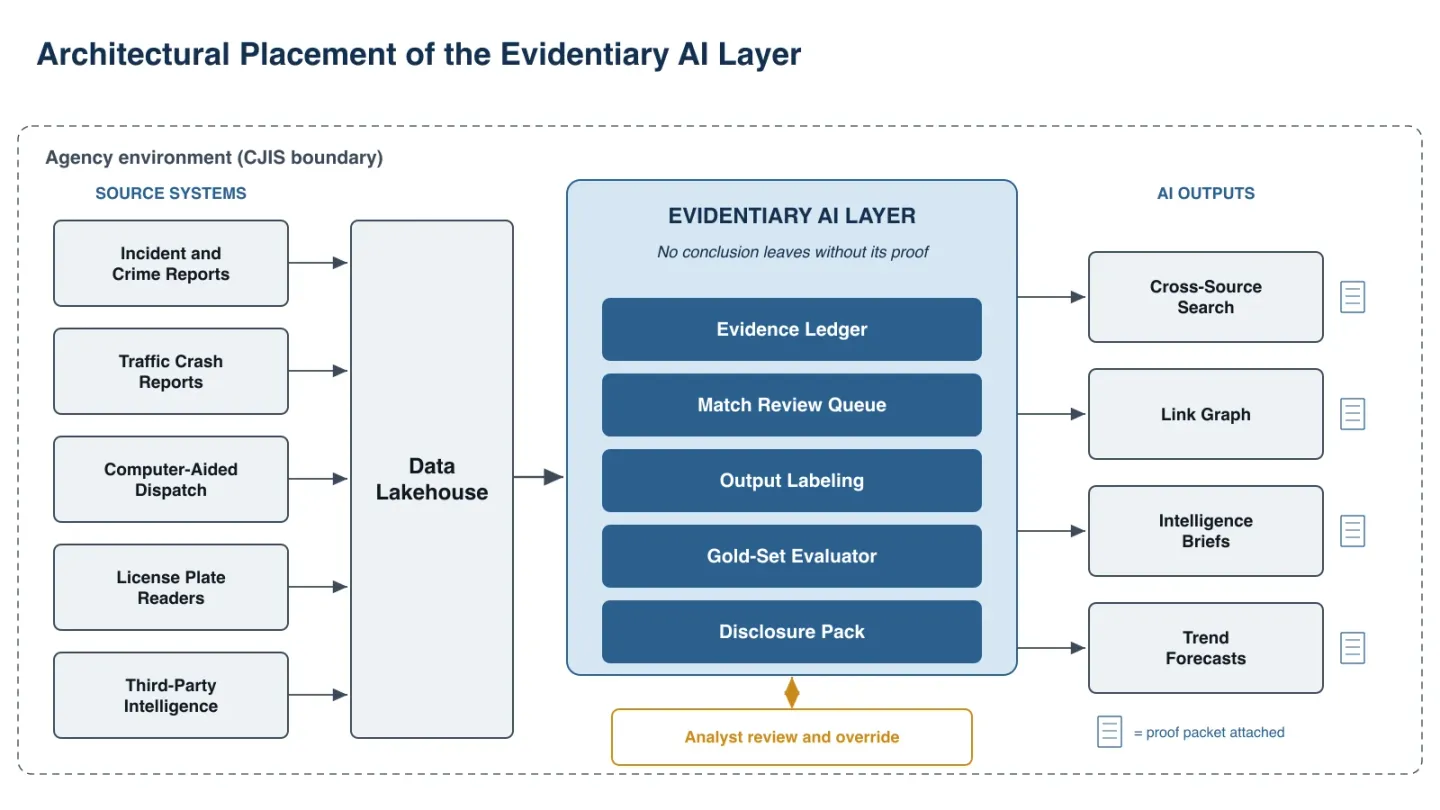
The layer doesn’t replace your records system, your data lakehouse or your analysts. It sits between the data and every AI output, and enforces one rule: no conclusion leaves the platform without its proof. It also keeps agency data out of model training entirely, which most law-enforcement contracts now require in writing.
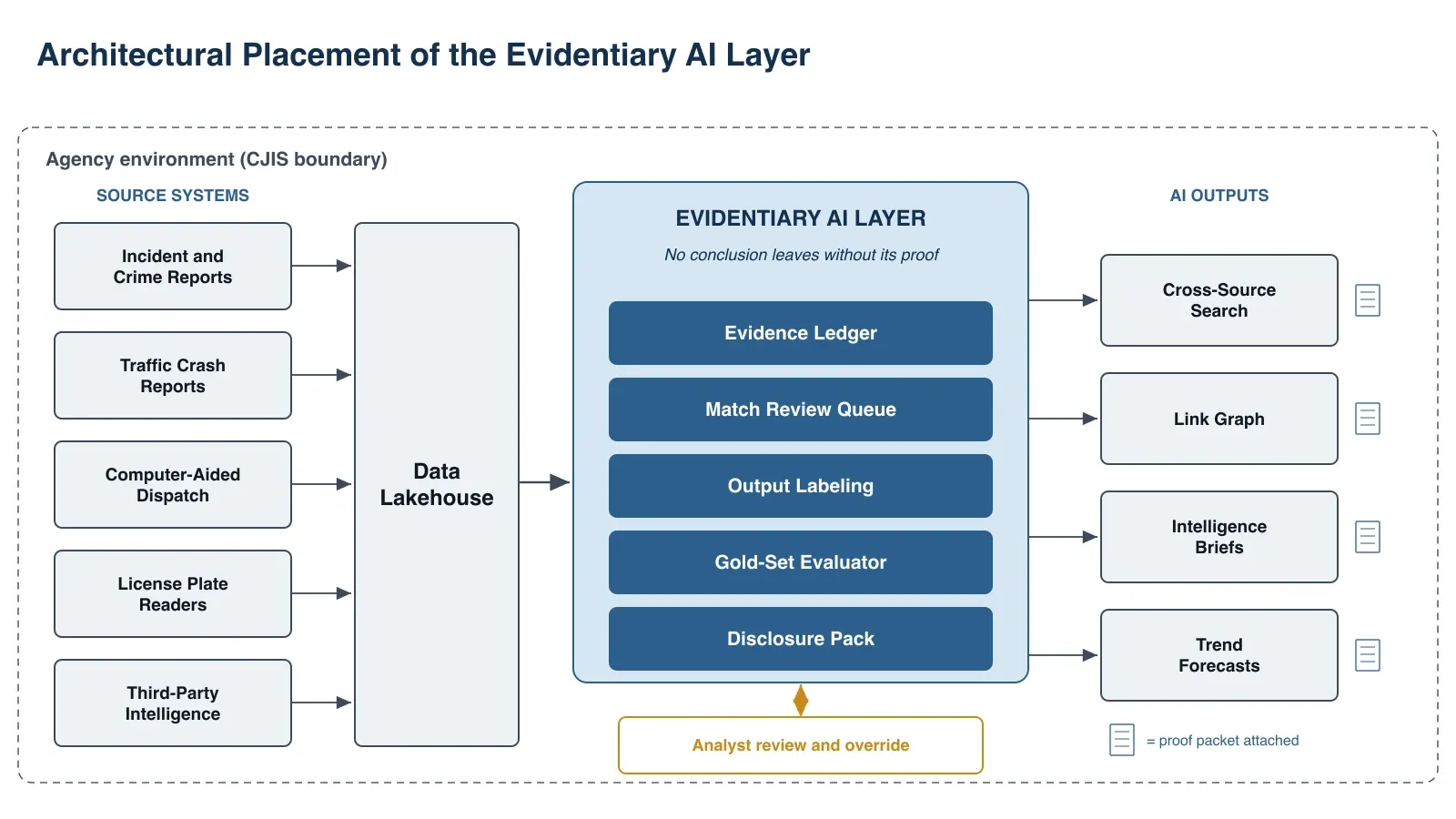
- Evidence ledger: binds every assertion to source records, systems and retrieval times, and assembles proof packets on demand.
- Match review queue: routes low-confidence entity merges to analysts and logs every split or confirmation.
- Output labeling: tags each result as retrieved, resolved, generated or predicted.
- Gold-set evaluator: scores precision, recall and hallucination rate continuously, and supports blind tests.
- Disclosure pack: exports model cards, bias test results, known limitations and reconstruction logs for counsel.
Integration with Existing Investigative Systems
Data platforms and dispatch
Most agencies already hold their records in a lakehouse with dispatch, crash and GIS feeds alongside. The layer reads from those systems in place, aligns entities to NIEM exchange standards, and keeps all data inside the agency’s own environment under the CJIS Security Policy.
Dashboards and governance
Analysts keep their existing dashboards and maps. The layer feeds them proof-linked results and maps its controls to the Measure and Manage functions of the NIST AI Risk Management Framework, so governance evidence is generated as a by-product of normal use. For the platform-side controls behind that evidence, see our enterprise AI governance framework requirements.
Courtroom Standards: Why Reliability of Method Decides
Many AI-assisted leads never reach a courtroom. They still appear in warrant affidavits and discovery, and anything offered as expert opinion faces the reliability test. Under Federal Rule of Evidence 702, the proponent must show the method is reliable and reliably applied to the facts. Since the 2023 amendment, the rule says the proponent must demonstrate this is “more likely than not,” and the committee note says reliability questions are matters of admissibility, not just weight. The Supreme Court’s Daubert v. Merrell Dow Pharmaceuticals decision made the judge the gatekeeper for that question. Factors courts weigh include testing, known error rates, peer review and general acceptance. State courts apply their own standards, so confirm with counsel which one governs your jurisdiction.
An output with no proof packet, no match logic and no measured error rate gives an expert nothing to defend. That is the practical case for the layer.
Five Questions for Evaluating an Investigative AI Platform
1. Can every generated sentence be traced to a source record in one click? If the answer involves a support ticket, the platform isn’t discovery-ready.
2. Can an analyst split a bad entity match without vendor help? Correction must be self-service, logged and propagated.
3. Is every output labeled reactive or predictive when it is created? Labels applied later are reconstructions, not records.
4. What are the precision, recall and hallucination rates on your data, and who checks them? Vendor benchmarks on vendor data don’t count.
5. Could your expert explain this output to a judge? An unexplainable output is an unusable one.
The Jarvis Evidentiary AI Layer
At ASCENDING, these gaps shaped how we built governance into Jarvis AI. Every Jarvis response is grounded in retrieved source records with mandatory citations, and responses without a source are flagged or withheld. Human-in-the-loop checkpoints sit before high-stakes actions, every interaction is logged in the agency’s own environment, and NIST AI RMF-aligned governance workflows produce model cards and bias testing records continuously.
Learn more about the Jarvis Governed AI Layer.
Closing
Records systems, lakehouses and link-analysis tools remain the foundation of modern investigations. They aren’t obsolete; they were simply never asked to defend a conclusion.
AI changes that. Once a platform synthesizes across sources, recommends leads and forecasts risk, its outputs become claims, and claims need proof. The evidentiary AI layer is how agencies get the speed of AI without giving up the defensibility their cases depend on.
The question is no longer whether AI can find the link. It is whether you can prove it.
The same pattern shows up in other public-sector programs. Our Tennessee Medicaid pharmacy fraud pilot covers the capability gaps a state fraud-detection system has to close before its findings can be acted on.
References
| Source | Link |
|---|---|
| NIST AI Risk Management Framework | https://www.nist.gov/itl/ai-risk-management-framework |
| FBI CJIS Security Policy Resource Center | https://le.fbi.gov/cjis-division/cjis-security-policy-resource-center |
| National Information Exchange Model, Bureau of Justice Assistance | https://bja.ojp.gov/program/it/national-initiatives/niem |
| Federal Rule of Evidence 702, Cornell LII | https://www.law.cornell.edu/rules/fre/rule_702 |
| Daubert v. Merrell Dow Pharmaceuticals, 509 U.S. 579 (1993), Cornell LII | https://www.law.cornell.edu/supct/html/92-102.ZS.html |
| ASCENDING Inc., Jarvis Knowledge Base | https://ascendingdc.com/jarvis-ai/knowledge-base/ |
| ASCENDING Inc., Jarvis Governed AI Layer | https://ascendingdc.com/jarvis-ai/governed-ai/ |
Investigative AI and the Courtroom: Questions Agencies Ask
What is an evidentiary AI layer?
It is a governance layer between agency data and every AI output. It attaches source records, match logic, output labels and accuracy metrics to each conclusion, so the output can be verified, challenged and disclosed.
Does AI-generated analysis have to meet Daubert and Rule 702?
If it is offered as expert evidence, the proponent must show the method is reliable and reliably applied. See Federal Rule of Evidence 702 and Daubert v. Merrell Dow Pharmaceuticals. Many leads never reach court, but they can still surface in discovery and affidavits.
What should an agency ask an investigative AI vendor?
Ask whether every generated sentence traces to a source record, whether analysts can split a bad entity match, whether outputs are labeled reactive or predictive at creation, and who measures precision, recall and hallucination rate on the agency's own data.