
MCP vs RAG: Two Layers, One Stack | ASCENDING
TL;DR — MCP vs RAG in 2 sentences. The Model Context Protocol is a wire protocol, published by Anthropic in November 2024 with 3 core primitives (tools, resources, prompts), that standardizes how an AI client invokes tools over JSON-RPC 2.0. Retrieval-augmented generation is an architecture pattern that grounds model output in retrieved documents — and in a real enterprise AI architecture, the RAG layer runs behind an MCP gateway, so the answer is both, in 1 stack.
Every few weeks a customer architecture call opens with some version of the same question: “We’re trying to decide between MCP and RAG — which one should we standardize on?” It’s asked in good faith, and it’s the wrong question. Not because the answer is complicated, but because the 2 things being compared don’t live at the same layer of the stack. Asking “MCP vs RAG?” is like asking “HTTP or PostgreSQL?” You will almost certainly use both, and the interesting engineering questions are about the seam between them.
Where the Confusion Comes From
Both acronyms got popular in the same 18-month window, both get pitched as “how enterprise AI connects to your data,” and both show up in the same vendor decks. If you’re a platform owner triaging a dozen AI proposals a quarter, the collision is understandable.
But the 2 solve different failures:
- RAG exists because models hallucinate. A model answering from its training weights will confidently invent policy numbers, cite documents that don’t exist, and go stale the day after training cuts off. Retrieval fixes the grounding problem: fetch relevant passages from your corpus, hand them to the model as context, and the answer stays tied to what your organization actually knows.
- MCP exists because integrations don’t compose. Before a standard protocol, every AI client needed a custom connector to every enterprise system — 10 clients against 12 systems means 120 bespoke integrations. Anthropic published MCP in November 2024 to collapse that matrix to 22 protocol implementations: any client that speaks MCP can call any server that speaks it.
One is about what the model says. The other is about how systems talk. Different layers, different failure modes, different fixes.
The Side-by-Side That Actually Makes Sense
| Question | Model Context Protocol | Retrieval-Augmented Generation |
|---|---|---|
| What kind of thing is it? | Open protocol (spec, Nov 2024) | Architecture pattern |
| What failure does it fix? | The N×M integration matrix | Hallucination / ungrounded answers |
| Where does it live? | On the wire, between client and server | Inside a server, over your corpus |
| Core pieces | 3 primitives: tools, resources, prompts | Retrieve → rank → generate, with citations |
| Can it replace the other? | No — it carries no grounding | No — it defines no transport |
| How they compose | The gateway publishes many tools | 1 of those tools is the RAG server |
What MCP Actually Specifies
MCP standardizes the conversation between an AI client and a server over JSON-RPC 2.0: how the client discovers what tools exist, how it invokes 1 of them, how results and context come back. That’s the whole job. The protocol is deliberately silent about where data lives, how retrieval works, or what the server does internally.
That silence is the point. Because the wire format is fixed, the pieces become swappable — Claude Desktop, an IDE copilot, and an internal chat product can all reach the same server, and the server team can rewrite its internals without breaking a single client.
What MCP does not give you: grounding. An MCP server that answers from nothing is just a well-connected hallucination.
What RAG Actually Specifies
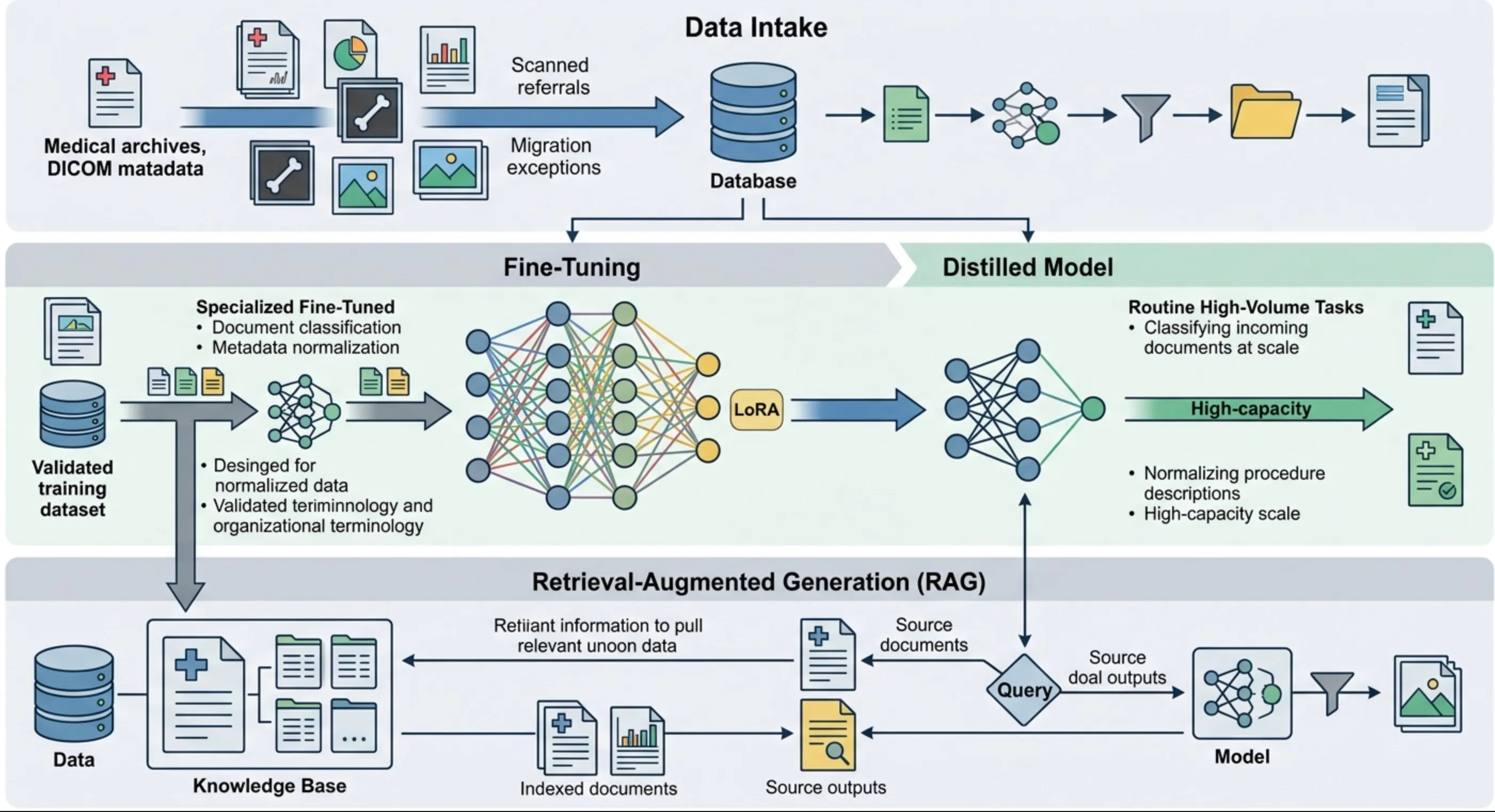
RAG is a pipeline shape: retrieve candidate passages, rank them, pass the survivors to a model, generate a grounded answer — ideally with citations back to the source documents. The retrieval layer underneath can be vector search, keyword search, a knowledge graph, or a hybrid of all 3; the pattern doesn’t care.
The implementation details are where RAG projects live or die — chunking strategy, re-rankers, permission-aware indexing, evaluation. (AWS maintains a solid primer on the pattern if you want the fundamentals.) But notice what RAG does not specify: how an agent finds and calls the retrieval system in the first place. A beautiful RAG pipeline that every client integrates against with custom glue code has solved grounding and reinvented the integration matrix.
How They Compose in a Real Deployment
Here’s the architecture we build over and over, and the one we’d defend in any design review:
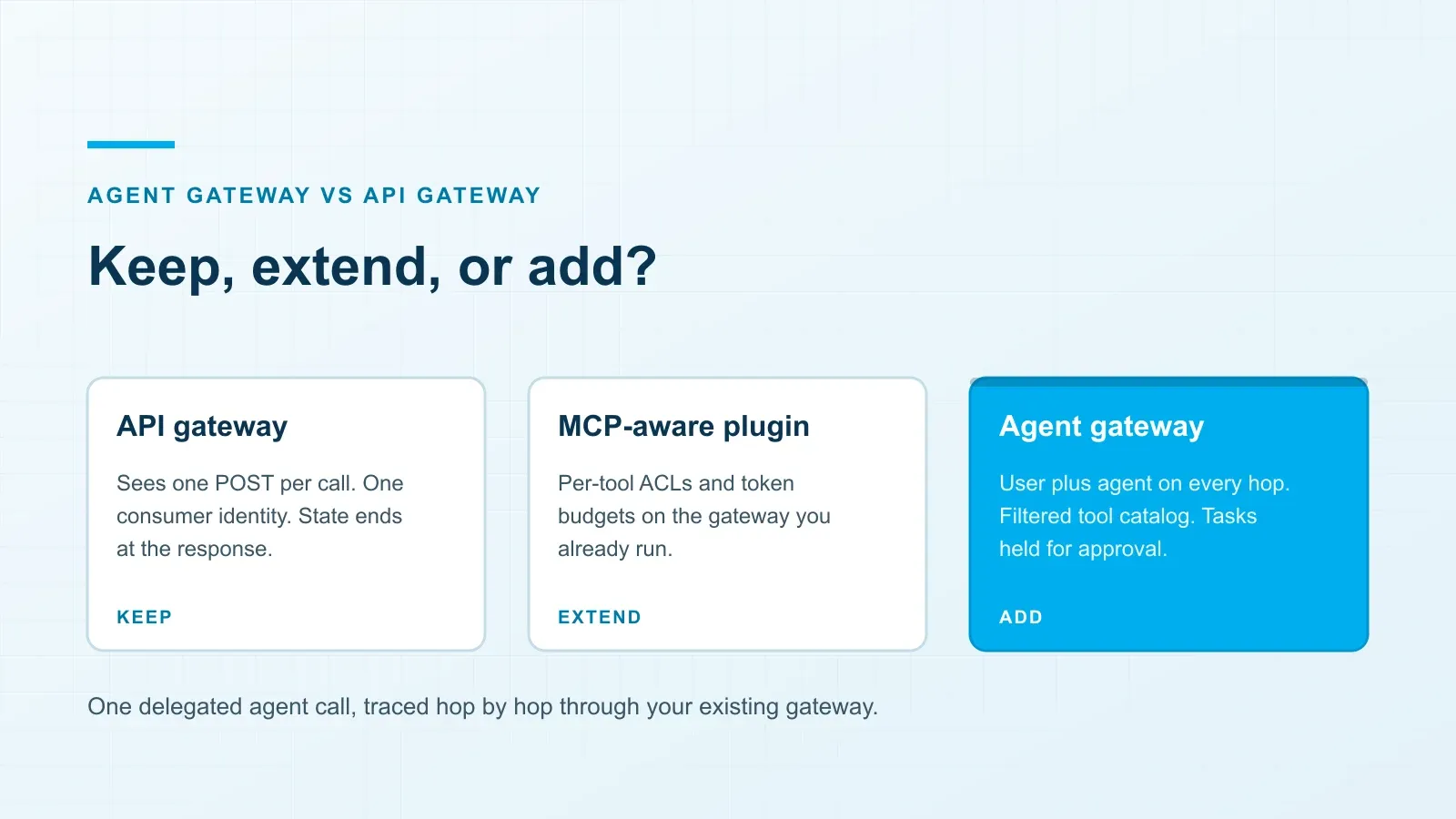
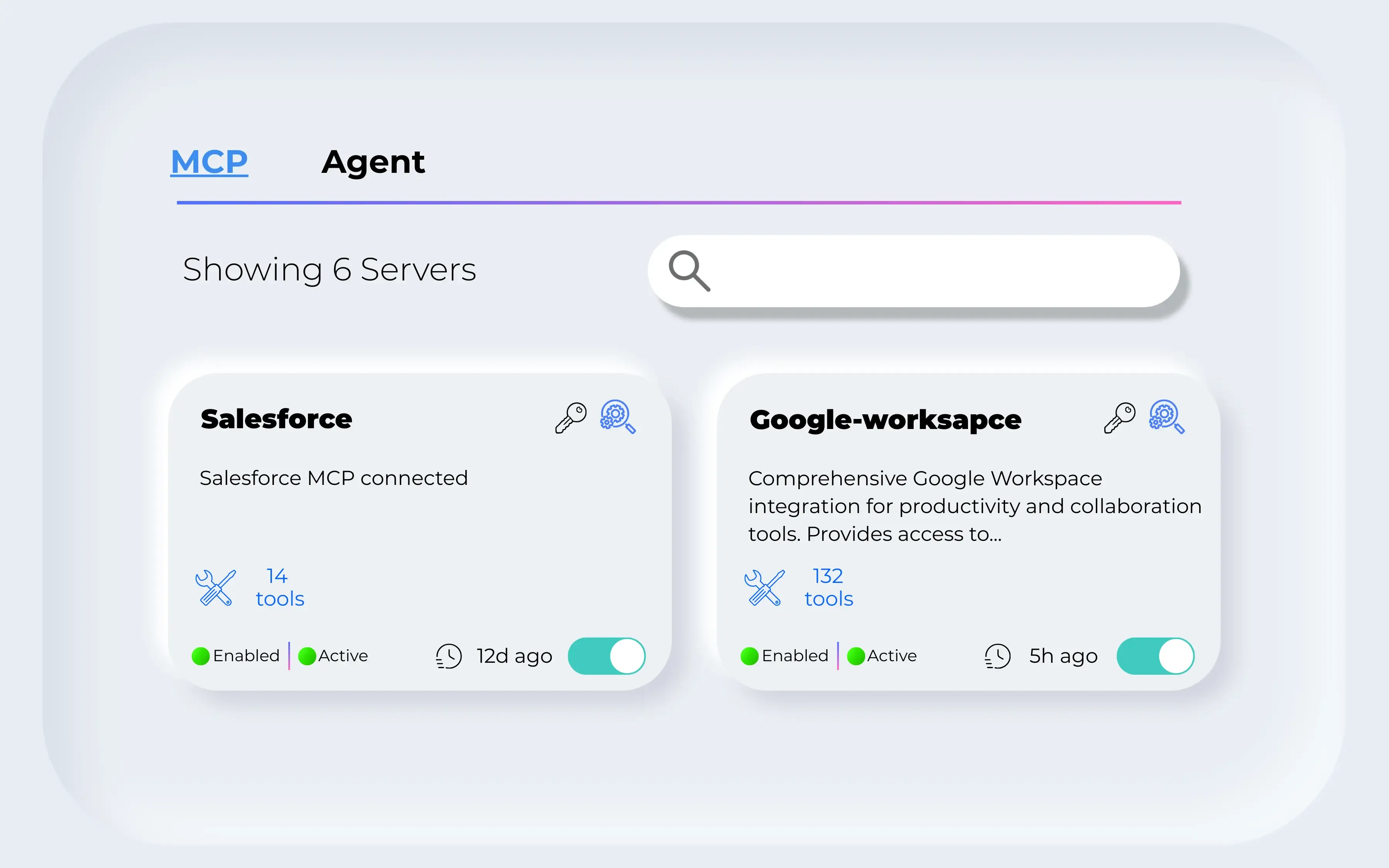
- The agent speaks MCP to a gateway. It sees a catalog of governed tools — ticketing, databases, document search — and it neither knows nor cares how any of them work inside.
- One of those tools is a RAG server. From the agent’s side it’s just “a tool that returns relevant, cited context.” From the server team’s side it’s a full retrieval pipeline over the corpus.
- Governance lives at the gateway: who can call which of the tools, OAuth 2.0-scoped egress, audit logs of every invocation. Retrieval quality lives in the RAG server: chunking, ranking, citations.
The separation pays for itself the first time you need to change something. Swap the vector store? The agent never notices. Replace the agent framework? The RAG server never notices. That’s what a protocol boundary is for — and it’s exactly the shape we shipped for an insurance defense law firm, where a RAG intake pipeline with 100% source-cited fields sits behind an MCP gateway that pushes reviewed records into the firm’s practice management system with 0 manual re-keying steps.
What Breaks When You Pick Only One
We’ve been called in after both failure modes, so this isn’t hypothetical:
- “We standardized on RAG” usually means a monolithic chat product with retrieval bolted in. It answers questions well — and then the roadmap asks for actions: file the ticket, update the record, push to the system of record. Without a tool protocol, every action becomes a custom integration, and 18 months later you own a private, undocumented version of MCP.
- “We standardized on MCP” usually means excellent connectivity and ungrounded answers. The agent can reach 12 systems and still invents what the policy document says, because nobody built the retrieval layer. Tool access without grounding produces confident, well-integrated nonsense.
The tell in both cases is the same: a layer is missing, and its work has been silently pushed onto the layer that exists.
How We Ship It in Jarvis
ASCENDING is an AWS Advanced Tier Services Partner with the AWS Generative AI Competency, and in Jarvis the 2 layers are literally separate products — which keeps the architecture argument honest. Jarvis Chat carries the RAG side: retrieval over 12 knowledge source types with passage-level citations on every answer. Jarvis Registry carries the MCP side: a gateway in general availability that catalogs servers, enforces per-tool access policy, and gives every MCP-compatible client 1 governed endpoint. The knowledge base registers itself as an MCP tool, so agents discover retrieval the same way they discover everything else. Pricing is published on AWS Marketplace — 3 standard tiers from $18K per year.
You can adopt either without the other. But in every serious deployment we’ve done, the answer to “MCP vs RAG?” has been the same: that’s not a choice, that’s the stack.
We publish a longer, vendor-neutral side-by-side of the 2 — scorecard included — on Explore Agentic.
FAQ — MCP vs RAG Questions We Hear Most
What is the difference between MCP and RAG?
MCP is an open protocol — published in November 2024, with 3 primitives: tools, resources, and prompts — that standardizes how an AI client calls tools over JSON-RPC 2.0. RAG is an architecture pattern that grounds model answers in retrieved documents. One defines how systems talk; the other defines how answers stay tied to your data.
Can MCP replace RAG?
No. MCP carries requests and responses; it contains 0 retrieval logic. An MCP deployment without a retrieval layer connects beautifully to a dozen systems and still hallucinates, because nothing grounds the model's output in your corpus.
Can RAG work without MCP?
Yes, and many first-generation deployments did exactly that — 1 chat product with retrieval bolted in. The cost shows up later: every new client and every new action becomes a custom integration, rebuilding the N×M matrix that a protocol exists to collapse.
How do MCP and RAG work together in practice?
The agent calls an MCP gateway; the gateway publishes a catalog of governed tools; 1 of those tools is a RAG server over your corpus. In our deployments the gateway also enforces per-tool access policy and OAuth 2.0-scoped egress, while the RAG server returns passages with citations — 100% of answers traceable to a source document.
Is MCP production-ready for enterprise use?
Yes. The protocol has been public since November 2024, and gateways like Jarvis Registry run it in general availability with governance, audit logging, and published pricing from $18K per year on AWS Marketplace. Vendor support varies — some platforms still carry MCP in preview — so check maturity per vendor, not per press release.