
AI Token Cost Tracking: Users, Teams and Budgets
AI token cost tracking connects spending to the teams and applications that produced it. A monthly total does not explain repeated model calls, team budgets or whether the spending produced a useful result.
When evaluating enterprise AI platforms, separate three requirements: attribute spending, investigate usage and control future consumption. One dashboard may expose all three, but each needs different data and behavior.
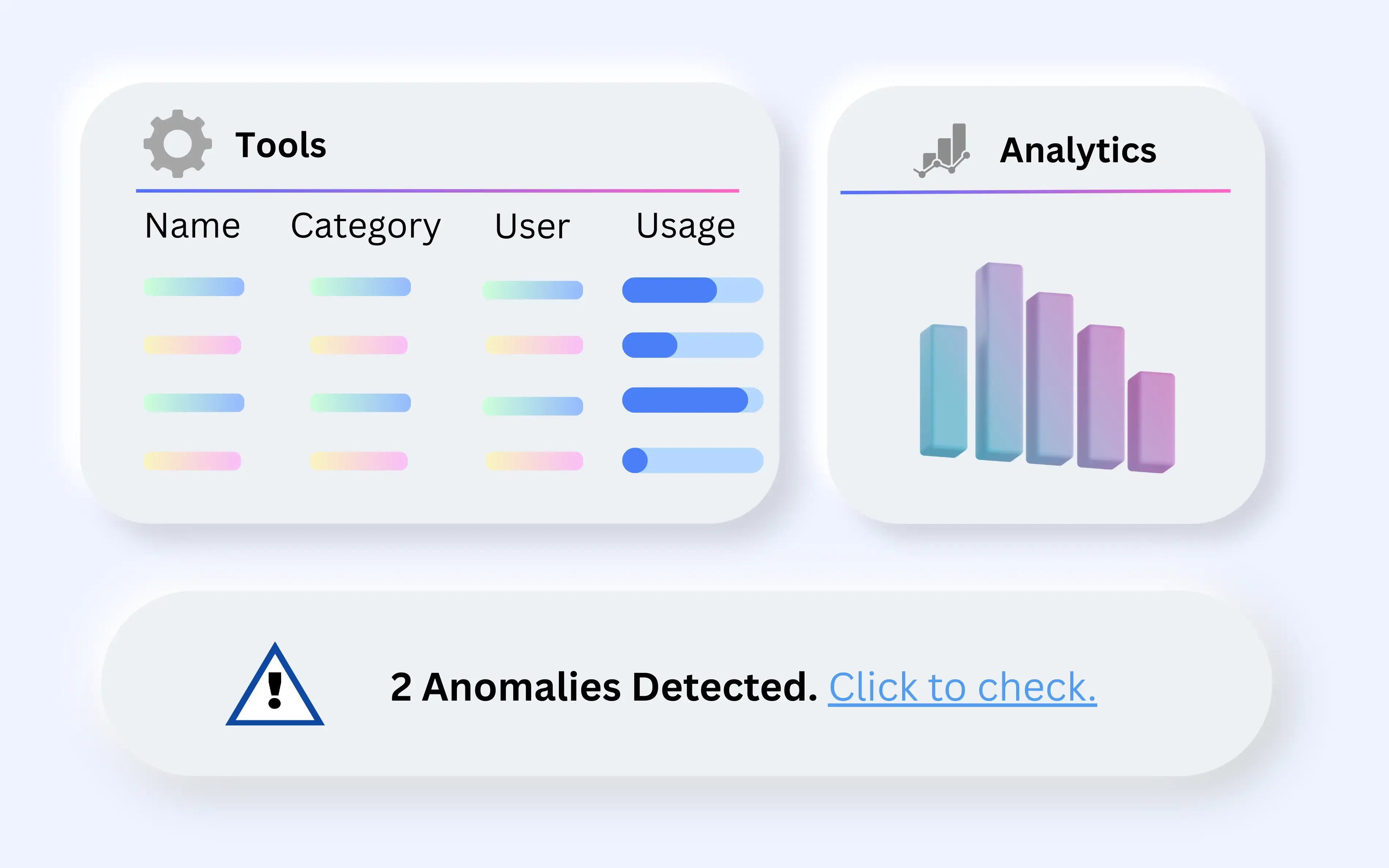
Jarvis Registry illustration showing usage by tool, user and category.
Decide what every cost should belong to
Choose useful dimensions: user, team, model, application and environment. An agent or workflow identifier helps when one request triggers several calls.
Ask how those identifiers survive the complete request path. If everyone shares one credential, the model provider may see a single caller even though several departments generated the traffic. Decide how to handle service accounts and missing identifiers so unattributed usage remains visible rather than silently assigned to the wrong team.
Use stable internal identifiers where possible. Do not add sensitive customer content to tags simply to make a cost report easier to read.
Separate billed totals from request-level estimates
Billing reports and application traces answer different questions. Billing reconciles spending with the provider. Traces help explain a specific run, including its model calls, token counts, retries and failures.
Amazon Bedrock already provides native usage and cost attribution. Options depend on identity, API and desired granularity. For supported workloads, application inference profiles associate model usage with cost-allocation tags.
An additional gateway or observability platform should solve a demonstrated gap, not be justified by saying the cloud provider has no attribution. For example, a shared gateway may need to preserve end-user identity or request metadata, while the finance team still uses provider billing records for reconciliation.
Label estimates clearly. Token counts need the relevant model rates and billing rules before they become a cost estimate. Compare those estimates with billed totals and investigate differences rather than presenting both as interchangeable.
Distinguish alerts, quotas and hard limits
A budget alert tells an owner that a threshold has been reached or is approaching. It does not necessarily stop another request. AWS notes that Budgets data and notifications can be delayed, so billing alerts should not be described as real-time spending caps.
A rate limit constrains activity over time. A spending limit needs a policy that decides whether another operation may proceed. Ask where that decision happens and what it does when usage data is late or incomplete.
For any proposed hard limit, test the boundary: multiple simultaneous requests, a long-running agent, retries and a budget reset. Confirm whether the system rejects new work, pauses a workflow or only sends a notification. Treat these as requirements to verify, not capabilities every product automatically provides.
For a healthcare example, allocate model usage to the verification job and then reconcile it with non-model costs. The insurance verification ROI calculation includes routine staff review, exception labor, and recurring technology charges. The payer-call evaluation guide adds attempts, hold time, retries, and vendor review to the commercial questions. Token spend is one component of that total, not the cost of an accepted verification.
Ask for a useful platform demonstration
Bring one representative workflow and ask the vendor to show:
- Its usage assigned to the correct user, team and application.
- A trace explaining multiple model calls and retries.
- A distinction between measured tokens, estimated cost and billed cost.
- A threshold notification reaching the responsible owner.
- The actual behavior of any claimed enforcement control.
Also compare quality, latency and cost per successfully completed task. Lower spending can reflect improved efficiency, but it can also reflect failed requests or reduced usage. The business outcome supplies the missing context.
Where Jarvis fits
Jarvis Governed AI describes traced calls, token usage, latency and errors. ASCENDING’s Claude-on-Bedrock governance offering also covers cost attribution and budget alerts. The Jarvis token-usage demonstration shows the observability context.
Use those materials to start an evaluation, then confirm the dimensions, integrations and enforcement behavior needed for your environment. For the instrumentation background, see our OpenTelemetry guide. Contact ASCENDING with the missing control you want to test.
References
- AWS: Track usage and costs in Bedrock
- AWS: Application inference profiles
- AWS: Managing costs with AWS Budgets
AI cost tracking questions buyers ask
Can Amazon Bedrock attribute costs without another platform?
Yes. Bedrock offers native attribution mechanisms. The right approach depends on your APIs, identity setup and whether you need billed totals or individual request details.
Does a budget alert stop an AI workflow?
Not by itself. An alert notifies someone. A hard limit needs an enforcement mechanism, and its behavior for active requests must be tested separately.
Why do shared API credentials make attribution harder?
The provider may see the shared caller rather than the person using the application. Preserve an appropriate user, team or application identifier through the request path.
Which cost metric should we use to compare models?
Compare cost per successfully completed task alongside quality, latency and total spend. Token price alone does not capture retries or human correction.