


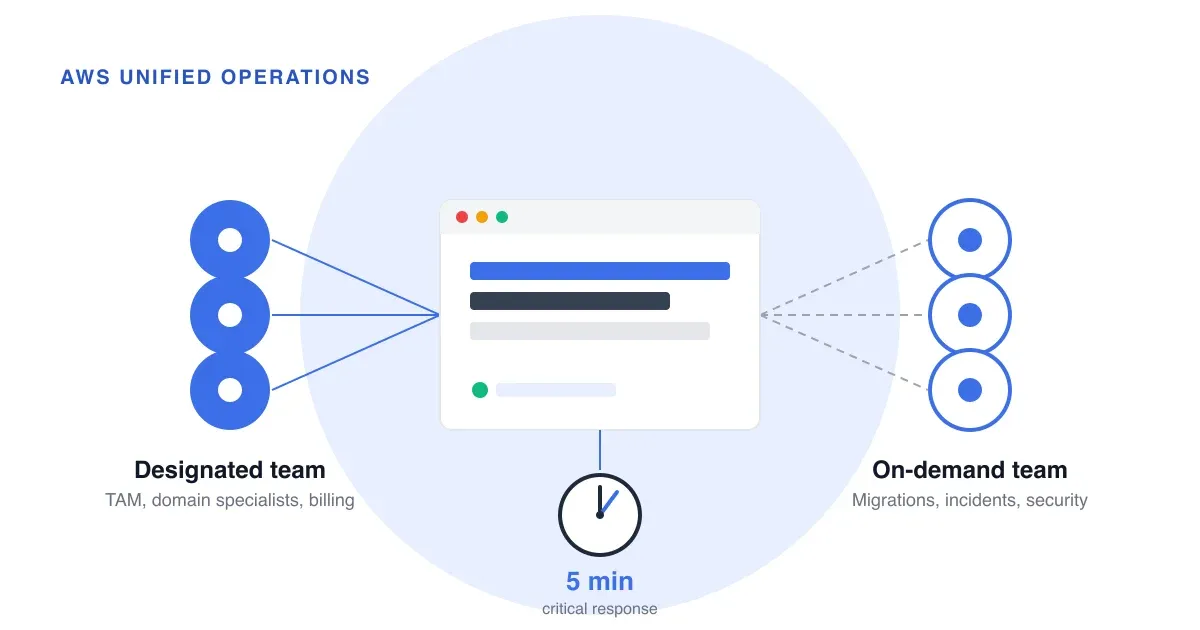
AWS Unified Operations is AWS’s top paid support plan. It is built for mission-critical workloads. It adds a designated team of specialists and a five-minute response from Incident Management Engineers. It costs the higher of $50,000 a month or a tiered share of gross AWS charges, with a 90-day minimum commitment. For most workloads, Enterprise Support is the better starting point.
Key Takeaways
- Unified Operations is a designated team plus an on-demand team. Enterprise Support has a designated Technical Account Manager.
- The five-minute response comes from Incident Management Engineers. AWS says resolution “depends on available context.”
- The fee is the higher of a $50,000 monthly minimum or a tiered share of gross AWS charges, with a 90-day minimum commitment.
- Unified Operations and Enterprise Support both satisfy a Private Pricing Agreement’s support requirement. ASCENDING does not sell Unified Operations.
Last verified against AWS pages on 2026-11-15. AWS changes support terms, so check the linked pages before you decide.
What Unified Operations is, and where it sits
AWS sells three paid support plans: Business Support+, Enterprise Support and Unified Operations. Our plan lineup post compares all three and covers the 2026 changes. This post explains only the top plan.
Unified Operations is not simply a larger Enterprise Support. Enterprise Support gives you a designated Technical Account Manager. Unified Operations differs in two ways. It changes who works on your environment day to day, and it changes who arrives during a launch or an incident.
The two teams: designated and on-demand
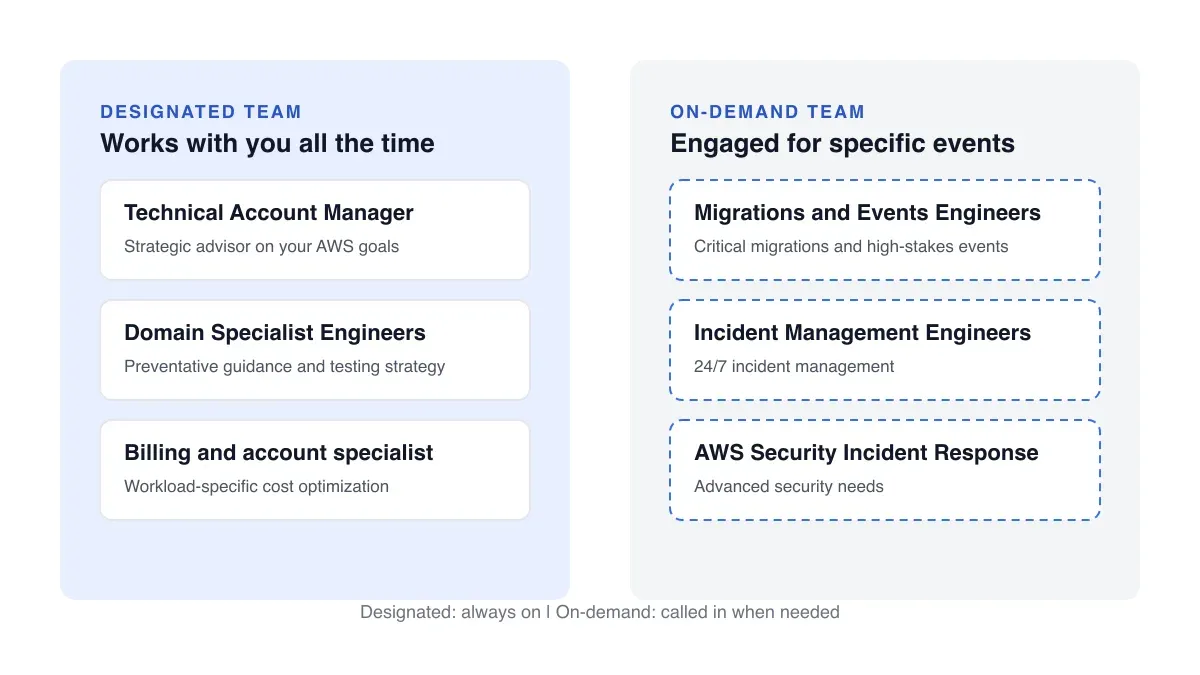
The plan has two teams. The designated team works with you continuously. The on-demand team is engaged for specific events.
The designated team
AWS describes three roles on the designated team:
- Technical Account Manager (TAM). AWS calls the TAM “your strategic advisor who aligns AWS solutions with your business objectives.”
- Domain Specialist Engineers. They work in a follow-the-sun model. Their work covers preventative guidance, testing strategy and planned-event support.
- A designated billing and account specialist. They give workload-specific cost optimization guidance.
AWS describes these roles as preventative as well as reactive. The team is meant to help before a problem starts.
The on-demand team
The on-demand team is a separate group. AWS engages it when a specific need arises:
- Migrations and Events Engineers for critical migrations and high-stakes events.
- Incident Management Engineers for 24/7 incident management.
- AWS Security Incident Response engineers. AWS describes this as a separate offering for advanced security needs.
The five-minute response, and what it depends on
AWS says its Incident Management Engineers respond within five minutes. That is a response time. It is not a promise that the problem is fixed.
AWS says resolution “depends on available context.” The context you have in place changes how fast the engineers can work:
- Onboarded workloads give the engineers more information. AWS says workloads onboarded to alarms get more context than those that are not.
- Workloads that are not onboarded start from service health data and whatever the customer provides.
AWS’s page does not publish a step-by-step incident process. Based on its description, an incident follows three steps:
- An alarm fires, or the team reports a problem.
- Incident Management Engineers respond within five minutes.
- The engineers work from service health data and your context. Onboarded workloads start with more.
The AWS page does not say whether the five-minute response is a contractual commitment. Ask your AWS account team before you rely on it in an agreement.
What it costs, and the 90-day minimum
The fee is the higher of two amounts. The first is a $50,000 monthly minimum. The second is a tiered share of your gross AWS charges: 10% of charges up to $1M, 6% of charges from $1M to $5M, and 5% above $5M.
| Monthly gross AWS charges | Tiered fee | Fee charged (higher of the two) |
|---|---|---|
| $500,000 | $50,000 | $50,000 (the minimum) |
| $1,000,000 | $100,000 | $100,000 |
| $3,000,000 | $220,000 | $220,000 |
The table shows where the minimum stops mattering. Up to $500,000 a month, the $50,000 minimum sets the fee. Above that, the tiered share is larger, so the fee grows with your spend.
Three rules from AWS’s pricing page apply to every row:
- Fees are calculated on gross AWS charges before any discounts or credits. A partner discount does not lower the base.
- The plan requires a minimum commitment of 90 days.
- The fee is set by AWS’s published formula. Check the current pricing page on the day you buy.
For comparison, Enterprise Support has a $5,000 monthly minimum. See how much AWS Enterprise Support costs at the same spend levels.
Who it fits, and when Enterprise Support is enough
Unified Operations fits workloads where an outage is very costly. It also fits teams that need specialists who know that one application in detail. The decision below is our judgment, not an AWS rule.
| Your situation | Lean toward |
|---|---|
| Mission-critical workload with a hard launch date or strict recovery targets | Unified Operations, to evaluate |
| Several production accounts, a regulated workload, or you want a named TAM and proactive reviews | Enterprise Support |
| Small spend, or no need for a designated team | Business Support+ or Enterprise Support (plan lineup) |
| You hold a Private Pricing Agreement (PPA) | Either plan satisfies the requirement, so choose on the rows above |
If you hold a PPA, Enterprise Support is part of the agreement. Unified Operations also satisfies the requirement. For the PPA requirement itself, see the PPA support requirement explained. AWS does not publish PPA terms, so confirm the exact contract clause with your AWS account team. ASCENDING delivers Enterprise Support through an authorized partner, and that route also satisfies the requirement. See AWS Partner-Led Enterprise Support.
Questions for your AWS account team
Before you commit, put these questions to your AWS account team:
- Which plan does my agreement name, and does it count Unified Operations toward the requirement?
- Is the five-minute response part of the contract? If it is missed, what is the remedy?
- How is the 90-day minimum billed if we need to end the plan early?
- Which of our workloads would the on-demand team support, and how do we onboard them to alarms?
References
- AWS Unified Operations, AWS, opened 2026-11-15.
- AWS Support pricing, AWS, opened 2026-11-15.
- AWS Support plans, AWS.
FAQ — AWS Unified Operations Questions
What is AWS Unified Operations and who needs it?
It is AWS's top paid support plan, built for mission-critical workloads. It adds a designated team of specialists and a five-minute incident response to what Enterprise Support provides. It fits workloads where downtime is very expensive. See the AWS Unified Operations page.
How much does AWS Unified Operations cost?
The fee is the higher of $50,000 a month or a tiered percentage of gross AWS charges, with a 90-day minimum commitment. For the Enterprise Support fee at the same spend levels, see how much AWS Enterprise Support costs.
Is AWS Unified Operations the same as Enterprise Support?
No. Enterprise Support adds a designated Technical Account Manager. Unified Operations adds a designated team of domain specialists, an on-demand team for migrations and incidents, and a five-minute response from Incident Management Engineers. For the full plan lineup, see AWS support plans in 2026.
Does Unified Operations satisfy a PPA's support requirement?
Yes, and so does Enterprise Support. Confirm the exact clause in your agreement with your AWS account team, because AWS does not publish the terms of a Private Pricing Agreement (PPA).