


An AWS Managed Service Provider (MSP) is a partner that helps you manage the applications and workloads you run on AWS: operations, monitoring, security, cost and support. A validated AWS MSP has also passed a third-party audit of its technical skills and business health. That validation is a separate credential from partner tier and from authorization to deliver Partner-Led Support.
If you are shopping for an AWS managed service provider, “we’re an AWS MSP” is a common claim. This guide explains what it means, what AWS checks, and how to test the claim yourself. ASCENDING is a validated AWS MSP and sells managed services on AWS. Weigh that interest as you read, and hold every provider, us included, to the questions at the end.
Key Takeaways
- An AWS MSP operates your AWS environment across its lifecycle. It is more than a support plan. It is also unrelated to AWS Managed Services (AMS), a service AWS runs itself.
- “Validated” means a third party audited the partner’s technical skills and business health. AWS says validated partners must keep passing annual audits.
- MSP validation, partner tier and authorization for Partner-Led Support are three separate credentials.
- Before you sign, check the credential, the access model, the SLA in writing and the exit terms.
Last verified against AWS pages on 2026-11-01. AWS changes its partner programs, so check the linked pages before you decide.
What is an AWS MSP?
An AWS MSP is a partner that operates your AWS environment across its lifecycle, from the first design through day-to-day running. The AWS MSP program page says the program “validates and recognizes AWS Partners who excel at delivering comprehensive solutions across the entire cloud journey—from planning and migration to ongoing operations and optimization.”
Two layers share the name, and the difference matters:
- A managed service provider in general is any company that manages cloud infrastructure for you under a contract. Nothing certifies it.
- A validated AWS MSP is a partner that has been through AWS’s MSP Program. AWS says “to become a validated AWS MSP Partner, you must complete a rigorous third-party audit that assesses your technical skills and business health per enterprise standards.”
An MSP is not a consultancy that finishes a project and leaves, and it is not an AWS support plan. It keeps running your environment after the project ends. Partners who want to join the program will find the application steps on AWS’s page. This guide is written for the buyer.
What does an AWS managed service provider do?
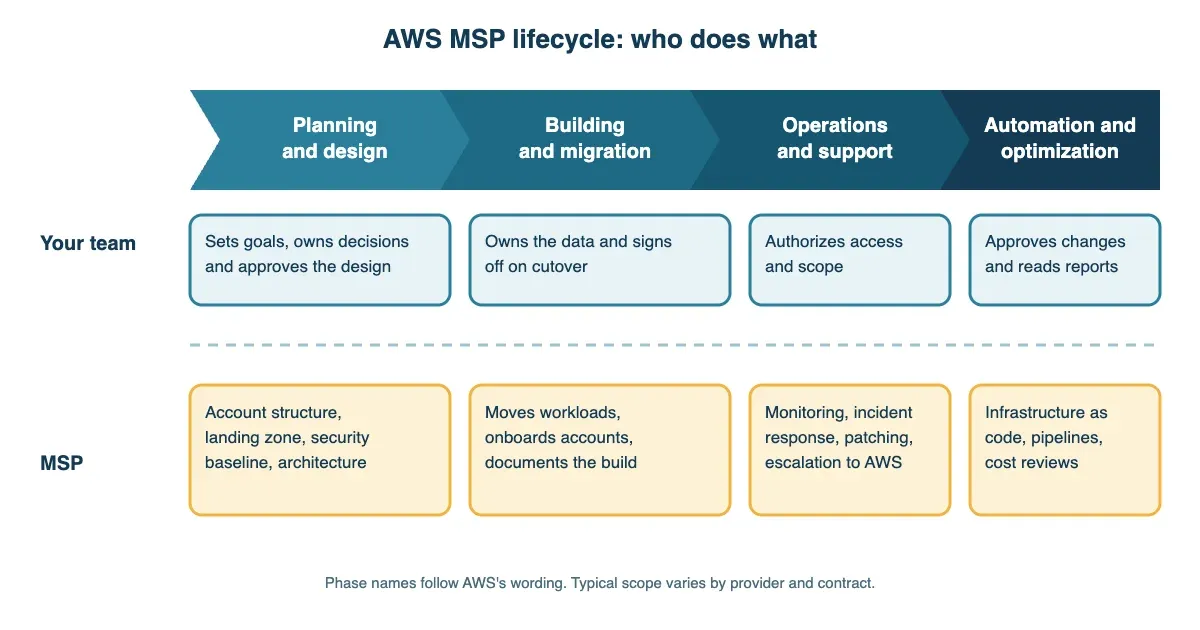
An MSP takes responsibility for running AWS, from onboarding through daily operations. Scope varies by provider and contract, so read the table as typical scope, not a program requirement. AWS’s partner announcement says the program validates partners with end-to-end experience, including “planning and design, building and migration, operations and support, and automation and optimization” (AWS Partner Network Blog, 2026-07-06). The table follows those four phases.
| Phase (AWS’s wording) | Typical MSP work | What you get | Who owns it afterwards |
|---|---|---|---|
| Planning and design | Account structure, landing zone, architecture and security baseline | A documented design you can review | You own the decisions; the MSP keeps the design current |
| Building and migration | Moving workloads, onboarding accounts. See AWS migration and modernization | Workloads running on AWS | The MSP operates them; you own the data |
| Operations and support | Monitoring, incident response, patching, escalation to AWS | A team that answers first and keeps the environment healthy | The MSP, under the SLA you agree |
| Automation and optimization | Infrastructure as code, delivery pipelines and cost reviews. See DevOps and GitOps | Repeatable changes and a cost trend you can read | Shared: the MSP proposes, you approve |
Two areas cut across all four phases: container platforms and security and compliance. Ask any provider which of these it does itself and which it subcontracts.
What does “validated by AWS” mean, and what does it not?
Validated means a third party has audited the partner’s technical skills and business health against enterprise standards. AWS adds that partners “must maintain this status through annual audits” (AWS Partner Network Blog, 2026-07-06). The program page points applicants to a checklist and calibration guides but does not publish the full criteria, so you cannot read the audit yourself.
Just as useful is what validation does not tell you. Three claims are easy to mistake for one another:
| Claim | What it shows | Who checks it | Where to verify | What it does not show |
|---|---|---|---|---|
| Validated AWS MSP | The partner passed AWS’s third-party audit of skills and business health | AWS and its auditor | The validated-partner list on the AWS MSP page; AWS Partner Network Blog announcements | Partner tier, or authorization to sell AWS support |
| Premier Tier Services Partner | The top of AWS’s Select, Advanced and Premier tiers, whose partners AWS says have “deep technical expertise with multiple partner program validations” | AWS | AWS Partner Solutions Finder | That the partner runs operations for customers |
| Authorized for Partner-Led Support | The partner can deliver AWS Partner-Led Support, which AWS has said requires an Advanced or Premier tier (confirm current terms) | AWS enrollment | The partner’s offer, in writing | That it operates your whole environment |
AWS lists the three tiers (Select, Advanced and Premier) on its Services Tiers page. The PPA support guide covers the Premier requirements and the sources for the Partner-Led Support rules, so they are not repeated here. ASCENDING is a validated AWS MSP, named in the same AWS Partner Network Blog announcement.
How is an MSP different from AWS Support or a consultancy?
AWS Support answers cases and, on the Enterprise plan, gives you a designated Technical Account Manager (TAM). An MSP operates your environment. A consultancy delivers a project and leaves. AWS says the TAM “provides strategic guidance and deep AWS knowledge” (AWS Enterprise Support). Neither AWS Support nor a TAM runs your workloads for you.
| AWS Support | MSP | Consultancy | |
|---|---|---|---|
| Accountable after go-live | You | The MSP, under the contract | You |
| Scope | Cases, plus guidance on the Enterprise plan | Operations across the lifecycle | A defined project |
| Typical pricing | Fees set by AWS (the Enterprise plan has a monthly minimum) | Percent of spend, fixed fee, per-resource or hybrid | Fixed fee or time and materials |
| Makes changes in your accounts | No: you make them | Yes, with the scope you authorize | During the project |
| Who answers an AWS case | AWS Support | Depends on the support route you buy | You |
Apart from the TAM description, the rows above are ASCENDING’s reading of how these models usually work, not AWS definitions. Confirm them in each contract. The PPA support guide shows how AWS sets its support fee.
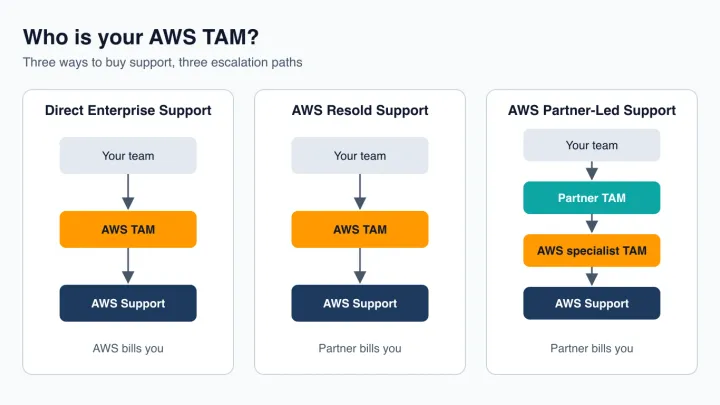
An MSP can sit on top of AWS Support or alongside it. Some MSPs also sell AWS support, which is a separate choice from the operations contract. With AWS Partner-Led Support, the partner is your first line. With AWS Resold Support, the partner bills you and you keep AWS’s own team. To see the routes side by side, compare AWS support plans and buying routes. For the TAM question, see what an AWS TAM does.
Is an AWS MSP the same as AWS Managed Services?
No, they are unrelated. AWS Managed Services (AMS) is a service that AWS itself provides, as described on the AWS Managed Services page. An AWS MSP is a separate partner company that helps you manage the applications and workloads you run on AWS, under its own contract with you. The names are similar, which is why search results for “AWS MSP” show both. Check which one a vendor is talking about before you compare offers.
Do you need an AWS MSP?
Not always. A lean in-house team running a steady workload may need nothing beyond AWS Support. An MSP earns its fee when you lack the people, the hours or the specialist skills to run AWS well yourself. The table below is ASCENDING’s reading, not an AWS recommendation.
| Your situation | Lean toward | Why |
|---|---|---|
| Small team mid-migration | An MSP for the migration and the first year of operations | Skills you do not yet have in-house |
| Steady workload, capable ops team | AWS Support alone, or a Business Support+ plan delivered by a partner if you want a first line without handing over operations | You already operate it; you may only need escalation |
| Regulated environment | An MSP that can show the controls you need | Ask for the controls and the audit trail in writing |
| PPA holder | An MSP that is also authorized for Partner-Led or Resold Support at the Enterprise level | The support requirement and the operations contract can be met by the same partner |
| Cost reduction is the main goal | A cost review first, then decide | An MSP is not the only way to cut spend |
Handing over operations has costs too. Ask how the provider handles lock-in, how much control you keep over changes, and whether quality depends on which engineer you get. The checklist below covers these questions.
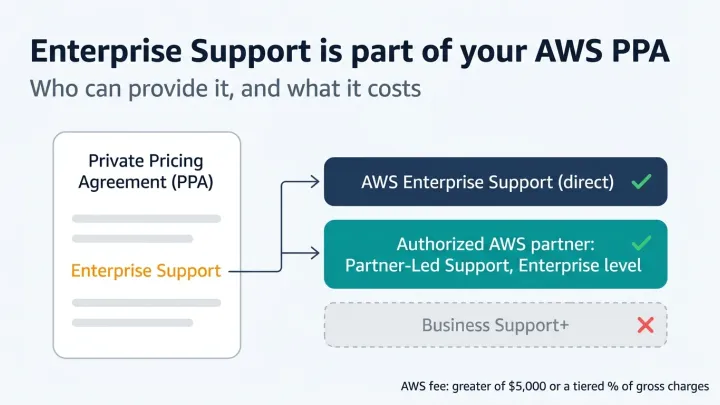
If you hold a cross-service Private Pricing Agreement (PPA), formerly the Enterprise Discount Program (EDP), the support requirement matters. In ASCENDING’s reading, Enterprise Support is part of a cross-service PPA. AWS does not publish PPA terms, so confirm the clause with your AWS account team. An MSP meets the requirement only if it is also authorized for Partner-Led or Resold Support at the Enterprise level. ASCENDING sells AWS Partner-Led Enterprise Support for that case. The PPA support guide explains how to check any partner.
How do AWS MSPs charge?
AWS does not publish MSP pricing, so each provider sets its own model. Fees may follow your AWS spend, a fixed monthly amount, the number of resources managed, or a mix. What matters more than the model is what you can confirm in writing:
- The price basis. Ask what the fee is calculated on and what is billed separately.
- The scope. List what is in and out, so extra work does not become a dispute.
- How the fee moves. Ask what happens to the fee if your AWS spend doubles or halves.
This guide gives no ASCENDING price. Compare quotes on the same workload and the same service hours.
How do you choose an AWS MSP? Seven questions
This checklist is ASCENDING’s own. Ask every provider the same seven questions, including us:
- Is the partner a validated AWS MSP, and can I find it in AWS’s validated-partner list?
- Which partner tier does it hold (see AWS’s Services Tiers page), and which AWS Competencies?
- Who has root and billing access, and how is my authorization scoped?
- Who opens and owns cases with AWS?
- What are the SLAs, and are they in writing?
- What are the minimum term, the notice period and the exit terms?
- Can the partner show references for a workload like mine?
These are questions to put to the provider, not claims about the market. A good answer is specific, in writing and verifiable.
ASCENDING is a validated AWS MSP and sells AWS Partner-Led Support and AWS Resold Support. To see how the work is organized, read about ASCENDING’s AWS MSP services.
References
- AWS Managed Services Provider (MSP) Program, AWS, retrieved 2026-11-01.
- Say Hello to 184 New AWS Competency, Service Delivery, and MSP Partners Added in June, AWS Partner Network Blog, 2026-07-06, retrieved 2026-11-01.
- AWS Partner Services Tiers, AWS, retrieved 2026-11-01.
- AWS Enterprise Support, AWS, retrieved 2026-11-01.
- AWS Managed Services, AWS, retrieved 2026-11-01.
- AWS Partner Solutions Finder, AWS, retrieved 2026-11-01.
- Enterprise Support Is Part of Your AWS PPA, ASCENDING, for the Partner-Led Support tier rule and Premier requirements.
- AWS MSP, ASCENDING, retrieved 2026-11-01.
- AWS Partner-Led Enterprise Support, ASCENDING, retrieved 2026-11-01.
- Compare AWS Support Plans, ASCENDING, retrieved 2026-11-01.
FAQ: AWS MSP Questions Buyers Ask
What does an AWS managed service provider do?
An AWS managed service provider (MSP) takes day-to-day responsibility for running your AWS environment. Typical work covers onboarding and migration, monitoring and incident response, security and governance, cost optimization and escalation to AWS when a case needs it. See what an MSP does, phase by phase.
Is an AWS MSP the same as an AWS Premier Partner?
No. The MSP program is a validation: a third-party audit of a partner's technical skills and business health. Premier is a Services Path tier, and Partner-Led Support is a separate support offer that needs its own enrollment. A partner can hold one without the others. The PPA support guide lists the Premier requirements and how to check each credential.
Does an AWS MSP meet my PPA's Enterprise Support requirement?
Only if it is also authorized to deliver AWS Partner-Led Support or AWS Resold Support at the Enterprise level. MSP validation alone does not meet the requirement. AWS does not publish PPA terms, so confirm the clause with your AWS account team and get the partner's confirmation in writing. See who can provide Enterprise Support under a PPA.
How do I check that a partner is a validated AWS MSP?
Search the validated-partner list that AWS links from its MSP program page, and check the AWS Partner Network Blog, where AWS names newly validated MSPs. Then ask the partner when it was validated, because AWS says validated partners must maintain the status through annual audits.
Is an AWS MSP the same as AWS Managed Services (AMS)?
No, they are unrelated. AWS Managed Services (AMS) is a service that AWS itself provides, described on the AWS Managed Services page. An AWS MSP is a separate partner company, validated through the MSP Program, that helps you manage the applications and workloads you run on AWS under its own contract. The names are similar, so check which one a vendor means.
How is an MSP different from AWS Support?
AWS Support answers cases and, on the Enterprise plan, gives you a designated Technical Account Manager for guidance. An MSP operates your environment and is accountable for it day to day. Some MSPs also sell AWS support, which is a separate decision. See Resold Support vs Partner-Led Support.