


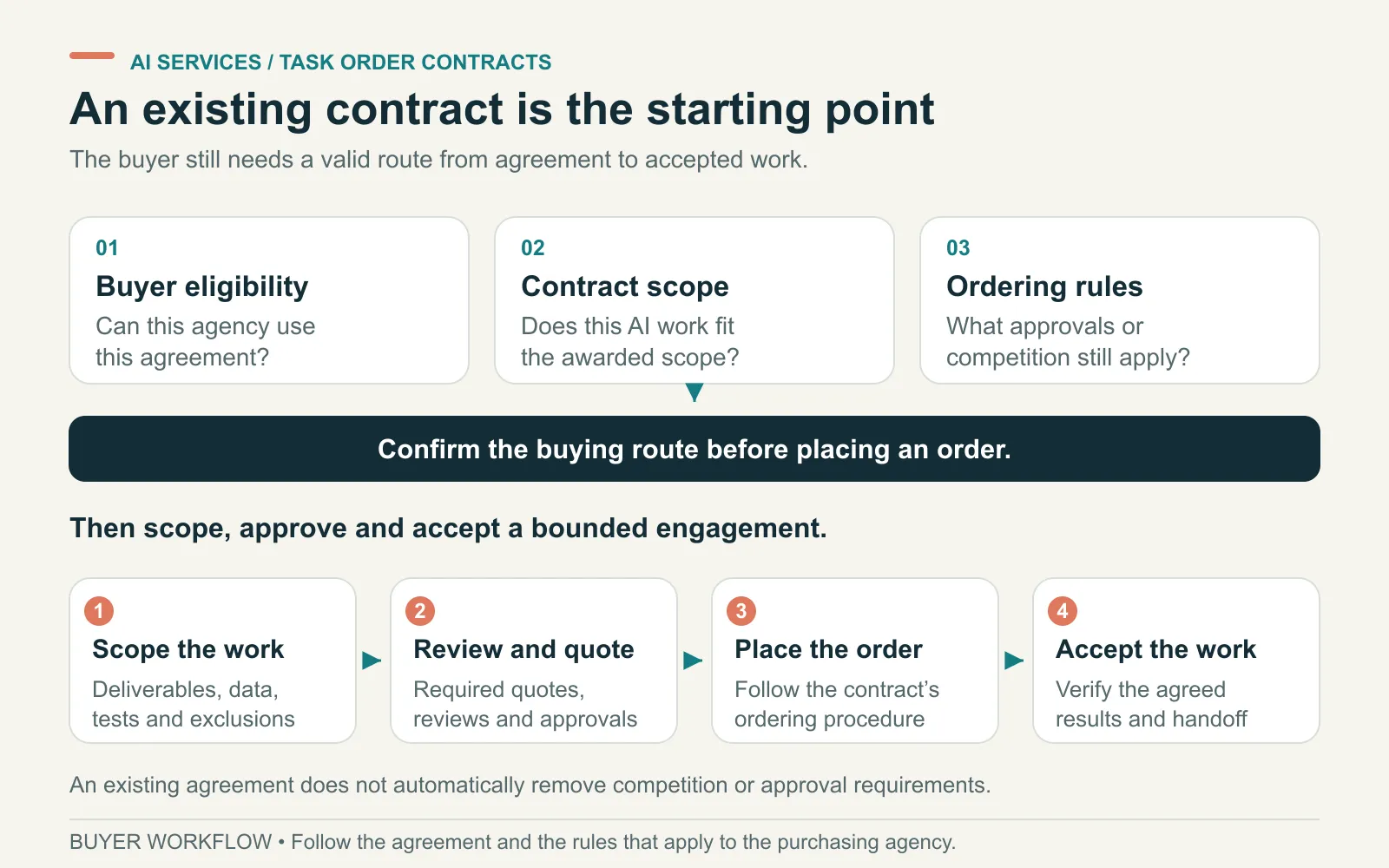
A task order contract can be a way to buy AI services. First, check that your agency can use it and that it covers the work. Each order still needs approval. It should say what the supplier will deliver, what it costs and how staff will check the work.
Ask more than whether a vendor has a contract. Ask which part covers your project, who may buy and what steps your agency must follow.
Key Takeaways
- Check who may buy, which work is covered and what rules apply before drafting the order.
- Buy a defined piece of work with clear outputs, rather than an open-ended promise to add AI.
- Agree how staff will sign off on the work and get their data back before the project starts.
Contract and reference pages reviewed November 11, 2026. The sample project below is an example. Your purchasing and legal teams must review it before use.
What is a task order contract?
In federal procurement, FAR 16.501-1 describes a services contract that provides for task orders during its term. It doesn’t fix a total service quantity at award, beyond any minimum or maximum. The definition distinguishes services from supply delivery orders.
That federal definition doesn’t give a city or county permission to use a contract. State and local buyers must check their own buying powers and the contract’s order rules.
A contract vehicle is the contract or program you plan to buy through. Don’t assume a cooperative purchasing program follows the same rules as a federal contract for orders over time.
Read the order rules for the contract you choose. They may call for a statement of work (SOW), which sets out the tasks and required outputs. They may also require a request for quotation (RFQ), which asks suppliers to quote for the work.
| Question | Existing contract or purchasing vehicle | Proposed order |
|---|---|---|
| Who may buy? | Establishes eligible buyers and conditions | Identifies the authorized agency and signatory |
| What may be purchased? | Defines covered categories, services and suppliers | States the particular workflow and deliverables |
| How is the supplier selected? | Sets the applicable ordering provisions | Documents the required process and selection |
| What will the agency accept? | Supplies relevant terms and constraints | Specifies tests, evidence, approver and remedies |
The order must fit the contract’s scope. If the work doesn’t fit, ask your purchasing team how to proceed before a supplier starts.
Confirm the purchasing route before requesting a proposal
Ask the purchasing lead to check five things. Can your agency buy? Is the supplier listed? Is the work covered? Is the contract current? What steps must staff follow?
GSA’s Cooperative Purchasing program is one example. It lets eligible state and local buyers purchase listed IT, law-enforcement and security products and services. Not every AI service or vendor qualifies.
GSA’s state and local program guidance also explains order terms. If grants fund the purchase, follow the local buying rules and the grant agency’s rules, including those for competition.
For a project in Ohio, ASCENDING’s Ohio DAS Contract 0A1335 Category 4 page describes an AI-services contract to explore. That page doesn’t prove your agency or project qualifies. Check the current contract with its manager and your purchasing office.
That is our supplier page, not the state’s award record. Keep the official contract documents in your purchasing file.
Keep their written decision in the purchasing file. Include the contract number, service category, dates and rules the order must meet.
An existing contract gives you terms and supplier details to review. Its scope also sets limits. The easiest contract to find may not cover the work you need.
Write the statement of work around one agency task
Choose one task with a clear start, finish and department owner. “Deploy an AI platform” could mean very different things to each bidder.
Consider a hypothetical city pilot that checks whether permit files are complete. The assistant would compare approved documents with a checklist. Staff would review draft notices about missing items before anything reaches an applicant.
The SOW could require these outputs, often called deliverables:
| Deliverable | What the agency receives | What the agency checks |
|---|---|---|
| Workflow and data inventory | Sources, users, permitted actions and excluded data | The inventory matches the agreed department process |
| Test environment | Configured access, approved sample data and operating instructions | Unauthorized test users cannot retrieve restricted material |
| Working completeness check | Draft findings linked to source pages and checklist items | Staff can inspect and correct each proposed finding |
| Evaluation report | Cases, expected outcomes, observed results and known gaps | The report includes failures and exceptions, not selected demonstrations |
| Handoff package | Configuration, documentation, ownership and recovery steps | Agency staff can operate or disable the scoped workflow |
State what’s out of scope beside those outputs. In this example, the assistant wouldn’t decide code compliance, approve permits or send notices without staff approval.
Our municipal permit AI guide explains the permit-checking task. Use the AI readiness checklist to find missing data or access before the supplier prices the work.
Agree on acceptance tests before the demo
Acceptance tests are the checks staff use to decide whether to accept the delivered work. Agree on them before the supplier adjusts the system. A demo using familiar examples won’t show how it handles all the cases your department sees.
Ask staff who know the task to write expected results for approved sample files. Keep some cases out of the supplier’s tuning work. Use those cases to test the finished system.
These are suggested checks for the permit example. They aren’t test results or rules that apply to every purchase.
| Test | Expected behavior | Evidence for the agency reviewer |
|---|---|---|
| Complete application | No unsupported missing-item notice | Finding linked to the submitted document version |
| Missing required attachment | Identifies the omission and checklist requirement | Inspectable source and checklist references |
| Conflicting document versions | Escalates the ambiguity instead of choosing silently | Exception record and staff resolution |
| Restricted document | Denies access for the unauthorized test identity | Permission decision and independent destination check |
| Staff rejection | Does not send or apply the rejected proposal | Review record connected to the protected action |
| Interrupted integration | Reports an unresolved state without blindly repeating an update | Request history and destination reconciliation |
| Model or source change | Runs the agreed regression cases before broader use | Changed-version record and repeat evaluation |
Agree which cases to test and what counts as a pass. Name who may approve an exception and which failures prevent sign-off.
The NIST Generative AI Profile offers guidance on AI risks, tests and outside suppliers. It doesn’t set one accuracy target for all projects or approve a supplier.
Put data, costs and ownership in the order
An AI system can give good answers and still leave the agency with a confusing bill. Staff might also find they can’t export their work when the contract ends.
Write down which data the system may use, where it’s processed, who can see it and how long it’s kept. Check whether the supplier or model provider may use agency data for training. Name other firms that process the data and any terms that differ by model.
The AI vendor risk assessment gives your security and purchasing teams a fuller checklist. Close serious gaps before the pilot uses real agency records.
Separate project fees from ongoing model use and support. Ask who pays for model calls, storage and software needed to connect systems. Set a process to request and approve extra work.
A fixed project fee doesn’t cap model charges unless the terms say so. An hourly rate doesn’t tell you what finished work you’ll receive. Ask what the estimate assumes and who can approve changes.
List what staff get when the supplier hands over the system. Include settings, agreed source-code access, test cases, instructions and account access under agency control. State which parts the agency owns and which it licenses from others.
Plan how to leave. Require exports staff can use, agreed data-deletion steps and enough instructions for the next approved team to run the system.
Name the people who can approve changes
Name the project owner, purchasing contact, technical lead and person who will accept the finished work. Agency policy may let one person fill several roles. Write down what each role must do.
Adding a data source can change who needs access and which records rules apply. A new model can bring different terms or results. Connecting another system can let a drafting assistant change business records.
Decide which changes need written approval, new tests or a check that the contract still covers the work. The supplier shouldn’t expand the project just because a feature is easy to turn on.
Use the human-approval checklist to test who may approve each action and what their approval covers. The government AI audit-trail guide explains which records staff need to follow a case from start to finish.
When staff accept the work, keep the test results, known limits, approved settings and unfinished duties together. Record any later decision to expand the project.
Ask five questions before the order is signed
- Which contract provision covers this work? Ask procurement to confirm the category, supplier and required order process.
- What exactly will the agency receive? Match the proposal, statement of work and pricing line by line.
- What evidence triggers acceptance? Name the tests, reviewer, pass criteria and treatment of defects.
- Which costs continue after the pilot? Identify usage charges, support responsibilities and the approval route for additional spend.
- What can we take with us? Confirm exports, documentation, access transfer and the agreed deletion evidence.
ASCENDING Inc builds and maintains Jarvis, an open source AI project. We also help teams put AI systems into use. Our Jarvis AI overview can inform that discussion. Your contract’s scope and agency approvals still govern the work.
To discuss an AI services scope with ASCENDING, bring one task, the proposed contract, your data rules and the tests staff will use. Both sides then have a clear basis for the price and review.
References
- Acquisition.gov: FAR 16.501-1 definitions
- GSA: Learn about Cooperative Purchasing
- GSA: State and local program terms and ordering procedures
- NIST: Generative AI Profile, AI 600-1
Questions about buying AI services under a contract
What is a task order contract?
In federal procurement, FAR 16.501-1 describes a services contract that provides for task orders during its term without fixing the total service quantity at award. State and local buyers must check their own authority, contract terms and ordering process. The federal definition does not establish their eligibility.
Can a city buy AI services through an existing cooperative contract?
Possibly, if the buyer is eligible, the services and supplier are covered, and the required ordering process is followed. Ask your procurement office to confirm those points, including funding conditions, before requesting an order.
Does using an existing contract mean we can skip an RFP?
An existing contract does not automatically remove competition or approval requirements. The applicable vehicle, agency rules and funding source determine the process. Document the procurement office's decision rather than relying on a vendor's assurance.
What should an AI services statement of work include?
Define the workflow, approved data, integrations, deliverables, responsibilities, acceptance tests, charges, change control and exit requirements. State which actions the AI may perform and which decisions remain with agency staff. Tie acceptance to evidence the agency can inspect.