

Jarvis AgentFlow and Registry provide visual workflow orchestration, agent delegation, approval gates and governed tool access. AgentFlow supplies the workflow canvas; Registry controls access to registered resources. Teams can evaluate these supplied components alongside ASCENDING’s scoped customer-cloud deployment and integration support when deciding whether to build their own AI agent infrastructure.
The choice is between maintaining your own orchestration and governance components and adopting a platform while scoping the business integrations around it. Compare both against one process, such as reviewing purchase exceptions while retaining human approval.
What does Jarvis AgentFlow provide?
AgentFlow connects Model Context Protocol (MCP) tool calls and Agent-to-Agent (A2A) delegation with routing and human approval. MCP provides a standard interface for tools; A2A supports communication between agents. Node-level execution traces help engineers inspect the steps in a run.
The responsibilities remain distinct:
- AgentFlow coordinates the process: inputs, steps, routing and approval.
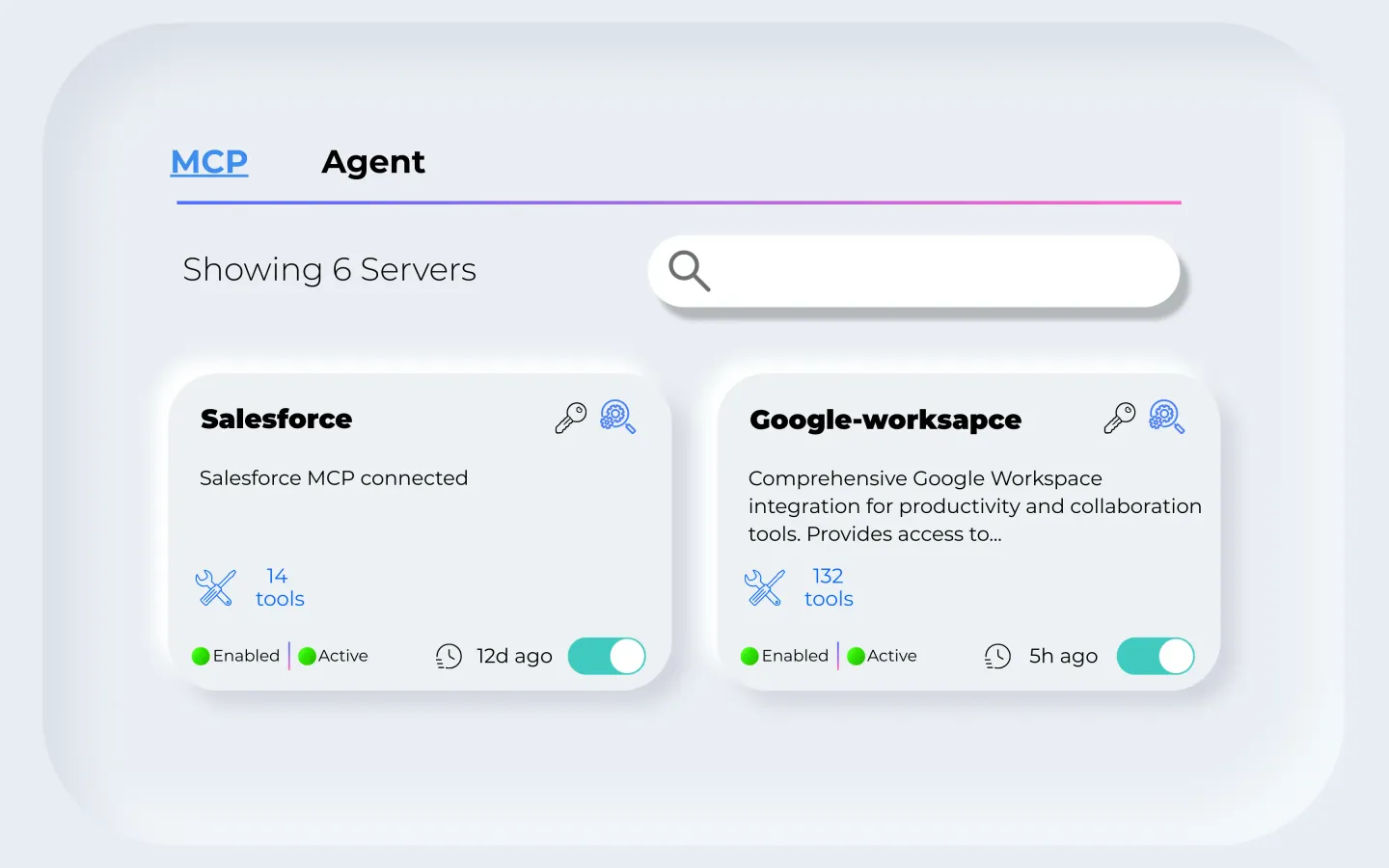
- Registry governs registered resources: which callers may access the tools and agents.
- Business systems govern their records: the operations and data available to the connector identity.
Registry’s authorization design separates endpoint scopes from resource access-control lists. Business-system permissions separately determine which purchasing records an integration may read or change.
When does buying a workflow platform make sense?
Shortlist Jarvis when a defined process needs several agents or tools, human decisions and a shared governance layer. Its reusable components give the team a supplied workflow and access-control foundation; business-specific APIs, data and approval rules remain implementation work.
Build internally when your team already operates suitable components or has requirements the platform does not meet. Neither option is automatically cheaper or faster. Compare the integration effort and ongoing maintenance for the same workload, not a working prototype against a production service.
The commercial question is which components you want to own and maintain, and which you want supplied with agreed delivery support.
Which capabilities are supplied, and what still needs implementation?
The workflow orchestration documentation describes agent and tool steps, parallel execution, branching, approvals and retries. Map that functionality to your process before agreeing responsibilities.
| Requirement | Internal-build work | Supplied Jarvis capability | Implementation scope |
|---|---|---|---|
| Workflow orchestration | Build routing and execution | AgentFlow visual canvas, branches and parallel logic | Define steps, inputs and exception paths |
| Tool access | Build tool routing and authorization | Registry MCP gateway, scopes and resource access controls | Connect business APIs and set record permissions |
| Agent coordination | Build delegation and result handling | A2A agent steps | Select agents and define task inputs and outputs |
| Human approval | Build pause and resume behavior | AgentFlow sign-off gate | Set reviewer, decision scope and timeout |
| Monitoring and recovery | Instrument execution and failures | Node-level traces and retry controls | Connect telemetry, test retries and assign operators |
How should integrations and hosting be evaluated?
Software functionality and delivery responsibilities are separate. Request a quote covering the chosen cloud environment, installation, integrations, support and handoff. Assign operating and maintenance duties to your team, ASCENDING or another partner.
For each business system, specify the required operation, accepted input and executing identity. Include any missing connector work in the scope. Customer hosting also needs a data-flow review: external model API requests can leave the application hosting boundary. Confirm model endpoints, storage, tool services and telemetry destinations.
Knowledge retrieval is another dependency. If a workflow needs policies or operational guidance, use the customer-hosted knowledge assistant guide to define source ownership, citations and access tests.
What should pass before production access expands?
Use the AI readiness checklist to establish the workflow, baseline, evidence owners and launch gates before comparing implementations. It keeps missing source access or untested approval behavior visible alongside the build-or-buy estimate.
Test the intended process, including failures. For a request-review workflow, the acceptance set should include:
- A permitted request that completes correctly.
- A rejected proposal that makes no system change.
- A caller without the required tool or record access.
- An unavailable tool or expired approval.
- A system update whose acknowledgement is lost.
The last case matters because retrying a write may repeat its effect. AWS’s idempotent API guidance explains how request identifiers can make retries safe. Your implementation must use the destination’s actual duplicate-detection support or reconcile whether the update already happened.
Use the human-approval checklist to define the reviewed proposal, approver and permitted action. An approval must remain connected to the action that executes.
How should the team compare results and cost?
Compare equivalent workloads, reporting periods and acceptance standards for both options. Include software, allocated implementation cost, infrastructure, model usage, integration maintenance, support and human correction. A technically successful response is not necessarily completed business work.
Cost per accepted outcome = total in-scope cost ÷ accepted outcomes.
Define what counts as accepted before calculating. Count retry expense in cost, but do not count repeated attempts as additional completions. Allocate one-time implementation expense over an agreed period and compare both options on that basis.
For arithmetic only, suppose 1,000 task starts produce 800 accepted outcomes and 200 failed or unresolved tasks. This hypothetical excludes valid policy rejections; define their treatment separately in real reporting.
| Illustrative input | Amount |
|---|---|
| Other in-scope cost for the period | $240 |
| Human correction: 20 hours × $40 | $800 |
| Total | $1,040 |
| Accepted outcomes | 800 |
| Cost per accepted outcome | $1.30 |
The calculation is $240 + (20 × $40) = $1,040; $1,040 ÷ 800 = $1.30. These are invented arithmetic inputs, not Jarvis prices or customer results. In a real comparison, itemize every agreed cost within the total.
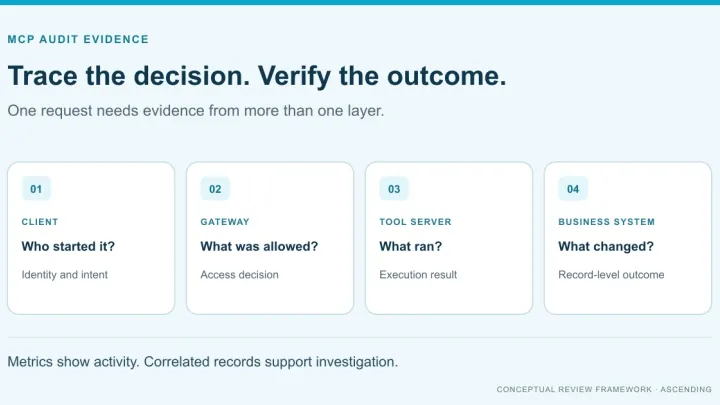
Registry observability provides execution signals. Accepted business outcomes, labor and quoted costs need separate records; this calculation is not a claim of an automatic cost-per-success dashboard. Track elapsed time and quality alongside cost. Released employee capacity is not automatically cash savings.
Bring one workflow to the demo
Request a Jarvis AgentFlow demo with one process, the systems it touches, approximate daily volume and a current time or cost baseline. Bring an ordinary request and a difficult exception. Ask to see an approval, a denied tool call and a failed-step trace, then agree what the product provides and what implementation work remains.
References
- Registry authorization and access scopes
- Jarvis workflow orchestration
- AWS: Making retries safe with idempotent APIs
- Jarvis Registry: Observability
Questions to resolve in an AgentFlow demo
What would we buy rather than build?
Jarvis supplies reusable visual orchestration, agent delegation, approval gates, execution tracing and governed resource access. Deployment, business integrations, operating responsibilities and support are scoped separately.
Can Jarvis use systems we already have?
Integration depends on available APIs, authentication and destination permissions. Confirm each required operation; a demo does not prove a native connector exists for every application.
Does customer hosting remove the need for security review?
No. Review the selected model endpoint, connector credentials, data access and telemetry destinations. External model API requests can leave the application hosting boundary.
How should we compare platform cost with building in-house?
Compare equivalent workloads and accepted outcomes. Include software, allocated implementation, model usage, infrastructure, integration maintenance, support and human correction for both options.
Can our internal engineers operate the result?
Agree the handoff scope: integration maintenance, permissions, failure recovery and workflow changes, together with the documentation and access those duties require.