

What is the difference between MCP and a REST API?
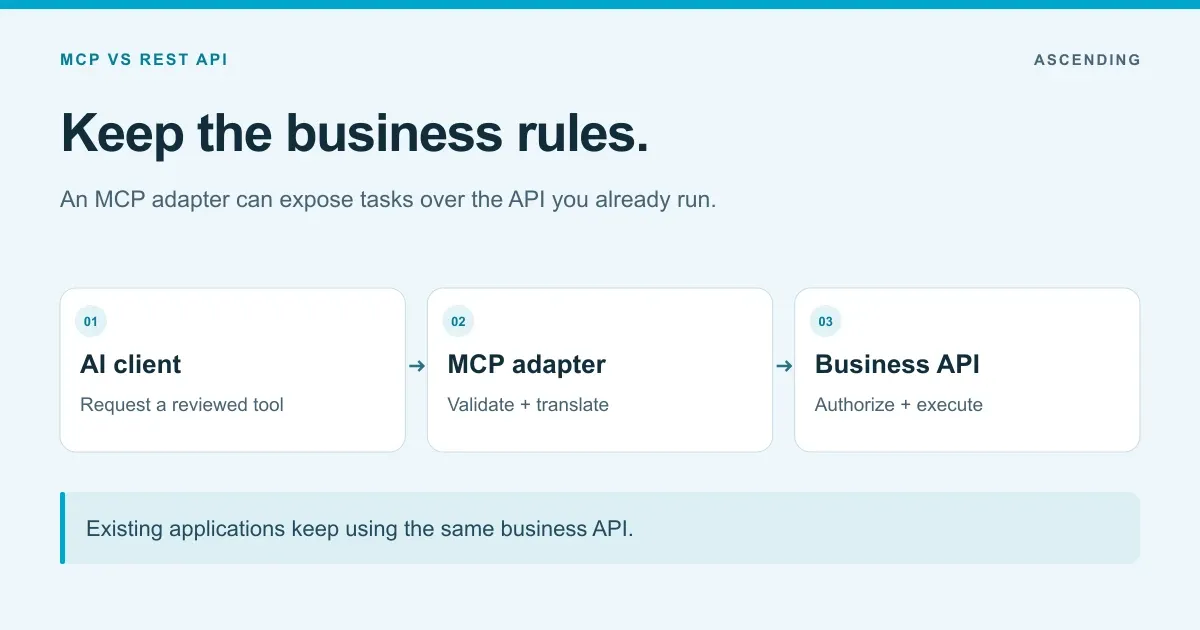
MCP gives AI applications a shared way to discover and invoke tools. A REST API exposes an application’s resources and operations over HTTP. An MCP server can translate a tool call into an existing API request, keeping business rules in the service that already owns them. Add that adapter when it solves a real client-integration problem.
Last verified: November 3, 2026.
Imagine an employee asking an assistant to find an open support ticket and update its status. The ticket service already has a REST API used by the website and reporting jobs. Replacing that API would create work for all of those consumers. A smaller change is to expose two reviewed MCP tools that call the existing service.
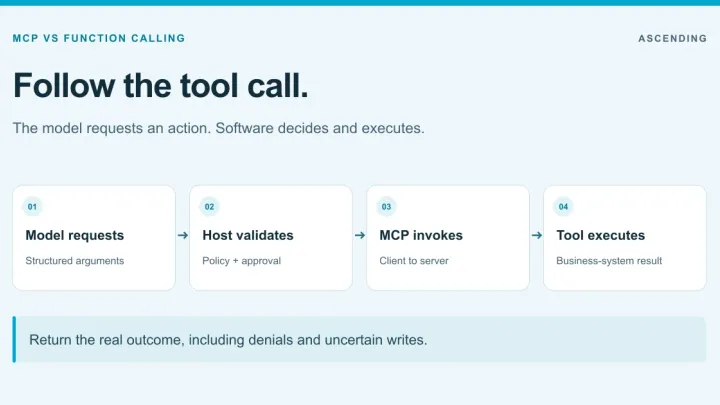
The decision is how much interface work to share across AI clients, and which operations those clients should see. The related MCP vs function calling guide covers the boundary between the model’s request and the code that executes it.
Compare the two interfaces at the right layer
REST and MCP describe different aspects of an integration. MCP can use HTTP as its transport; that does not turn its tool protocol into a resource-oriented REST interface.
| Attribute | REST API integration | MCP server or gateway integration |
|---|---|---|
| Primary contract | Application resources and operations | Tools and other context exposed to an AI host |
| Discovery | Documentation, OpenAPI or application-specific mechanisms | MCP capability and tool discovery supported by the client |
| Deployment model | An application service, often behind API management | Local server, remote service or gateway in front of servers |
| Identity and access control | API authentication plus operation and record permissions | MCP-side authentication and tool permission, plus downstream API permission |
| Audit logging | Application/API records configured by the operator | Correlation across client, MCP layer and destination API |
| Supported MCP transports | Not applicable to REST itself | Standard MCP bindings include stdio and Streamable HTTP |
| Hosting | Your service platform or provider | Your process/container platform, cluster or managed service |
The MCP architecture separates the host application, clients and servers. The transport overview describes how messages are carried. For an HTTP API, the OpenAPI specification can describe operations, inputs, responses and security schemes. Neither document chooses your business permission model.
Keep the business API as the system of record
Let the ticket service decide whether a status transition is valid and whether the caller may change that ticket. The MCP adapter should not build a second, divergent copy of those rules.
For the example workflow, the paths could look like this:
Existing website -> ticket REST API -> ticket database

AI host -> MCP client -> ticket MCP adapter
        -> ticket REST API -> ticket database
The adapter translates a reviewed tool operation into a business request. It also translates the result into a useful response for the client. The database is not exposed as a general query tool simply because the model can produce JSON.
Our MCP gateway guide places a shared policy layer in this route. A gateway may centralize access to several servers; it does not remove the API’s responsibility to validate the operation and enforce record access.
Design tools around tasks rather than every endpoint
Start with the work the assistant needs to complete. For this example, search_tickets and update_ticket_status are easier to review than a single request tool accepting any URL, method and payload.
A useful search tool describes its supported filters, result limit and returned fields. A useful status-update tool explains which status values are accepted, whether the change triggers notifications and whether a confirmation step is required. Keep unrelated administration and bulk export out of this first surface.
An OpenAPI-based generator can reduce schema transcription. It still needs a review pass. An endpoint name meaningful to a backend developer may not explain to an AI client when to use the operation. An API optional field may allow behavior the initial tool should deliberately exclude.
Review four things before accepting generated tools:
- Scope: Does the tool expose only the operations this audience needs?
- Arguments: Are identifiers, limits and allowed values constrained?
- Effects: Is it clear what the call changes and which approvals apply?
- Results: Can the client distinguish no matching records, denied access and a system failure?
Use tool-definition change review when the underlying API or generated descriptions change. Treat a newly exposed operation as a review event, even when the generator runs automatically.
Preserve user permissions across the adapter
The MCP connection and the REST API request may use different credentials. Decide whether the API receives a delegated user token or a scoped integration identity. Write down the resulting record permissions in either case.
For example, an employee can be permitted to invoke search_tickets while still lacking access to an HR queue. The adapter must preserve that restriction. A shared API administrator key would require additional enforcement; logging the employee’s name alone would not supply it.
The MCP authorization security considerations require audience validation and refer to the prohibition on token passthrough. Do not forward the client’s inbound credential to an unrelated API. Use the supported credential flow for that destination.
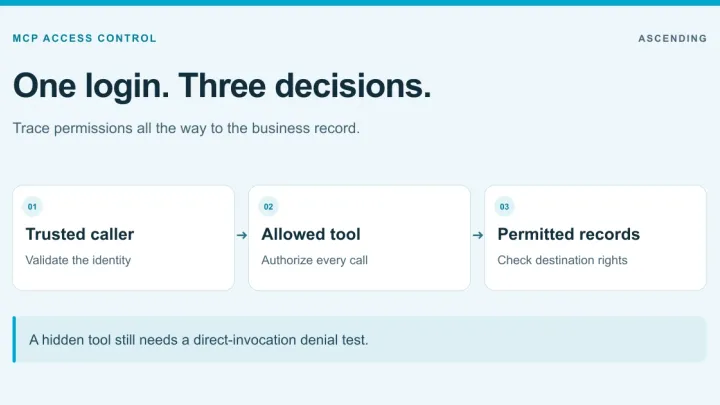
The OAuth setup guide covers the two authentication legs. The per-user tool-permission guide adds a test matrix for discovery, invocation and record access.
Decide how errors and retries should behave
An API timeout does not always mean an operation failed. The ticket service might commit an update and lose the response on the way back. Retrying that request could send a second notification or perform a duplicate write.
HTTP semantics in RFC 9110 distinguish safe and idempotent methods. An adapter still needs to understand the actual business operation rather than infer that a generic MCP request is safe to retry.
For a write, define whether the API supports an idempotency key or an operation identifier. If it does, retain the same identifier across a retry. If it does not, use a recovery path that checks the operation’s outcome before repeating it. This is an application design requirement, not an idempotency feature supplied automatically by MCP.
Also define what the assistant sees. An error response should make clear whether the action was denied, failed before execution or has an uncertain outcome requiring investigation. A generic success-shaped message containing an error string makes recovery unnecessarily fragile.
Correlate the adapter request and the destination event using the MCP audit-evidence approach. Evidence from the destination is especially useful for a timeout whose business outcome remains uncertain.
When should you keep a direct API integration?
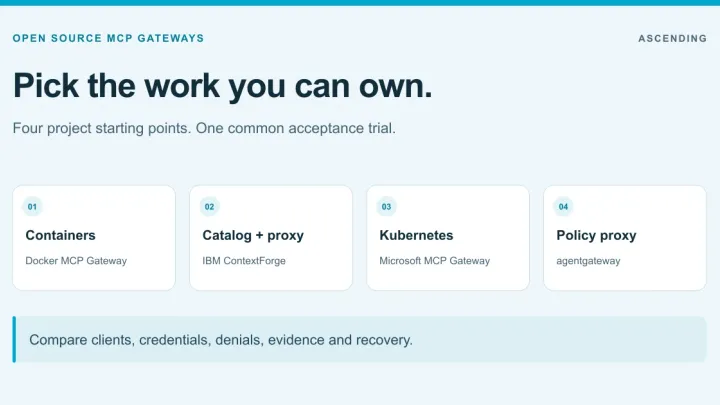
If the adapter needs a shared runtime, use open source MCP gateways compared to separate container execution, catalog management and proxy policy. Select only the operating responsibilities this integration actually needs.
Use a direct integration when one application has a small, stable set of operations and the team already owns the model-tool execution loop. An MCP adapter is most useful when several compatible AI clients need the same maintained tool interface, or a platform team needs shared discovery and governance.
Count the work on both sides. MCP introduces an adapter, protocol compatibility checks and another deployment to support. It can also remove repeated client-specific integrations. The trade is worth making when that shared work is substantial enough to maintain as a service.
Before expanding, test one read and one write from the client people actually use. Include a restricted record, a denied direct tool call, an expired credential and a timeout after a simulated commit. Register the approved adapter and its owner in a private MCP registry.
ASCENDING builds Jarvis. If you need a shared access layer for several adapters, the Jarvis MCP gateway is one evaluation path. Keep the existing business API and its permissions in the trial so the demonstration covers the complete operation.
References
- MCP architecture
- MCP transport bindings
- OpenAPI Specification 3.2.1
- MCP authorization security considerations
- RFC 9110: HTTP Semantics
MCP and REST API integration questions
What is the difference between MCP and a REST API?
A REST API exposes application resources and operations over HTTP. MCP provides a shared interface through which AI applications discover and invoke tools and access other context. An MCP server can call an existing REST API, so the two often sit in the same request path.
Does MCP replace our existing REST APIs?
Usually the existing API should remain the business interface for applications and integrations. Add an MCP adapter when AI clients need a reusable tool surface. Preserve business validation, authorization and transaction behavior in the underlying service.
Can we generate MCP tools from an OpenAPI document?
An OpenAPI document can supply operation names, schemas and security descriptions for an adapter. Review the resulting tools before exposing them: narrow broad operations, explain side effects, map errors and verify user and record permissions. Generation does not complete those design decisions.
Is MCP more secure than a REST API?
The protocol name does not establish security. Both designs need authenticated callers, least-privilege authorization, input validation, safe credential handling and evidence. MCP adds a model-facing tool surface that also needs description review and invocation controls.