

What is a private MCP registry for?
A private MCP registry is your company’s catalog of approved MCP servers: where they run, who owns them and which versions employees may use. It gives teams a controlled discovery source. To make an approval decision affect real tool calls, connect the registry to gateway, server and endpoint controls.
Last verified: November 3, 2026, against the official registry and protocol documentation.
Consider a platform team with two ticket-system servers. One is an internal production integration; the other is a developer’s experiment. Both expose a tool called search_tickets. A directory containing two URLs gives the next team very little help. They need to know which integration has a support owner, which identity reaches the ticket system and whether the experimental server may see production records.
Those are the questions worth solving before choosing a registry UI. For the full system diagram, use our enterprise MCP registry architecture. This guide concentrates on the records and decisions the catalog must keep current.
How does a private registry differ from the public MCP Registry?
The official MCP Registry distributes server metadata. Package registries still host the software. The official registry’s documentation recommends a private registry for servers restricted to an organization’s users or private networks; it also says its own codebase is not designed or supported for self-hosting.
That leaves room for several implementations: an internal catalog service, a commercial platform or a compatible registry built around your approval workflow. Copying the public service is one possible engineering project, with maintenance responsibility attached.
Keep public metadata and internal approval separate. An aggregator can import upstream descriptions and package locations, then add your review outcome in its own store. The aggregator guidance describes downstream consumers that persist metadata and add curation. It does not make an imported server trusted.
| Catalog question | Public discovery source | Private enterprise record |
|---|---|---|
| What exists? | Published server metadata | Servers submitted or observed in your environment |
| Can our team use it? | Listing is not company approval | Named reviewer and decision for a defined use |
| Which release? | Available versions or installation metadata | Approved package digest or deployment reference |
| Who supports it? | Publisher information | Internal owner and escalation contact |
| What happens when withdrawn? | Upstream listing behavior | A documented change across catalog, clients and runtime controls |
For an inventory of servers already running outside that workflow, start with MCP server discovery. Import observations as findings to review, rather than quietly declaring them approved.
What should each server record contain?
Start with one record you can use during an incident. A person who did not onboard the server should be able to find its owner, approved artifact and withdrawal procedure without searching chat history.
The following is an illustrative internal record, not an official server.json schema or a Jarvis configuration file:
server_id: support/tickets
environment: production
owner: support-platform
endpoint: https://tickets-mcp.example.com/mcp
deployment_ref: tickets-mcp/release-2026-11-03
artifact_digest: sha256:<reviewed-image-digest>
approval:
  state: approved
  review_ref: SEC-241
  next_review: 2026-12-03
identity:
  caller: employee
  downstream: delegated-user
policy_ref: support-tools-v3
secret_ref: vault://support/ticket-api
withdrawal_runbook: runbooks/tickets-mcp-disable
Store a reference to a secret rather than its value. Limit visibility of the references too: internal hostnames, tool descriptions and support contacts can disclose operational detail.
Record the tool manifest or a reviewed digest alongside the deployment reference. A server’s URL can stay the same while the code, tool names or descriptions change. The tool-definition change review explains why reviewing only the initial connection leaves an important gap.
Be precise about the word version. A package version identifies software; a policy version identifies a permission decision; an approval revision identifies what a reviewer accepted. Preserve the relationship among all three. One generic version: latest field cannot answer which policy authorized yesterday’s call.
Who approves a server, and what does approval mean?
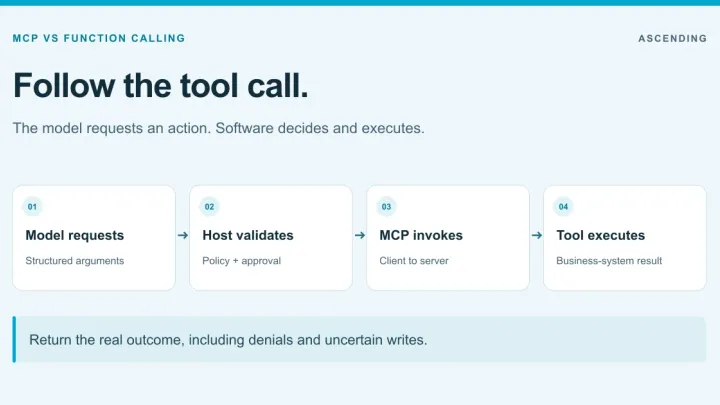
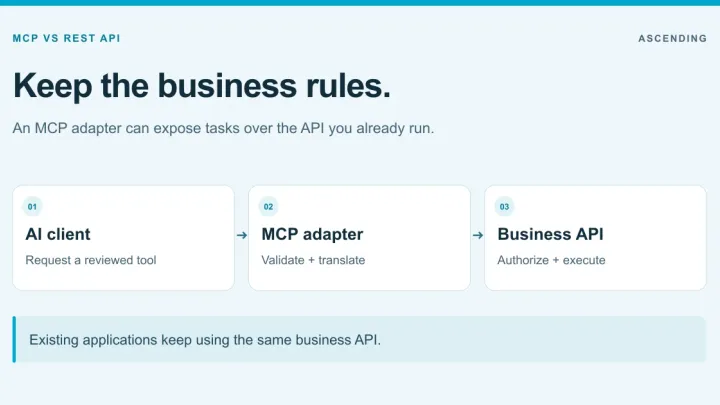
If the server wraps a business API, MCP vs REST API helps define which operations belong in its reviewed tool surface. MCP vs function calling identifies the host and server responsibilities that the record’s owners need to cover.
Approval should identify an allowed use, an environment and an owner. A security review for a test ticket dataset should not silently authorize production payroll access.
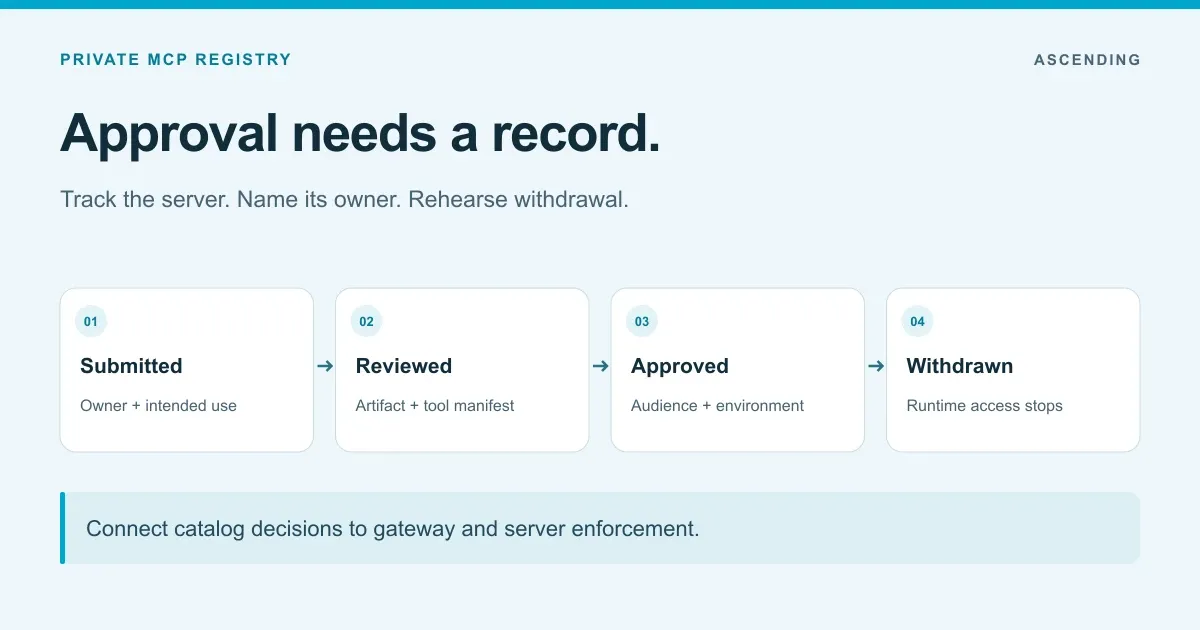
A small workflow can use four states:
- Submitted: The owner provides the record, artifact and intended data access.
- Under review: Platform and security reviewers inspect authentication, credential use, execution permissions and the proposed tools.
- Approved: A specific release is available to a defined audience in a defined environment.
- Withdrawn: New calls must stop according to the withdrawal procedure; the historical record remains available for investigation.
You may also need a temporary suspension state for an incident. Decide whether it blocks discovery, execution or both, and who can restore service. Avoid an ambiguous disabled flag whose effect differs between components.
Publishing permissions deserve their own review. The official registry’s publishing authentication establishes publisher namespaces. An enterprise still needs to decide which internal people may submit records, approve them and change production policy. A publisher’s verified identity does not answer those questions.
Assign the operating responsibilities in your MCP governance checklist. If the team maintaining the catalog cannot reach the team running a server, approval will age into guesswork.
How do you make withdrawal take effect?
Treat withdrawal as a change to several systems. Removing a search result does not erase a known endpoint or a cached tool list.
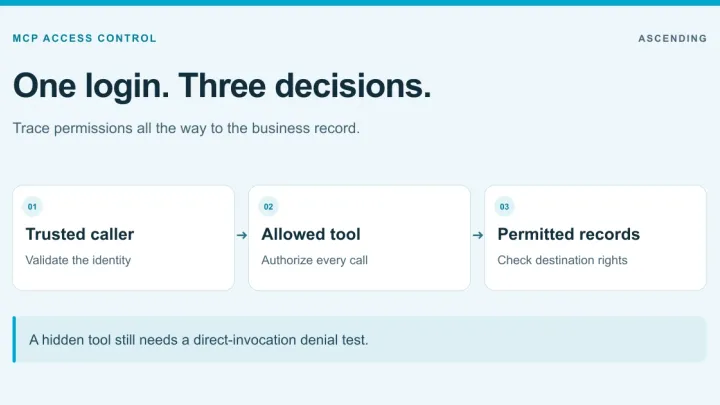
The registry can record the decision. A gateway or server must reject subsequent prohibited invocations. Endpoint and network controls may also need to close direct routes. Our MCP gateway guide explains that runtime boundary, and the per-user access-control guide covers the decision on each invocation.
Before rollout, choose a maximum propagation interval that the server owner can actually support. Then rehearse this sequence in a test environment:
- Discover and call an approved read tool from a supported client.
- Withdraw that server’s production approval.
- Retry using the already-open client and its cached tool name.
- Try the direct endpoint from an ordinary employee device.
- Restore the previously approved release through the normal review path.
Keep timestamps for the decision, the last successful call and the first denied call. That measures the effective withdrawal interval. If the test only checks that the catalog card disappeared, it has measured the UI.
Decide what happens during a catalog outage too. One possible design is a cached, last-approved snapshot with a bounded lifetime; another is to deny access when current approval cannot be established. The right choice depends on the workflow. Document stale-state behavior, especially for writes, so an outage does not produce an accidental permission expansion.
How do you keep the catalog useful after launch?
Review changes that alter what a server can do: new write tools, broader downstream scopes, changed hosting, new maintainers and replacement artifacts. Routine uptime checks are useful, but they cannot replace that review.
Once a month, reconcile the catalog with endpoint and deployment observations. Ask whether every approved record still has a reachable owner, a supported release and a working withdrawal path. Ask whether every observed production endpoint has a record. These two comparisons catch different failures.
Keep historical approvals and link them to MCP tool-call audit evidence. You need to reconstruct what was approved when an event occurred, even after the current record changes.
For teams standardizing both instructions and integrations, pair the server catalog with SKILL.md ownership and distribution. A skill can refer to an approved tool; it still needs its own version and review. Combining the two catalogs should preserve those separate records.
Where does Jarvis fit in the evaluation?
To choose the runtime behind the catalog, compare the operating responsibilities in open source MCP gateways compared. Keep the catalog’s approval procedure consistent even when the selected proxy or hosting platform changes.
ASCENDING builds Jarvis. The Jarvis MCP gateway page describes a shared catalog with permission-scoped discovery. Use the record, approval and withdrawal tests above to evaluate how the proposed deployment connects catalog state to real access decisions.
Bring one internal server and its owner to the review. Ask who can change its record, what happens to existing clients after withdrawal and which evidence survives the change. A useful trial ends with those answers and a documented operating responsibility for each one.
References
- MCP Registry: purpose, private servers and self-hosting limits
- MCP Registry aggregators and curation
- Authentication for publishing to the official MCP Registry
- MCP tools specification
Private MCP registry questions
What is a private MCP registry?
A private MCP registry is an access-controlled catalog of MCP servers available within an organization. It can record endpoints, packages, owners and approved versions. Enterprise approval state and policy references are additional governance metadata; the catalog needs a separate enforcement mechanism to stop prohibited calls.
Can we put internal servers in the official MCP Registry?
The official registry is for publicly accessible servers or publicly available installation methods. Its documentation directs organizations with private servers to a private registry. A public listing also does not constitute your company's security approval.
Does removing a server from a registry stop existing clients?
Only if the deployment connects that change to runtime enforcement. Clients may retain configuration or tool lists, and a direct endpoint may remain reachable. Test withdrawal through both the gateway and any direct route, including existing client processes.
Do we need a private registry for one MCP server?
A reviewed configuration file can be enough for a small pilot with one owner. A private registry becomes useful when teams need shared discovery, different approval states, version history and a reliable way to withdraw access across several clients.