

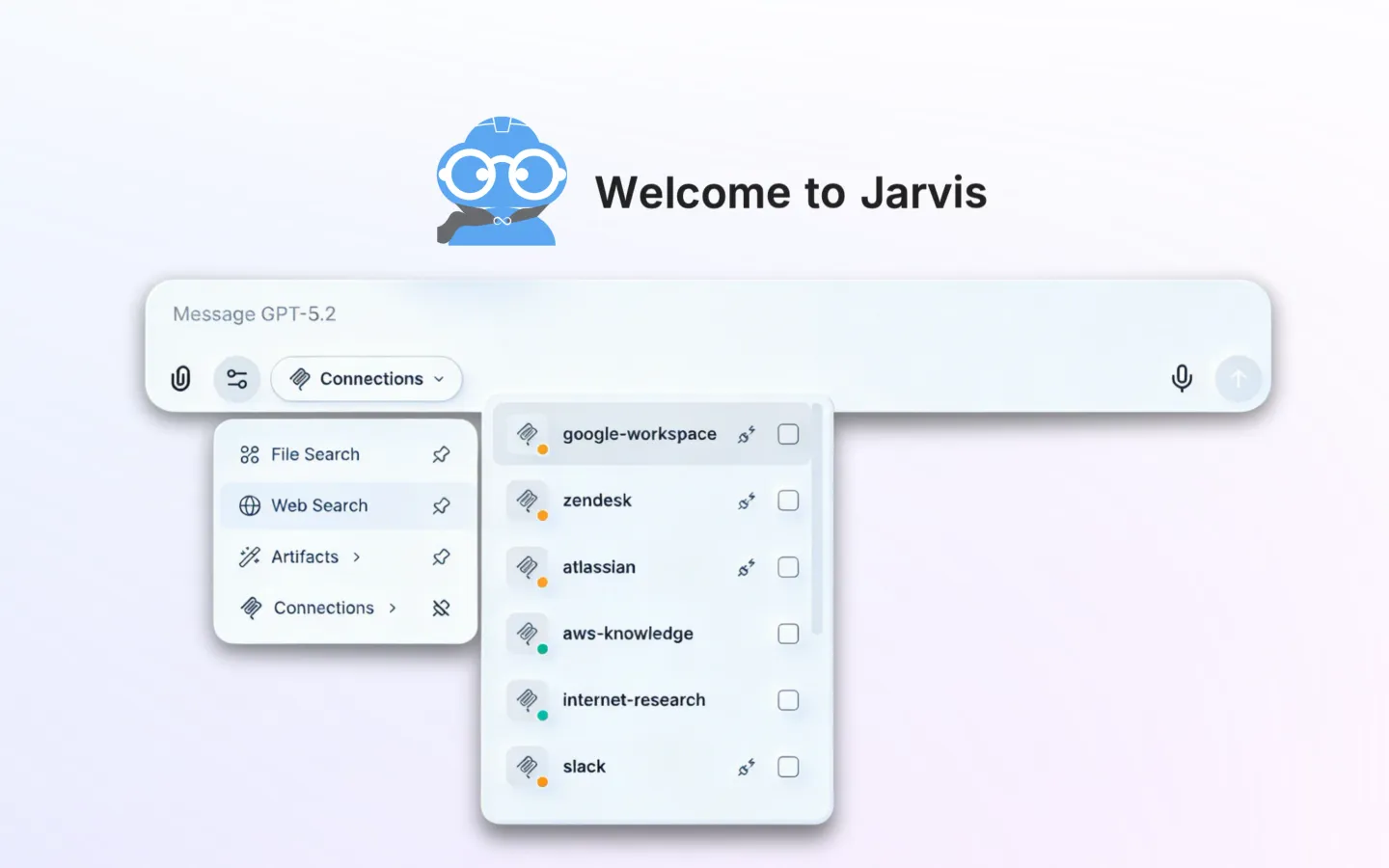
Yes. Jarvis Chat gives employees a customer-hosted workspace for asking questions about selected company information. Jarvis Knowledge Base supports retrieval and passage-level source citations. Together, they are worth evaluating when teams need recurring policy or support answers, inspectable sources and defined employee access.
For example, an employee could ask which policy applies to a purchase exception, read the answer and inspect the cited passage before acting. This is a proposed use case: the selected documents, identities and answer quality must be checked in your implementation.
When should you shortlist a customer-hosted assistant?
Shortlist this approach when four conditions are present:
- Employees repeatedly ask policy, operations or support questions.
- A content owner maintains the documents that should answer them.
- The organization wants the application in its own cloud environment.
- A platform owner can define who may use each source and model.
A maintained troubleshooting collection is a stronger starting point than a large, ownerless document dump. Start with one question category, then expand when employees can reliably find and verify useful answers.
What does Jarvis provide for employee knowledge?
Match the employee’s need to the documented product mechanism, then verify its configuration:
| Employee need | Documented Jarvis capability | Configuration check |
|---|---|---|
| Find company guidance | Knowledge Base ingestion, metadata and retrieval | Selected source, refresh owner and expected answer |
| Inspect the evidence | Passage-level source citations | Cited passage supports the answer and opens for the user |
| Use approved models in one workspace | Jarvis Chat’s multi-model interface | Permitted models and their processing destinations |
| Keep restricted knowledge restricted | Knowledge-domain access controls | Allowed and denied tests with representative identities |
| Stay in an existing employee portal | Jarvis Chat embedding | Sign-in, source links and the portal’s support route |
Knowledge-domain access and source-document permissions are separate configuration questions. Test both; access controls do not establish that every repository’s original permissions transfer automatically.
What does “in our own cloud” cover?
Check each data path once, as part of the architecture review:
| Part of the deployment | Boundary to confirm |
|---|---|
| Chat application | Customer environment, region and operating owner |
| Knowledge storage and retrieval | Document, index and connector locations; access and retention |
| Model endpoint | Privately deployed model or configured managed/external API |
| Telemetry | Log destinations, captured content, retention and access |
Customer-hosting the application does not mean every connected model runs there. A request to an external model API goes to that provider. Amazon Bedrock’s data-protection documentation also distinguishes customer responsibilities from managed-service infrastructure.
Should you buy a workspace or assemble a retrieval service?
A retrieval service and an employee-ready workspace cover different parts of a project. Choose according to how much your engineering team wants to build and operate.
| Starting option | Appropriate situation | Work to scope |
|---|---|---|
| Jarvis Chat with company knowledge | A customer-hosted workspace and implementation support are needed | Identity, sources, models, acceptance and ownership |
| Cloud-native retrieval service | Engineers will build and own the application | Interface, permissions, retrieval, evaluation and operations |
| Existing enterprise search product | Employees already use a potentially suitable system | Hosting, source coverage, evidence and contractual fit |
Amazon Bedrock Knowledge Bases can return generated answers with citations. That is a useful building block, not a complete definition of the employee experience or support process.
The same distinction applies to workflow automation. If the assistant must act on an answer, assess the separate responsibilities in our build-or-buy workflow guide.
What should the knowledge-assistant demo prove?
Choose current source material, representative user roles and a controlled question set. The process owner records the expected source and acceptable answer before reviewing the assistant’s output.
Use one checklist:
- Supported answer: resolve a recurring question from current material, including an exception or conflicting older policy.
- Inspectable source: open the cited passage and confirm it actually supports the answer.
- Allowed and restricted users: repeat relevant questions with two roles and check both retrieval and source access.
- Missing information: ask something the selected documents cannot answer and check that the assistant does not invent a policy.
Review the answer, citation and employee outcome together. A convincing paragraph linked to an irrelevant document fails the test. So does an appropriate answer whose source the employee cannot open.
Our metadata and hybrid-search guide covers the retrieval design behind this exercise. For numerical questions over business records, consider the separate conversational analytics guide; retrieving a passage is not the same operation as calculating a total.
Before expanding, record the question mix, supported answers, verified resolutions and employee correction effort. More chat messages alone do not establish usefulness. The NIST AI Risk Management Framework provides a broader reference for evaluating risks in the actual use context.
For an employee portal, the embedding guide adds identity, source-link and service-desk checks. Keep the existing support route available throughout the pilot.
Bring one knowledge problem to the demo
Book a Jarvis Chat demo with one recurring question category, approximate monthly volume, a representative document set, intended users and your cloud environment. Ask to see a supported answer, a denied request and the proposed data-flow architecture. Use those checks to agree the first useful scope and its operating owner.
References
- AWS: Amazon Bedrock data protection
- AWS: Query a knowledge base and generate cited responses
- NIST AI Risk Management Framework
Knowledge assistant questions buyers ask
When is Jarvis Chat a fit for company knowledge?
Shortlist it when employees repeatedly ask about maintained company information and you need a customer-hosted workspace with defined user access. Start with one useful question category and a named content owner.
Does hosting the assistant in our cloud keep every model request there?
Not automatically. The application, knowledge storage, model endpoint and telemetry each have a deployment boundary. Requests sent to an external model API go to that configured provider; a private model deployment is a different arrangement.
Do citations guarantee a correct answer?
No. Check that the cited passage supports the answer. Include incorrect-source, outdated-policy and conflicting-document cases in acceptance testing.
Can we begin without connecting every repository?
Yes. Start with one maintained document set and a named owner. Expand after proving usefulness, access controls and a reliable content-refresh process.
Do we need Jarvis Registry for the first workspace?
Jarvis Chat can operate on its own. Add Registry when the intended architecture needs its governed tool and agent access.
Can employees use the assistant in their existing portal?
Jarvis Chat supports embedding. Scope and test the portal's identity flow, source access, citation links and escalation route for the implementation.