
Enterprise RAG: Metadata, Hybrid Search and Embeddings
Enterprise RAG does not require every kind of question to use vector search. A policy explanation, an exact invoice lookup and a count of open tickets need different retrieval decisions. Metadata-aware hybrid search is useful when you need semantic matching, exact terms and filters together, but it should not become a reason to rebuild every existing data source.
For teams comparing enterprise RAG platforms, the useful question is: what must be indexed, what can be queried in place, and how will user permissions survive either path?
Start with Jarvis Knowledge Base capabilities, then use the checks below to scope your own sources.
Match the retrieval method to the question
Consider four requests an employee might make. These are evaluation examples, not claims about a specific deployed customer.
| Request | Retrieval requirement | What to test |
|---|---|---|
| Find invoice INV-2041 | Exact identifier lookup | Does the right record appear without similar-but-wrong IDs? |
| Explain our equipment return policy | Relevant document passages | Are the answer and citation supported by the current policy? |
| Find policies updated this quarter | Date and document-type filtering | Are older versions excluded? |
| Count unresolved tickets by team | Structured query or aggregation | Does the result match the source system? |
Microsoft’s retrieval-design guidance distinguishes retrieval approaches according to data and query needs. Use that distinction during procurement: a platform demonstration should answer your representative questions, not only show a persuasive chat response.
Keep metadata and hybrid search separate
Metadata describes a record: its owner, source, date, department or document type. Filtering uses those fields to narrow a candidate set. Keyword search matches terms. Vector search finds similar meaning. Hybrid search combines keyword and vector retrieval.
These mechanisms can work together. Azure AI Search supports vector and nonvector fields in the same index. Its filter documentation explains how nonvector fields constrain results. An existing metadata field can therefore remain useful without becoming an embedding itself.
That does not mean an arbitrary repository can be connected without preparation. Field quality, source permissions, indexing requirements and refresh behavior still need inspection. Ask the provider to identify which fields are copied, indexed, embedded or queried directly.
Check permissions before measuring answer quality
A relevant answer is still unacceptable if it exposes a document the requester cannot open. Use two test users with different access, not an administrator account for every demonstration.
Ask the implementation team to show:
- An allowed query returning the expected source and citation.
- The same query under a restricted identity, without protected content appearing.
- A permission change and the resulting retrieval behavior.
- A deleted or superseded document no longer being treated as current evidence.
Metadata labels alone do not enforce these rules. The application needs a reliable identity-to-policy path. Jarvis describes identity-scoped knowledge domains through its Governed AI layer; validate that behavior against your actual connectors and access model.
A healthcare eligibility record illustrates why retrieval needs both context and freshness. Store the payer, patient-match context, service date, and source timestamp with the evidence, as outlined in the insurance eligibility workflow. If the evidence came from a call, the payer-call evidence package helps distinguish a transcript from the reviewed benefit fields. Retrieving an older record accurately does not make it a current coverage determination.
What Jarvis documents, and what to confirm
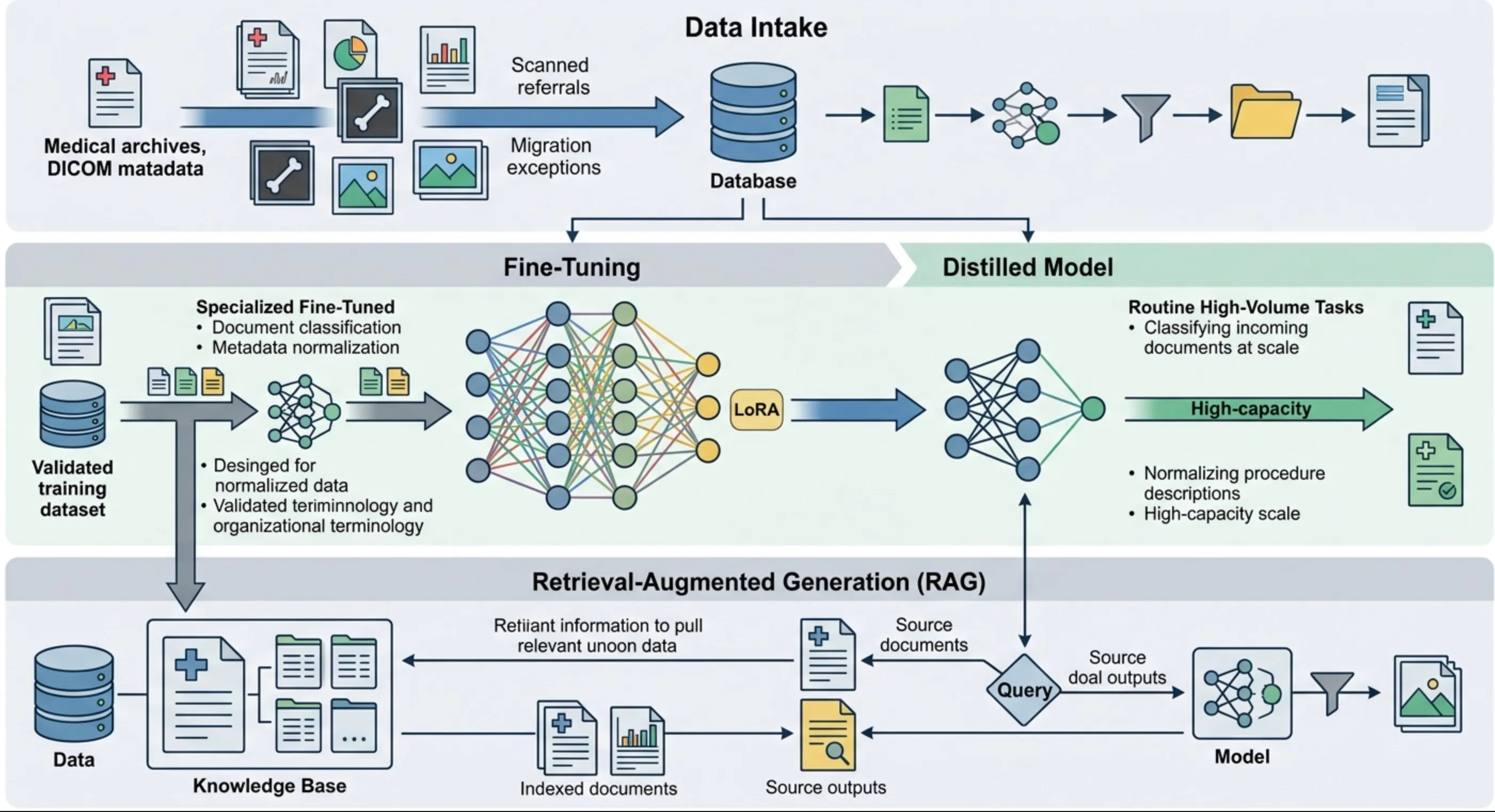
Jarvis Knowledge Base lists document sources, SQL databases and existing OpenSearch hybrid indexes. It describes ingestion that chunks content, creates vector embeddings and attaches metadata, with passage citations in retrieval responses.
Those capabilities support a conversation about mixed enterprise sources. They do not establish that Jarvis can bypass embeddings for every source or reuse every existing index unchanged. If avoiding a full re-index is a requirement, ask for the proposed path for each repository before agreeing to implementation scope.
The same review should identify the embedding and generation providers. A customer-hosted application can still send requests to an external model API if configured to use one.
Make the first evaluation small and measurable
Choose one business task and a representative sample of its documents or records. Include exact IDs, natural-language questions, an outdated document, a restricted source and a question with no supported answer.
Agree on expected evidence before running the comparison: correct source, supported answer, permission handling, freshness, response time and operating cost. Keep the question set fixed while comparing retrieval designs. A change that improves fluent answers but loses exact record matches is a trade-off, not an automatic improvement.
Bring your source list, existing metadata and five real questions to a Jarvis retrieval discussion. That gives the team enough context to assess ingestion and integration work without starting with a blanket “vectorize everything” assumption.
References
- Microsoft: choose an information-retrieval approach for RAG
- Microsoft: vector and nonvector index fields
- Microsoft: filters in Azure AI Search
Questions about enterprise retrieval
Does every enterprise data source need embeddings for RAG?
Not necessarily. Exact record lookups, structured queries and keyword retrieval can serve different needs from semantic search. The selected platform and ingestion design determine which sources require embeddings.
Is metadata filtering the same as hybrid search?
No. Metadata filters select records using fields such as date or department. Hybrid search combines keyword and vector retrieval; filters can constrain those results.
Can Jarvis use our existing metadata without vectorizing content?
Jarvis documents metadata-tagged, vector-embedded ingestion and support for existing OpenSearch hybrid indexes. A metadata-only path is not established by that description and needs a source-specific architecture review.
Do metadata fields automatically enforce document permissions?
No. The application must connect trusted identity and current permissions to the retrieval policy. Test permitted and denied queries, plus access changes, before rollout.