

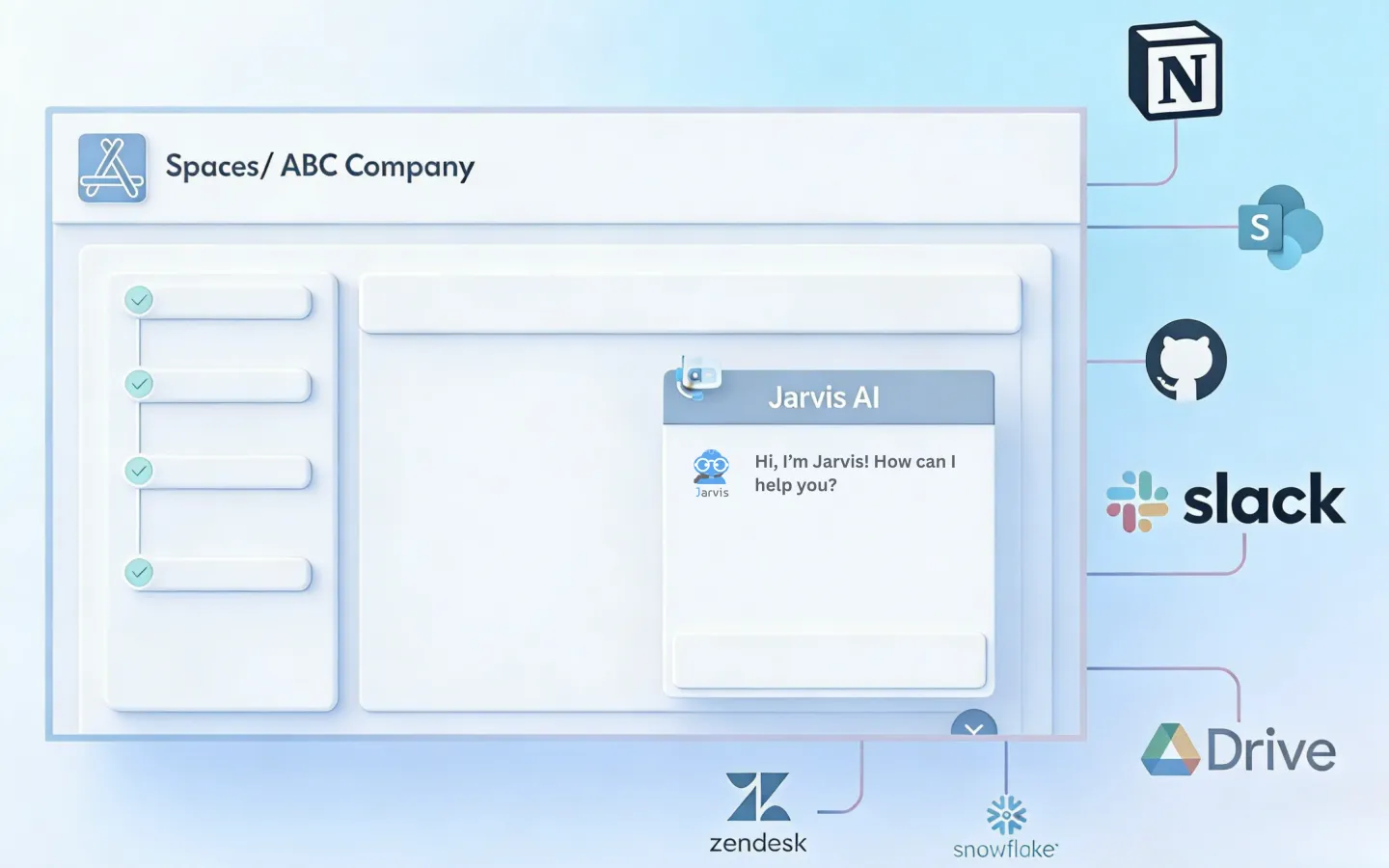
Jarvis AI by ASCENDING supports business-data questions in plain language. In our Digital Air Strike engagement, we migrated an existing assistant to a Jarvis-powered Amazon Bedrock solution while retaining natural-language access to warehouse data.
This makes Jarvis relevant to teams that want employees to ask recurring business questions without writing SQL or waiting for every answer from an analyst. The implementation connects that conversational experience to agreed metrics, the warehouse query route and the records each employee may access.
Customer example: preserving Digital Air Strike’s warehouse access
Digital Air Strike, an automotive and powersports marketing-technology company, already used a ChatGPT-based assistant for warehouse questions. As adoption grew, it wanted to change how sensitive business data was processed without removing the experience employees relied on.
- Starting problem: preserve a useful natural-language assistant while moving away from its external OpenAI processing dependency.
- Jarvis delivery: ASCENDING migrated the assistant to a Jarvis-powered Amazon Bedrock architecture with identity and governance integration.
- Preserved user capability: employees could still ask complex warehouse questions in conversational language, without SQL knowledge.
- Relevant buyer situation: a team with an existing data assistant, or a similar need for plain-language warehouse access, evaluating a customer-hosted Jarvis application and a different model-processing route.
The published case is an example of delivered conversational data access. The campaign walkthrough below is a separate illustration, not that customer’s implementation.
When is conversational analytics worth evaluating?
Shortlist Jarvis for conversational analytics when:
- Employees ask recurring questions about campaign performance, service volumes or outstanding orders.
- Analyst queues delay decisions even though the relevant data already exists.
- The business has agreed definitions for the metrics and reporting periods.
- A data owner can approve the query results and employee access rules.
Keep established dashboards for fixed reporting. A conversational interface is most useful for follow-up questions, not for resolving disagreement about what revenue or an active customer means.
Is business analytics the same as document search?
Usually not. Document search retrieves passages. Structured analytics filters, joins or calculates over records. Some questions need both.
| Employee question | Required operation | Evidence to return |
|---|---|---|
| What is our cancellation policy? | Retrieve an approved passage | Source document and relevant text |
| How many orders were cancelled last month? | Filter and count permitted records | Date range, filters and count |
| Why did cancellations rise? | Compare records and inspect explanations | Calculation, supporting evidence and uncertainty |
| Which accounts need follow-up? | Apply an agreed rule | Matching accounts and the rule used |
Amazon Bedrock documents a structured-data route that translates natural-language questions into queries, including a separate GenerateQuery operation. It is an implementation option for supported stores, not proof that every Jarvis deployment uses that route.
For policy and document answers, use the customer-hosted knowledge assistant guide and metadata and hybrid-search guide instead of treating every question as a database calculation.
How would a campaign-performance question work?
Consider: “Which campaigns had a higher cost per qualified lead last month than the previous month?” This is an illustrative implementation, not a description of Digital Air Strike’s specific workflow.
- Identify the caller. Determine the accounts the employee may analyze.
- Resolve the terms. Define qualified lead, timezone, currency and both reporting periods.
- Choose approved data. Use a view with campaign spend and qualified-lead counts.
- Calculate consistently. Divide spend by qualified leads for each campaign and period. Handle zero leads separately.
- Explain the result. Show both values, the change, applied filters and data freshness.
- Clarify ambiguity. Ask when the metric or requested period is unclear.
An increase is an observation, not its explanation. More expensive leads may coincide with a campaign change without proving the change caused the increase.
Where should data permissions be enforced?
Enforce permissions in the query path, not only in a chat instruction. Start with read-only access to approved views, explicit user-to-data permissions and query limits. Test allowed and denied requests with the same business question.
Registry scopes and ACLs govern registered resources. Downstream database permissions govern records. Permission to call an analytics tool must not silently become permission to read every row its connection can reach.
Database-specific note: if PostgreSQL is in your implementation, check its row-security bypass rules for the connection role. PostgreSQL is an example here, not a claim about Digital Air Strike’s database.
What should an analytics acceptance test cover?
Evaluate the complete answer against an approved result, not merely whether the query runs.
| Test | Expected behavior |
|---|---|
| Known metric and period | Matches the approved calculation |
| Ambiguous “best accounts” question | Clarifies or states the agreed definition |
| Restricted account | Reveals neither records nor a revealing summary |
| Empty period or zero denominator | Explains the condition without inventing a value |
| Stale or incomplete data | Shows freshness and relevant limitations |
Track accepted answers, analyst corrections, repeat use and elapsed time from question to usable result. Count released analyst capacity separately from cash savings. Less report preparation does not automatically reduce payroll or infrastructure bills.
If an answer should trigger an action, scope that separately using the human-approval checklist. Keep a read-only analytics pilot distinct from write access.
Bring known-answer questions to the demo
Book a Jarvis AI demo focused on one dataset and a recurring reporting bottleneck. Bring these five inputs:
- The team making the decision and the person responsible for the data.
- Representative questions with examples of accepted answers.
- The database or warehouse holding the records.
- Which accounts, regions or business units each user may see.
- Current request volume and time spent preparing and checking answers.
Ask to see the conversational experience, proposed query route and validation approach. Your data owner should be able to inspect the answer, its calculation and its access boundary.
References
- ASCENDING: Digital Air Strike Jarvis AI case study
- AWS: Knowledge Bases for structured data
- PostgreSQL: Row security policies
- Jarvis Registry: Scopes and resource access
Questions about conversational analytics
Can Jarvis work with our existing warehouse?
The Digital Air Strike deployment retained natural-language warehouse access using Jarvis on Amazon Bedrock. For your warehouse, scope the connection, query route, identity and permitted data before rollout.
Can employees use the assistant without knowing SQL?
Yes. ASCENDING's Digital Air Strike case describes natural-language warehouse access. Technical owners still maintain the data model, permissions and validated calculations.
Do we need to embed every database record?
No. Structured analytics can use a query route rather than vector retrieval. Select the approach for the supported data store and the question being answered.
Can the assistant replace existing dashboards?
Start with questions dashboards do not answer conveniently. Retain established reports for fixed metrics while evaluating whether chat reduces additional analyst requests.
Can the assistant change customer or financial records?
Begin an analytics pilot with read-only access. Treat any write capability as a separate workflow with its own authorization, validation and approval requirements.