


AWS Enterprise Support is worth it when an hour of production downtime costs more than the monthly fee and your team will use the Technical Account Manager (TAM). The fee is the greater of $5,000 or a bracketed 10% to 3% of gross monthly AWS charges. If you have a cross-service PPA, you must carry it.
Key Takeaways
- The fee is the greater of $5,000 or 10%, 7%, 5% and 3% of gross monthly charges in brackets. The effective rate is 12.5% at $40,000 a month, 8.8% at $250,000 and 6.45% at $1 million.
- Below $50,000 a month the $5,000 minimum applies, and Business Support+ often fits better. That is an editorial view, not AWS guidance.
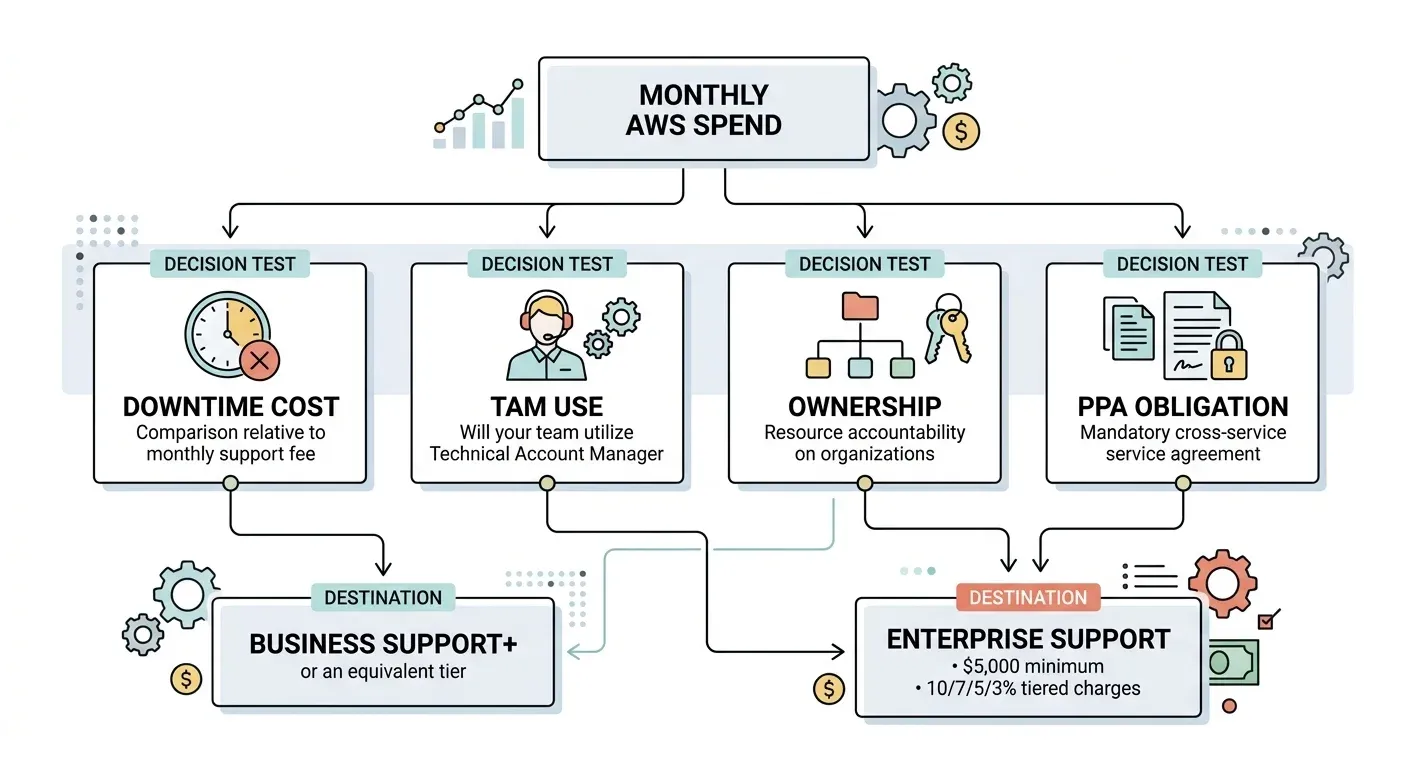
- Four tests decide it: downtime cost, whether you will use the TAM, whether your engineers already know the architecture, and whether a PPA makes it mandatory.
- With a cross-service PPA the question changes from “is it worth it” to “who provides it”.
Last verified against AWS pages on 2026-10-12. AWS changes support terms, so check the linked pages before you decide.
What does Enterprise Support give you?
Enterprise Support gives you a designated TAM, a 15-minute response to critical cases and a set of programs and tools. AWS describes the response time as a reasonable-effort target, not a guarantee, according to the footnote on the AWS Enterprise Support page.
What the plan includes, per AWS:
- A TAM. Provides strategic guidance, leads Well-Architected Reviews, gives FinOps guidance and runs workshops and GameDays.
- Event support. AWS Countdown covers launches, migrations and peak traffic, with reviews before and after.
- Tools. Trusted Advisor Priority, the AWS Support App in Slack, the Support and Health APIs and the AWS DevOps Agent for incident investigation.
- Security. AWS Security Incident Response, with 24/7 access to its engineers.
It does not replace your own engineers. AWS’s Support FAQ says AWS Support does not include custom code development, software debugging, system administration tasks or remote access to customer systems and accounts. For how this compares with Business Support+ and Unified Operations, see AWS Support plans in 2026.
What does it cost at your spend level?
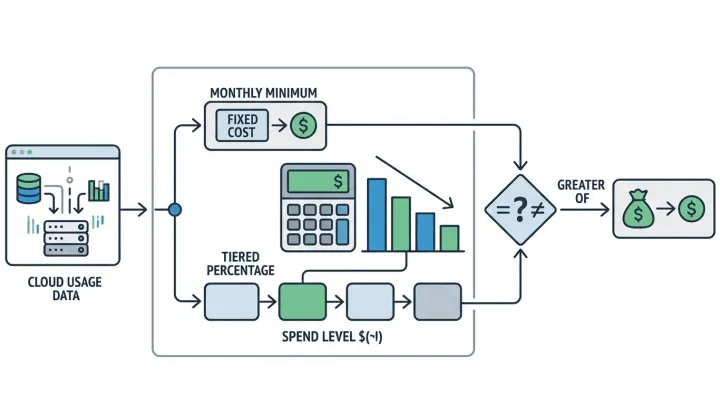
At $250,000 a month in gross AWS charges, Enterprise Support costs $22,000. The fee is whichever is greater: $5,000, or a percentage applied in brackets to your gross monthly charges, according to the AWS Support pricing page.
| Slice of gross monthly AWS charges | Rate |
|---|---|
| First $150,000 | 10% |
| $150,000 to $500,000 | 7% |
| $500,000 to $1,000,000 | 5% |
| Over $1,000,000 | 3% |
“Gross” means before any discounts or credits, and it covers every account enrolled in Enterprise Support. The minimum stops applying at $50,000 a month, where 10% equals $5,000.
| Monthly gross AWS charges | Enterprise Support | Effective rate | Business Support+ (one account) |
|---|---|---|---|
| $40,000 | $5,000 | 12.5% | $3,000 |
| $250,000 | $22,000 | 8.8% | $14,300 |
| $1,000,000 | $64,500 | 6.45% | $36,800 |
The Business Support+ column applies AWS’s published per-account rates (9% up to $10,000, 7% to $80,000, 5% to $250,000, 3% above) to a single account. A real multi-account bill will differ. The full working, a calculator and the PPA effect are in How Much Does AWS Enterprise Support Cost?
When is Enterprise Support worth it? Four tests
It is worth it when the fee is smaller than the downtime and rework it prevents, and your team will use what it includes. The four tests below are ASCENDING’s editorial framework, not AWS guidance. Answer all four before you decide.
1. The downtime test
Compare the monthly fee with the cost of one hour of production downtime. Divide the annual fee by your hourly downtime cost to see how many hours of avoided downtime it needs to break even.
A hypothetical example: you spend $250,000 a month, so the fee is $22,000 a month, or $264,000 a year. If one hour of downtime costs your business $20,000, the fee breaks even at about 13 hours of avoided downtime a year. If it costs $2,000 an hour, it needs about 132 hours, and the fee is hard to justify on this test alone. Use your own numbers; these are only to show the arithmetic.
2. The TAM-use test
Ask whether someone on your team will meet the TAM regularly and use the reviews, workshops and escalation help.
Practitioners say the same. Corey Quinn of Last Week in AWS wrote in 2018 that Enterprise Support is only worth the cost if you use it properly. He also wrote that it is not a substitute for your own staff.
A 2025 AWS Community Builders post by Danny Steenman says many customers get little strategic value because they do not engage their TAM proactively. It adds that TAMs plan and escalate rather than do day-to-day break-fix work. Both are individual opinions. Treat them as a prompt to check your own habits, not as proof.
3. The ownership test
If your engineers already know the architecture and handle most incidents, much of what Enterprise Support adds is guidance and escalation, which may not justify the fee. If your team is thin, a named AWS contact who knows your accounts matters more. AWS’s Support FAQ says AWS Support does not include custom code development, software debugging, system administration tasks or remote access to customer systems and accounts. Someone on your side, or a partner you hire, still has to do the hands-on work.
4. The obligation test
If you hold, or are negotiating, a cross-service PPA, Enterprise Support is not optional. The next sections cover it.
Decision guide by monthly spend
Below about $50,000 a month the minimum dominates and Business Support+ often fits better. Above $150,000 the lower tiers and TAM reviews more often pay back, and a cross-service PPA overrides everything. The fee and bracket figures come from AWS; the “typical lean” column is editorial judgment.
| Gross monthly AWS charges | Enterprise Support fee | Typical lean | What tips it |
|---|---|---|---|
| Under $50,000 | $5,000 minimum | Business Support+, unless incidents are costly | Fixed cost with the highest effective rate |
| $50,000 to $150,000 | 10% | Depends on the downtime test | Number of production accounts, regulated workload |
| $150,000 to $500,000 | 7% on the slice above $150,000 | Often Enterprise Support | Several production accounts, TAM reviews that pay back |
| Over $500,000 | 5%, then 3% above $1 million | Enterprise Support, or Unified Operations if mission-critical | Compare partner-led quotes |
| Any spend with a cross-service PPA | Required | Enterprise Support, from AWS or an authorized AWS partner | Who provides it |
“Typical lean” is not a rule. A $40,000 account whose outage would stop revenue may need Enterprise Support, and a $400,000 estate with a strong platform team may not.
Unified Operations is the step above for mission-critical workloads. It starts at $50,000 a month, and AWS says its incident management engineers respond within five minutes during critical incidents, per the Unified Operations page. AWS notes that how well an incident is resolved depends on the context available, and its FAQ says the service does not include hands-on keyboard support that provides direct operational management. It is covered in AWS Support plans in 2026.
If you have a PPA, the question changes
In ASCENDING’s reading of AWS’s terms, Enterprise Support is mandatory in a cross-service Private Pricing Agreement (PPA, formerly the Enterprise Discount Program). Only AWS or an authorized AWS partner can provide support that satisfies the requirement, so the question becomes who provides it and at what price. AWS does not publish PPA terms, so confirm the clause with your AWS account team.
Two cost points matter:
- The fee ignores your discount. AWS calculates it on gross charges before discounts or credits, so a PPA rate does not reduce it.
- Commitment treatment is contract-specific. Whether the fee counts toward your commitment depends on the agreement’s eligible-spend definition. Ask your AWS account team and get the answer in writing.
The PPA negotiation guide covers commitment sizing, term length and the support line.
How can you pay less, or buy less?
Check what is enrolled, match each account to the right plan, and compare partner-led quotes on the same basis.
- Review enrollment. The fee covers accounts subscribed to Enterprise Support. Ask AWS how enrollment works under your agreement before you move any account.
- Ask about plan fit. Ask your AWS account team whether your agreement lets non-critical accounts run a different plan from production.
- Compare partner-led quotes like for like. An authorized AWS partner can deliver partner-led support at its own rate. Compare gross-spend basis, coverage hours, response times and tools, using the worksheet in AWS Partner-Led Support vs AWS Enterprise Support.
ASCENDING is an authorized AWS partner. For what it offers, see AWS Partner-Led Enterprise Support.
What should you do next?
- Pull last month’s gross AWS charges for every account on, or considering, Enterprise Support.
- Run the four tests: downtime, TAM use, ownership and obligation.
- Check your renewal date and whether a PPA applies.
- If you need Enterprise Support, request a partner-led quote and compare it with AWS’s fee on the same basis.
If the fee is below the downtime it prevents and you will use the TAM, it is worth it. If not, Business Support+ is usually the better starting point.
References
- AWS Support pricing, AWS, retrieved 2026-10-12.
- AWS Enterprise Support, AWS, retrieved 2026-10-12.
- AWS Support FAQs, AWS, retrieved 2026-10-12.
- AWS Unified Operations, AWS, retrieved 2026-10-12.
- How to Properly Engage with AWS Enterprise Support, Corey Quinn, Last Week in AWS, 2018-12-17.
- AWS Enterprise Support vs Partners: Which One Do You Actually Need?, Danny Steenman, AWS Community Builders, 2025-11-14.
- New and enhanced AWS Support plans add AI capabilities to expert guidance, AWS News Blog, 2025-12-02.
- Developer, Business, and Enterprise On-Ramp end of support, AWS Support User Guide.
- AWS Support plans in 2026, ASCENDING Blog.
- How Much Does AWS Enterprise Support Cost?, ASCENDING Blog.
- AWS Partner-Led Support vs AWS Enterprise Support, ASCENDING Blog.
FAQ — Is AWS Enterprise Support Worth It?
Is AWS Enterprise Support worth it for a small company?
Rarely on cost alone. Below $50,000 in gross monthly AWS charges you pay the $5,000 minimum, which is a fixed cost and the highest effective rate you can pay. Run the downtime test in this guide and compare Business Support+ first. See how much AWS Enterprise Support costs for the fee at your spend.
Is Business Support+ enough for production workloads?
AWS calls Business Support+ its minimum recommended plan for production. It gives 24/7 access to AWS experts and a 30-minute response to business-critical cases, but no designated Technical Account Manager. The AWS Support plans in 2026 guide compares the plans side by side.
Do I have to buy Enterprise Support with a PPA or EDP?
Yes for a cross-service Private Pricing Agreement (PPA, formerly the Enterprise Discount Program), in ASCENDING's reading of AWS's terms. Confirm the clause with your AWS account team. AWS can provide it directly, and an authorized AWS partner can provide partner-led support that meets the same requirement while your PPA stays in place. See the PPA negotiation guide.
Does a Technical Account Manager pay for itself?
Only if your team uses it. A TAM leads Well-Architected Reviews, FinOps guidance and workshops, and helps escalate cases, but a TAM nobody meets with is cost without value. Use the TAM-use test and the downtime test in this guide to check it against your own situation.
Can I get Enterprise Support for less?
Through authorized partner-led support, which some AWS partners offer at their own rate. Offers differ in price, coverage hours, response times and tools, so compare them on the same gross-spend basis. See AWS Partner-Led Support vs AWS Enterprise Support.