
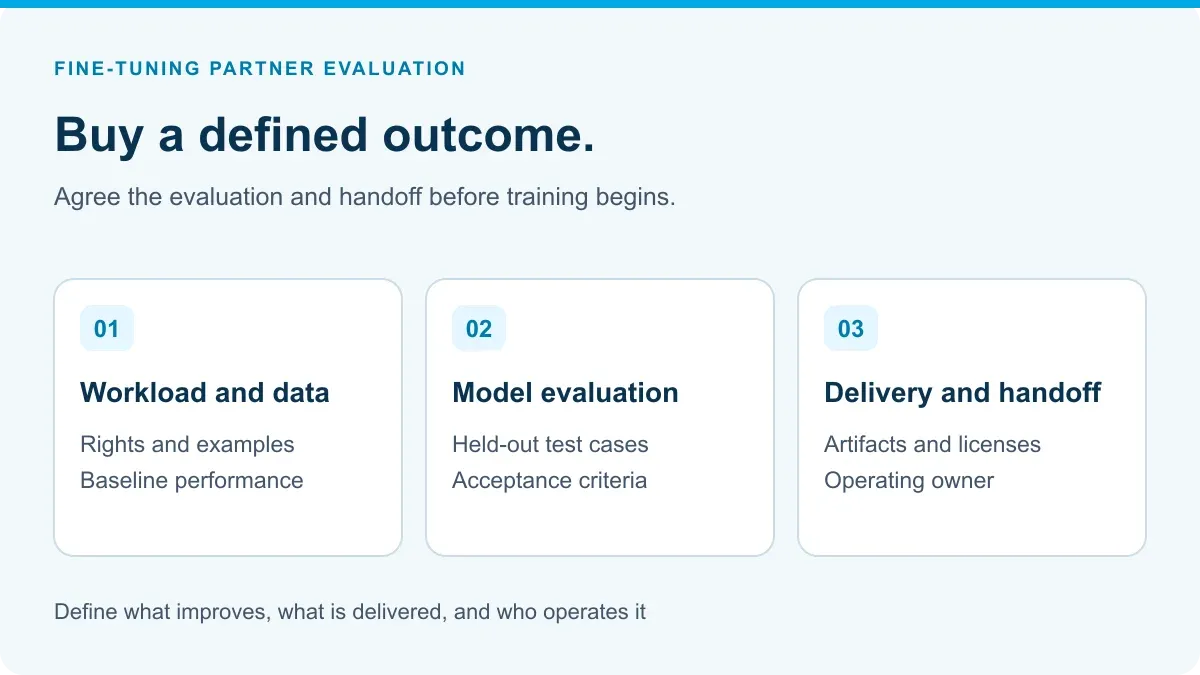
LLM fine-tuning services should deliver a tested capability your team can use and maintain—not just a completed training run. ASCENDING’s Custom LLM Development service adapts open-source models to company tasks, evaluates them against a baseline, and can include deployment, integration, and MLOps work. Agree on those deliverables before comparing proposals.
For example, ASCENDING’s published D2Nova call-intelligence case study describes domain-model fine-tuning with more than 8,000 transcript-summary pairs using SageMaker, followed by inference deployment. That is evidence of a specific delivered workflow, not a minimum dataset or a promised result for your project.
Use a call-summary task as a practical buying example: the system must capture the customer’s issue, agreed actions, and unresolved questions without inventing commitments. What must a provider hand over to make that dependable?
Choose the service scope your team actually needs
| Buying route | What you are buying | What your team still needs to own |
|---|---|---|
| A managed fine-tuning platform | Training infrastructure and supported tuning options | Task definition, usable data, evaluation, and application integration |
| A scoped model-development engagement | Agreed data work, adaptation, testing, and deployment deliverables | Business acceptance and the responsibilities retained in the contract |
| A reusable MLOps engagement | A repeatable process for training, evaluating, releasing, and operating models | Named owners, operating budget, and change approval |
These are different purchases. Together’s fine-tuning platform offers managed training options, while Turing’s LLM Lab combines an environment with specialist services. Compare the work and ownership included, not simply whether both proposals use the phrase “fine-tuning.”
If you are still deciding whether model adaptation is necessary, start with the RAG versus fine-tuning guide. This checklist is for comparing delivery proposals once you have a task worth testing.
Put six deliverables into the proposal
Each item below should be explicitly included, excluded, or assigned to your team. A small model engagement need not include a full operating platform.
| Deliverable | What a buyer should be able to inspect |
|---|---|
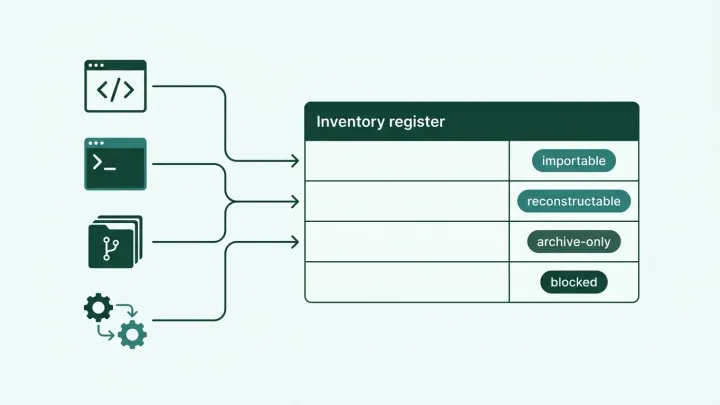
| Data-readiness findings | Source permissions, preparation steps, gaps, and examples excluded from training |
| Model and license decision | Selected base model, why it fits the task, and restrictions on its intended use |
| Reproducible training artifacts | The agreed weights or adapters, configuration, code, and versions needed to reproduce the work |
| Evaluation report | Baseline and adapted-model results on held-out examples, including important failure cases |
| Deployment package | Agreed endpoint or runtime configuration, access controls, dependencies, and rollback instructions |
| Operating handoff | Runbook, responsible team, monitoring requirements, support scope, and retraining decision process |
For the call-summary example, the report should show missed actions, invented obligations, and cases where the existing approach performed better.
Review the examples before paying for training
Inspect sample inputs and desired outputs together. An inaccurate reference summary can teach the wrong behavior. Include difficult conversations, not just short, orderly calls.
Keep evaluation examples separate from training examples. For this task, also check whether repeated conversations or closely related records leak between the two sets. Otherwise, familiar material may make the evaluation look stronger than performance on new calls.
Together’s data-preparation documentation illustrates another distinction: training files must meet the chosen service’s format requirements. Passing a file-format check does not establish that the labels are correct or that the data represents your customers.
Agree on acceptance before seeing the result
For the call-summary example, propose a review rubric before training begins:
- Does the summary preserve the issue and the actions actually agreed?
- Does it separate unresolved questions from confirmed facts?
- Does it avoid adding commitments that nobody made?
- Can it handle incomplete or unusual conversations acceptably?
- What review effort, response time, and operating cost remain?
Compare the current approach and the adapted model using the same examples and rubric. Record both improvements and regressions. A lower aggregate error count may still be unacceptable if the remaining mistakes create customer commitments or remove an important qualification.
Agree who signs off, what failures prevent release, and what happens if adaptation does not improve the baseline enough to justify deployment.
Make ownership and hosting explicit
Separate ownership of custom deliverables from the licenses covering the base model and pre-existing tools. Specify what can be exported, reused, modified, and operated by another team. If the deliverable is an adapter rather than complete model weights, name the base-model dependency and version.
For an AWS or Azure deployment, confirm where preparation, training, inference, and logs run separately. ASCENDING’s published AWS work supports discussing an AWS MLOps engagement; the exact Azure architecture and each provider-managed component still belong in the agreed scope. See the private LLM deployment buyer guide for the boundary review.
Also separate project handoff from ongoing operation. Who pays for compute, responds to endpoint failures, approves new training data, and decides when to retrain? A model file does not answer those questions.
Bring one task to the first conversation
Discuss a fine-tuning engagement with ASCENDING using one recurring task, approved sample data, examples of the current failure, and your intended AWS or Azure environment. Ask for a scoped proposal that identifies the deliverables above, the acceptance test, and the operating owner. That gives your team something concrete to compare and approve.
References
LLM fine-tuning service questions
Can ASCENDING fine-tune a small open-source LLM on company data?
ASCENDING's Custom LLM Development service includes adapting open-source models to company tasks and data. The engagement should confirm model licensing, usable examples, baseline results, deployment requirements, and acceptance criteria before training.
How much training data do we need?
There is no single minimum that establishes readiness for every task. Review whether the examples are accurate, representative, legally usable, and sufficiently varied, then separate training data from an independent evaluation set.
Will we own the model and everything used to build it?
The agreement should specify rights to custom weights or adapters, code, data processing, and documentation. Base-model licenses and any pre-existing provider technology retain their own terms; custom work does not automatically transfer ownership of all underlying components.
Can the project include a reusable MLOps workflow?
Yes. ASCENDING offers MLOps work alongside model development, with AWS delivery experience. Define the training, evaluation, release, monitoring, and retraining responsibilities in scope rather than assuming they are included in a single-model fine-tuning engagement.