

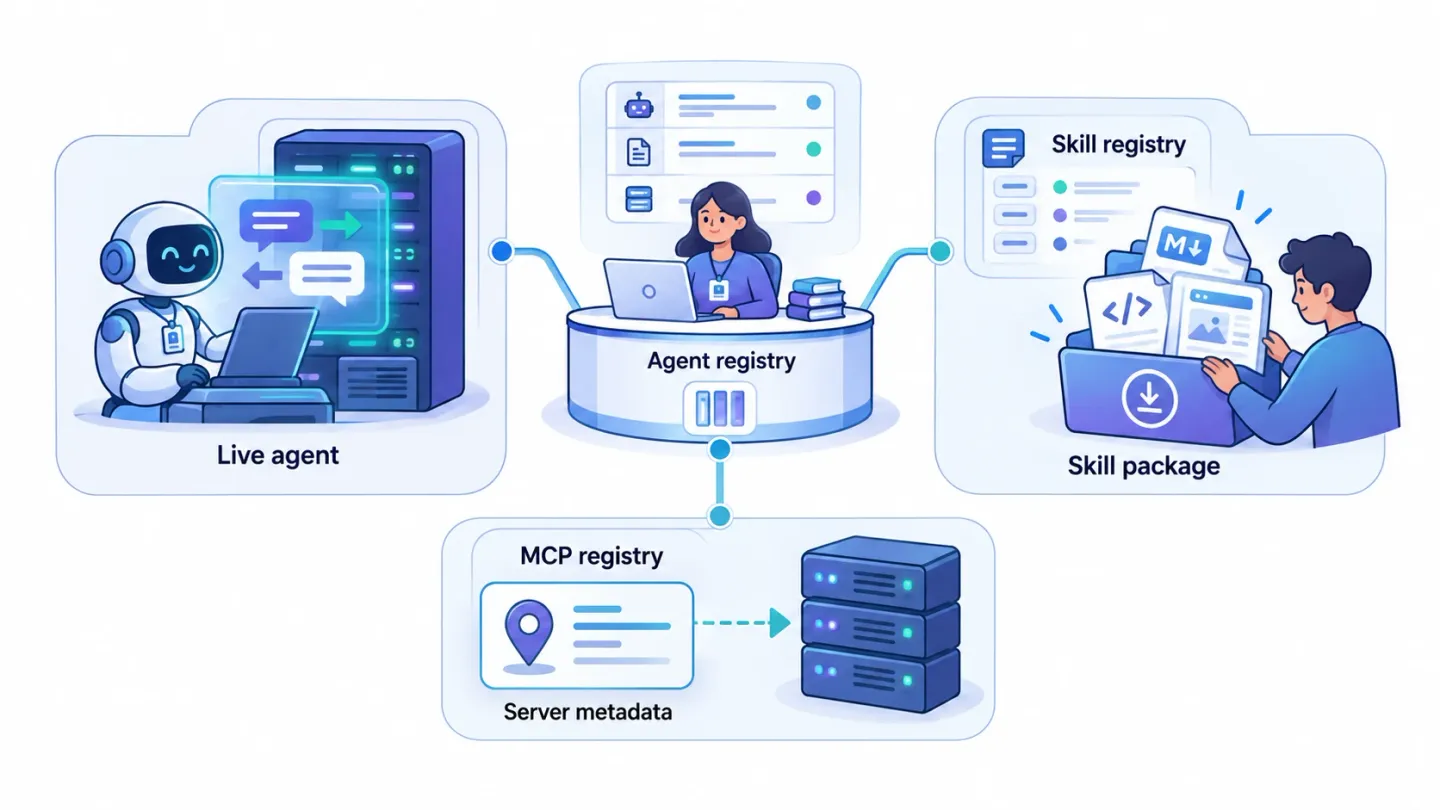
An AI agent registry catalogs agents and the services they expose. A skill registry manages reusable instruction packages and revisions. Some platforms store both. Evaluate the objects, consumers and lifecycle controls each registry supports, then test how its decisions reach running agents and downloaded skill copies.
This guide helps platform teams choose a catalog architecture. Start with the private skill marketplace guide if your immediate problem is sharing instructions among developers.
Last verified: October 27, 2026, against the linked specifications and product documentation. The release example and tests are proposed evaluation methods.
Disclosure: ASCENDING Inc builds and maintains Jarvis, an open source project with registry and gateway components in this category.
AI agent registry vs skill registry: compare the object
Ask the vendor to open one real record. Determine whether it describes a running endpoint, a downloadable package or metadata pointing to another service.
| Evaluation dimension | AI agent registry | Skill registry | MCP server registry |
|---|---|---|---|
| Deployment model | Catalog plus integration with agent services | Catalog or repository plus package distribution | Metadata service plus external server hosting |
| Supported AI tools | Clients that discover or invoke the agent | Hosts that load the package format | MCP-compatible clients |
| Auth and access control | Discovery permission and invocation permission | Package read, edit, publish and distribution permissions | Metadata visibility plus separate server authorization |
| Audit | Registration, policy changes and linked invocation events | Publication, approval, download and revision history | Metadata changes and linked server activity where integrated |
| MCP support | Optional integration alongside agent endpoints | Optional tools referenced by instructions | Core server discovery object |
| Hosting | Catalog hosting and agent runtime hosting may differ | Catalog hosting and local execution may differ | Registry hosting and server hosting may differ |
| Retirement test | Deprecated endpoint can’t receive prohibited new work | Withdrawn release stops future distribution; local copies are accounted for | Retired metadata and stale client configuration are handled |
The columns describe responsibilities, not universal product guarantees. A unified platform may implement several columns in one interface.
Why an A2A skill is different from a SKILL.md package
The word skill has two meanings in these ecosystems.
The A2A specification describes an Agent Card containing identity, capabilities, skills, interfaces and security information. Here, a skill advertises something a remote agent can do.
The Agent Skills specification defines a directory with SKILL.md and optional scripts, references and assets. A compatible host loads that package to carry out a workflow.
AI agent registry records describe an invocable capability
An incident-analysis agent might advertise “summarize service incidents” and expose an authenticated endpoint. A consumer needs to know how to call it, what it accepts and which operations it supports.
A release-notes package instead gives a host instructions and a template. Installing it doesn’t create a remotely addressable agent service.
Keep those objects linked where useful, but don’t collapse their identifiers. Several agents may use one skill revision, and one agent may use several packages.
MCP registry metadata points to a server
The official MCP Registry documentation describes a metadata repository that points to packages or remote servers. Package registries host code and binaries; the MCP Registry stores discovery information.
That distinction matters during incident response. Removing a discovery entry doesn’t necessarily stop a previously configured client from calling the server.
Use the enterprise MCP registry architecture guide for the catalog-to-enforcement boundary.
Follow one release through three records
Consider a proposed support agent that drafts incident summaries. Its architecture has three independently versioned parts:
- Agent record:
incident-assistant, with its endpoint, owner and supported operations. - Skill release:
incident-summary, containing the approved writing workflow and evidence template. - MCP record:
observability-tools, pointing to the server that exposes permitted log queries.
The agent release records which skill revision and tool integration it expects. The runtime event records what it actually used.
| Change | Record to review | Test before promotion |
|---|---|---|
| Template wording changes | Skill revision | Summary preserves source facts and required sections |
| Agent gains a ticket-writing capability | Agent capability and access policy | Unauthorized writes fail and approved writes are attributable |
| MCP server moves | Server metadata and client configuration | Approved clients reach the intended server with correct authorization |
| Agent is retired | Agent lifecycle and gateway policy | New prohibited requests fail, with queued work handled explicitly |
| Skill is withdrawn | Distribution state and installation inventory | Future installs stop and existing copies have a response plan |
This example is an architecture exercise, not a report of an executed deployment. Its value is that each change has a specific owner and acceptance test.
What an AI agent registry must prove
Discovery and invocation need separate tests
Use two test identities. One should discover an agent but lack permission to invoke a restricted operation. Another should be allowed to perform the approved operation.
Then change the access policy and repeat the requests through every supported route. Include direct endpoint calls when those are possible.
Record the propagation window and the enforcement component. “The catalog row says revoked” isn’t evidence that the next request is blocked.
Version and retirement behavior need explicit semantics
Ask whether consumers pin a release, automatically receive updates or negotiate versions. Test what happens to active jobs when a version is deprecated.
For packages, distinguish rollback of files from rollback of effects. Restoring an old skill can’t undo a ticket already created or data already sent to an external service.
Use AI identity governance to tie lifecycle changes to workload credentials and downstream grants.
Choose Git, a registry or a combined platform
Git can be enough when a small team needs reviewed repository-local packages and can manage installation itself. It provides version history, but your team still owns approval conventions and distribution.
A dedicated registry becomes useful when consumers need searchable capabilities, centralized lifecycle state or access decisions across many projects. Its trade-off is another service and policy integration to operate.
Product names don’t settle the architecture. Google Cloud’s Agent Registry overview explicitly includes agents, MCP components, endpoints and standalone skills. A product called an agent registry can therefore manage several object types.
Ask a combined platform to demonstrate the joins: an agent release to a skill revision, a tool endpoint and the policy used during an invocation. Separate catalogs can also work if those identifiers remain consistent.
Where Jarvis Registry fits
The Jarvis Agent Registry page describes lifecycle records for agents and a gateway that enforces access at runtime. Treat its documented catalog scope separately from the Skill Gateway’s distribution role.
For evaluation, request one agent retirement test and one skill withdrawal test. Measure actual behavior for running work, direct calls and installed copies.
If the immediate task is maintaining a common package across coding tools, use the shared Claude Code, Codex and Cursor skill library guide. It supplies the release and installation checks that a catalog alone doesn’t provide.
References
- A2A protocol specification
- Agent Skills specification
- The official MCP Registry
- Google Cloud Agent Registry overview
- Jarvis Agent Registry
- Jarvis Skill Gateway
Agent registry and skill registry buying questions
What is the difference between an AI agent registry and a skill registry?
An agent registry typically catalogs deployable or running agents, their endpoints, owners and capabilities. A skill registry manages reusable instruction packages and revisions. A platform can contain both, so inspect its resource model and lifecycle controls rather than relying on the product name.
Is an A2A skill the same as a SKILL.md package?
No. An A2A skill describes a capability advertised by an agent. An Agent Skills package contains instructions and optional resources that a compatible host loads. A capability description can refer to behavior implemented using a package, but the objects have different consumers and lifecycle requirements.
What is the difference between an MCP registry and a skill registry?
An MCP registry publishes server metadata such as package locations or remote endpoints. A skill registry distributes reusable instructions and resources. Neither catalog entry alone proves a caller is authorized to use the referenced service.
Does a registry enforce runtime access?
Some platforms connect catalog policies to a gateway. Test that connection by changing access and attempting a real invocation. A searchable catalog or approval label by itself doesn't demonstrate enforcement on direct calls or cached client configurations.