
Amazon Bedrock Migration Assessment: A Buyer's Checklist
An Amazon Bedrock migration assessment should answer a practical question: what must change, what can stay, and how will we know the application still works? Moving an OpenAI or Anthropic workload is not automatically a model substitution or a complete rebuild. The answer depends on how the application uses its model today.
Use this checklist when comparing migration providers or deciding what your own team can deliver. It helps turn a broad request into work that can be estimated and tested.
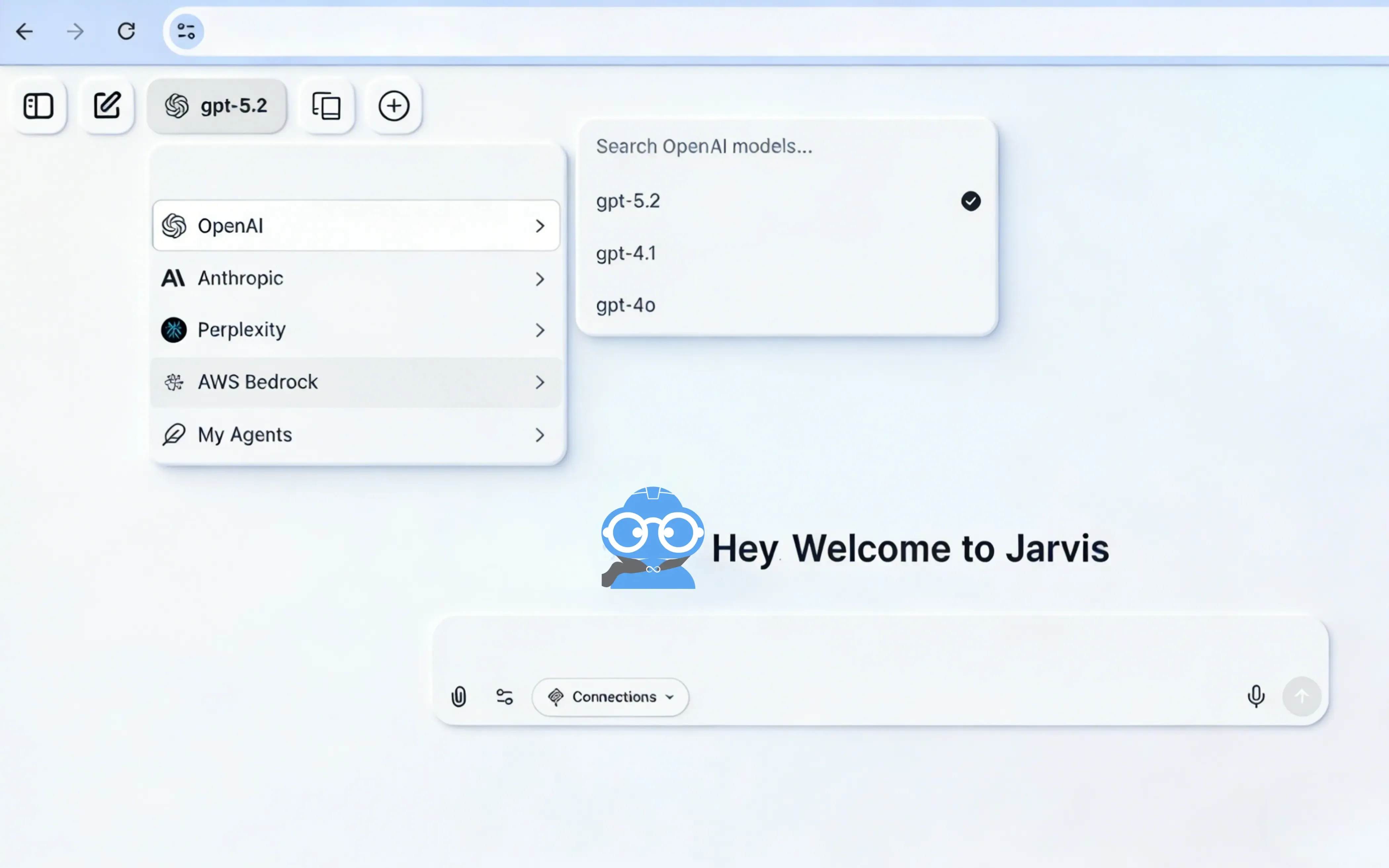
Jarvis Chat’s model selector brings several provider options into one interface.
1. Define the application, not just the model
Start with one workload and document its current behavior:
- Model provider, model version, API and SDK.
- Prompts, tool calls, streaming and expected output format.
- Retrieval sources, conversation history and other stored state.
- Authentication, integrations and the interface people already use.
- Request volume, token usage, latency and failure patterns.
Separate an application using a model API from a Claude subscription or developer-tool setup. They have different dependencies. AWS’s migration-assessment walkthrough similarly evaluates the codebase, requirements, model mapping and implementation steps before recommending a path.
2. Check compatibility before estimating the rewrite
Ask the provider to classify each dependency: keep, configure, adapt or replace. An existing frontend may remain useful while authentication or backend requests change. Conversely, an API-compatible endpoint does not establish that every feature behaves identically.
Use the current Bedrock API compatibility reference to check the proposed model and endpoint. Test representative tool calls, structured outputs, error handling and streaming behavior. Record unsupported features instead of hiding them inside an assumption that migration is straightforward.
The result should explain why each change is necessary and which team owns it.
3. Map the real data boundary
List where prompts, retrieved content, responses and logs travel. Include observability services and external tools, not only the model endpoint.
Amazon Bedrock is an AWS-managed service. AWS’s data-protection documentation explains the shared responsibilities and model deployment arrangements. That is different from running a self-hosted model in your own infrastructure.
The selected cross-Region inference configuration also matters. Confirm the regions and routing allowed for the workload, then check logging, access and retention requirements against that design. “It uses our AWS account” is not a complete data-flow assessment.
4. Agree on quality and cost acceptance tests
Create a small, representative test set from tasks the application must perform. Include difficult inputs and failures, not just successful demonstrations. Run the existing and proposed approaches against the same acceptance criteria.
Compare answer quality, tool correctness, latency, retries and cost per completed task. A cheaper token rate may not produce a cheaper useful result if the workflow needs more calls or more human correction.
State the assumptions behind the estimate: usage, model mix, prompt length, caching, supporting infrastructure and operating effort. Keep projected costs separate from observed test costs. Do not accept a savings percentage without its baseline and measurement method.
For a healthcare assessment, the insurance eligibility workflow supplies concrete acceptance cases: incomplete responses, conflicting fields, and writes that need review. Pair those quality checks with the verification automation cost model so the comparison includes exception labor and integration cost as well as model charges. Keep the same cases and cost boundaries on both sides of the migration test.
5. Plan rollout, rollback and handoff
A migration plan should identify the first workload, release owner, monitoring checks and conditions for returning to the previous configuration. Confirm how credentials, configuration and infrastructure changes will be managed.
Before work starts, agree on the deliverables: code changes, deployment configuration, test results, operating instructions and support responsibilities. Ask who maintains the integration when models, prices or APIs change. These details make competing proposals easier to compare than a single migration price.
Bring a specific workload to the discussion
For Claude governance, see how ASCENDING approaches model access and cost attribution on Bedrock. If keeping a familiar interface matters, review Jarvis Chat’s model and embedding options.
Then contact ASCENDING with the workload, current architecture and non-negotiable requirements. Confirm the scope, feasibility and next steps before agreeing on a migration plan.
References
- AWS: AI workload migration assessment
- AWS: Bedrock API compatibility
- AWS: Bedrock data protection
- AWS: Cross-Region inference
Bedrock migration questions buyers ask
Can we move to Bedrock without rebuilding our application?
Some components may stay unchanged. Check the model, API, tool calls, streaming, authentication, and stored state before agreeing on the migration scope.
Is moving a Claude subscription the same as migrating an API application?
No. A subscription, a developer tool, and an application using model APIs have different integration and billing arrangements. Assess the actual workload.
Will Amazon Bedrock automatically reduce our costs?
No. Compare actual token usage, target model rates, infrastructure, retries, and operating effort. Test quality as well as cost before making that decision.
What should a migration assessment deliver?
A scoped architecture, compatibility gaps, baseline results, cost assumptions, acceptance tests, rollout and rollback steps, and clear operational ownership.