

To switch AI models without rebuilding an existing application, evaluate an AI gateway or provider-adapter layer against the API your application already uses. A shared request format can reduce code tied to individual providers. It does not make their models, tool calls or outputs interchangeable.
Portkey’s Universal API documents shared API formats across supported providers. Vercel AI Gateway documents provider selection, ordering and fallbacks. These are examples to evaluate for application-level switching—not a claim that either removes every integration change.
If the need is instead to give employees several models in one governed workspace, Jarvis Chat provides that interface for configured providers such as OpenAI, Anthropic and Amazon Bedrock, with identity and role-based model access. Choosing a model in a chat workspace is a different job from replacing an application’s model API.
Match the platform to the part you need to keep
| What you need to keep | Relevant approach | What still needs checking |
|---|---|---|
| An existing application’s model calls | A gateway or adapter with a common API, such as Portkey’s Universal API | Supported request fields, outputs, streaming, tools, and error handling |
| Control over an application’s provider routes | A gateway with provider-routing settings, such as Vercel AI Gateway | Allowed providers, fallback behavior, credentials, and deployment fit |
| One employee workspace across models | A governed multi-model interface such as Jarvis Chat | Available models, role permissions, knowledge access, and data destinations |
| An application moving into Amazon Bedrock | A workload migration assessment | Model fit, authentication, architecture, operations, and rollout |
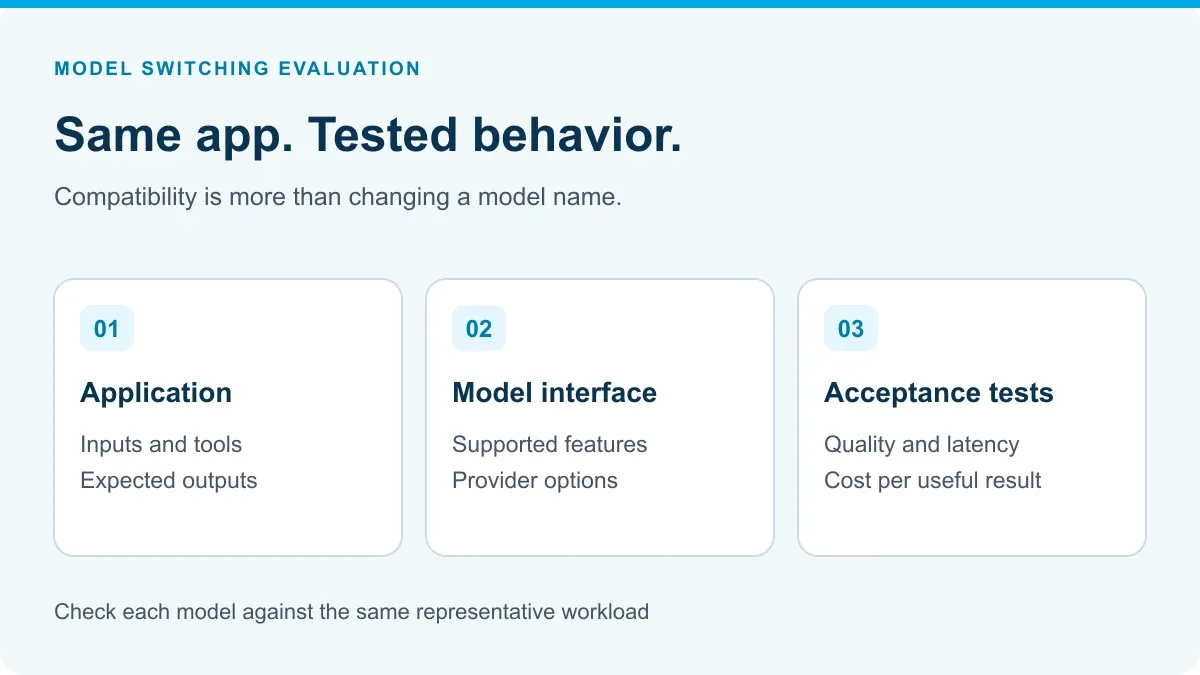
These approaches can overlap, but they are not equivalent purchases. Start with the application contract: the request it sends, the response it expects, the tools it invokes and the failures it handles. Then ask a shortlisted provider to demonstrate that contract with the two models you intend to use.
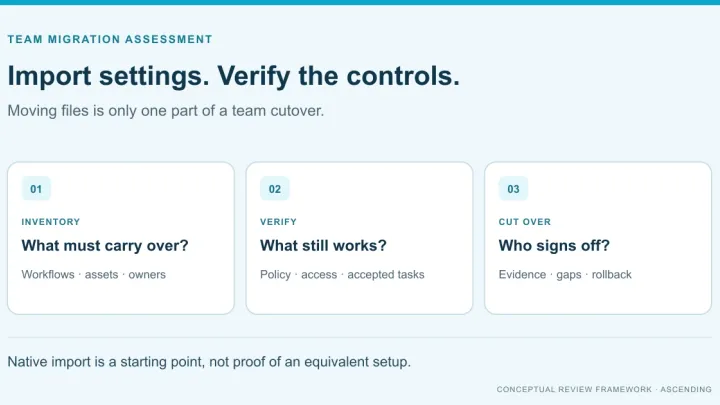
If your project is specifically a move to Bedrock, use the Bedrock migration assessment checklist. This article focuses on ongoing model choice and compatibility, rather than the wider migration project.
Define what “without rebuilding” means for your application
Keeping the interface and business workflow while changing a model integration is a useful goal. It is not the same as making no changes. The team may still need to update credentials, configure the gateway, map request fields or adjust how it handles responses.
Before comparing platforms, list the features the application relies on: structured output, tool calls, files, streaming and conversation history. Check the selected provider and model for each one. A gateway accepting the request is only a transport check; the application still needs a usable result.
Test one real task before changing the default
Consider an illustrative workplace-policy assistant. An employee asks whether a particular expense is allowed. The assistant should use an approved policy, explain the answer, and identify the supporting source. A new model is only useful if that entire result remains acceptable.
Prepare examples from normal work, not just a polished demonstration. Include a straightforward policy question, an ambiguous request, an outdated document, and a question for which no approved answer exists. Keep the source material and instructions the same when comparing models so you can tell what caused a difference.
Ask the reviewer to judge the answer, not the brand of the model. Record unsupported statements and missing qualifications alongside successful results. If a model sounds more confident but invents a policy exception, the switch has not improved the task.
Check compatibility beyond a successful API response
An application that displays free text has different dependencies from one that expects a structured record or invokes a tool. AWS’s inference-parameter reference documents model-specific request parameters and response fields. Check the actual model and API path you intend to use.
For the policy assistant, a change may affect:
- Inputs: document length, file or image support, and conversation history.
- Outputs: required fields, source references, and formatting the interface can display.
- Actions: tool arguments, authorization checks, and when human review is required.
- Operations: timeouts, rate limits, retries, and the response shown when a request fails.
A model selector should not become a way to bypass an application’s approval or access rules. Those controls need their own tests, even when both models generate plausible answers.
Preserve the data boundary when routing changes
Jarvis Chat can run in customer-managed infrastructure, but that does not make every connected model private. An external model API receives the content sent to it. Private deployment and external provider access need separate decisions about which information can be processed where.
Also inspect fallback routes. Vercel’s provider-routing documentation distinguishes preferred provider order from permitted providers. A fallback must be approved for the same data, not merely available during an outage. Apply this check to whichever gateway you shortlist; do not assume another product uses the same settings.
For your chosen setup, document the permitted model endpoints, credentials owner, information sent, and logging destination. Verify that a user who cannot access a policy source does not gain access by choosing another model.
Agree on a small acceptance test
These are proposed buyer tests, not a claim that every platform implements them automatically.
| Test | Evidence to request |
|---|---|
| Ask a normal policy question on both models | Correct answer with a supporting approved source |
| Ask for a policy the employee cannot access | No restricted information exposed through either route |
| Ask a question without enough evidence | Clear uncertainty rather than an invented policy |
| Interrupt the chosen model endpoint | Expected failure or an explicitly approved fallback |
| Repeat the same workload | Quality, latency, retries, and cost measured on the same basis |
Compare cost per accepted answer, including retries and review effort, rather than token prices alone. The AI cost attribution guide explains how to establish a consistent usage boundary. Keep the previous configuration available during a limited rollout and agree who can revert the change.
Choose the next step for your workflow
For an existing application, shortlist gateways against its required API behavior, approved providers and operating constraints. Run the same acceptance tests before changing the default. This is the evidence needed to judge how much of the application can remain unchanged.
If your requirement is a governed employee workspace, request a Jarvis Chat demo around one task, two candidate models and two user roles. Ask to see model choice, source access and the data route together. This evaluates Jarvis’s documented fit without treating a chat demonstration as proof of compatibility with an unrelated application API.
References
- Portkey: Universal API
- AWS: Inference parameters for foundation models
- Vercel: Provider routing and fallbacks
- Jarvis Chat: Multi-model workspace and access controls
AI model switching questions
Is Jarvis Chat the right choice for switching our application's model?
Jarvis Chat fits teams that want a governed employee workspace with a choice of configured models. An existing application's model API is a separate integration decision: evaluate an AI gateway or adapter against that application's requirements.
Does a model selector remove the need to change application code?
No. Selecting a model inside Jarvis Chat is different from changing the model behind a custom application. That application still needs compatibility checks for requests, outputs, tools, streaming, and failure handling.
Does customer-hosted chat keep all prompts inside the customer account?
Not when the selected model uses an external provider API. Those requests reach that provider. Private-model deployment and external API use have different data boundaries, which should be checked for each permitted route.
How should we decide whether to switch models?
Compare the same representative tasks on both models. Evaluate useful answers, permissions, latency, failures, and total cost per accepted result before changing the default.