

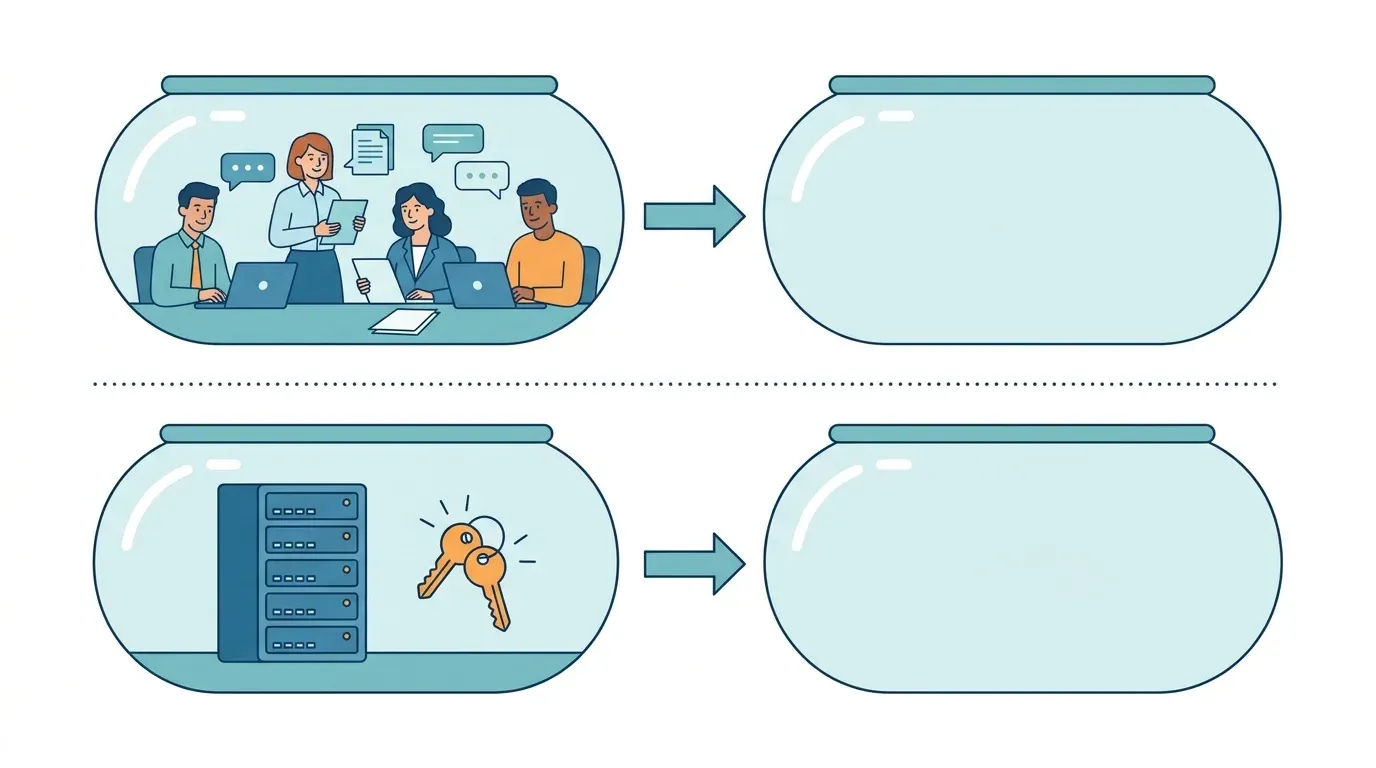
A ChatGPT workspace is where employees use ChatGPT. An OpenAI API project is where applications call models, with its own members, keys, limits and billing. They are separate systems, so moving employees to Claude doesn’t move applications. Plan two migrations, with different owners, destinations and tests.
A costly mistake would be to buy Claude seats for staff and assume the support chatbot and nightly batch jobs came along. The reverse is just as easy: move the API traffic and forget that employees still depend on a workspace full of custom GPTs. This page maps the objects on each side so you can assign owners before you commit.
TL;DR: Treat this as two migrations. Employees move through a Claude plan and are tested by their workflow owners. Applications move through the Claude Console and are tested with code, evals and a rollback plan. Nothing in either direction transfers automatically.
Vendor documentation checked October 28, 2026. This is our recommended planning approach, not a completed customer migration or a claim of automatic conversion.
Why ChatGPT and the API are two systems with two bills
OpenAI documents ChatGPT and the API platform as separate billing systems. API usage is billed separately from a ChatGPT subscription. ChatGPT Business billing sits in Workspace settings, eligible Enterprise and Edu workspaces use the Global Admin Console, and API billing sits with API organization owners.
Anthropic draws the same line. It describes paid Claude plans and the Claude Console as separate products, with the API billed separately from a subscription. Anthropic adds that Claude Max and Team plans include monthly API credits, so check whether your plan carries any before you budget the API side from scratch.
That has practical consequences:
- Two invoices on each vendor, usually owned by different budget holders.
- Two sets of administrators, one in the workspace console and one in the API organization.
- Two cutover dates, because an employee pilot and an application release don’t finish together.
What lives in an OpenAI API project
A project is the unit of access, limits, service accounts, usage and billing inside an API organization. According to OpenAI’s project documentation:
- Only organization owners can create projects. Every organization has an undeletable Default project, and members and service accounts can’t be added to it directly.
- Service accounts belong to one project and can’t be used outside it. Creating one creates an API key, and the secret is shown once.
- Files, assistants, storage and threads are scoped to their project and can’t be moved between projects. Fine-tuned models in the Default project are an exception.
- Spend limits exist at the organization and project level. OpenAI’s spend-limits guide says a hard limit is optional. Without it, alerts only notify. With it, affected requests return a
429error. - Enforcement isn’t instantaneous, so recorded spend can slightly exceed the limit.
- Archiving a project is permanent, and projects can’t be deleted.
Two details need care.
First, the help article is inconsistent about its 100 GB file-storage quota. It states the quota per project, but the error message says per organization. Don’t plan around a figure without testing it.
Second, Assistants objects are on their way out. OpenAI’s deprecations page lists the Assistants API shutdown date as August 26, 2026, with the Responses API and Conversations API as the replacement. That date has passed. Confirm in your own account whether any application still depends on assistants or threads before you inventory them as things to migrate.
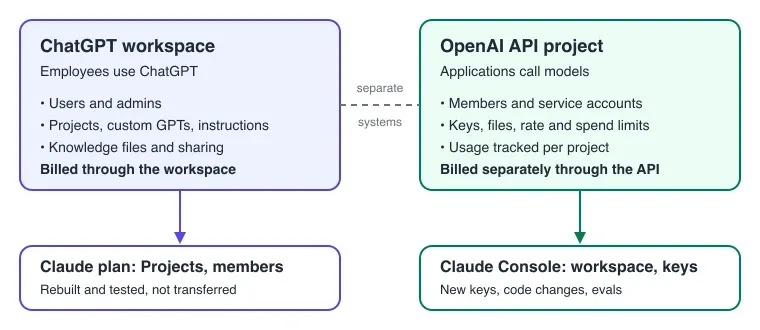
What lives in a ChatGPT workspace
The workspace is the employee-facing side: users, projects, custom GPTs, instructions, knowledge files and sharing, plus the connectors those workflows depend on.
Billing lives here too. OpenAI says ChatGPT Business billing sits in Workspace settings, where only workspace owners can update payment details or view invoices. Eligible Enterprise and Edu workspaces use the Global Admin Console instead.
We cover the inventory fields, export limits and pilot design in our company ChatGPT-to-Claude migration assessment, so this page doesn’t repeat them. If your connectors or custom GPT actions matter, read ChatGPT connectors vs MCP next.
How the objects map to Claude
Nothing in this table moves automatically, and the Claude side is also two systems: the Claude plan for chat, and the Claude Console for API usage. The mapping below shows proposed equivalents to rebuild and test, not a transfer path.
| Object | ChatGPT workspace | OpenAI API project | Claude destination | Moves automatically? |
|---|---|---|---|---|
| Who administers | Workspace owners and admins | Organization and project owners | Plan admins (chat); Console organization admins and Workspace Admins (API) | No |
| Billing | Workspace billing | API billing, separate | Claude plan billing; Console/API billing, separate | No |
| People and access | Workspace users | Project members and service accounts | Plan members (chat); workspace members and service accounts (API) | No |
| Credentials | Employee sign-in | Project and service-account keys, secret shown once | Workspace-scoped or personal and service-account keys | No, issue new keys |
| Instructions and knowledge | Projects, custom GPTs | Prompts in code; files and stores scoped to a project | Claude Projects (chat); prompts in code and Files API (API) | No, rebuild |
| Limits | Plan limits | Per-project access, rate and spend limits | Per-workspace rate and spend limits, up to the organization’s limits | No |
| Usage and cost | Check your plan’s admin reporting | Per-project usage | Console usage and the Usage and Cost API, grouped by workspace | No |
Claude workspaces are not Claude Projects
This is the naming trap. A Claude Console workspace organizes API usage: it holds keys, members, service accounts and limits. Claude Projects are a chat feature that holds knowledge, instructions and project memory, and sharing them is available on Team and Enterprise plans.
On the API side, Anthropic’s documentation describes the following:
- Every organization has a Default Workspace that can’t be renamed, archived or deleted, and spend limits can’t be set on it.
- Organizations get up to 100 workspaces by default, and archived ones don’t count.
- Workspace roles are User, Limited Developer, Developer, Admin and Billing. Organization admins automatically hold Workspace Admin everywhere.
- Files created through the Files API, Message Batches and Skills are scoped to a workspace.
- Workspace spend and rate limits can be lower than the organization’s limits, not higher.
- Archiving a workspace archives its keys and can’t be undone.
An OpenAI “project” and a Claude “Project” share a word and almost nothing else. Name them precisely in tickets and statements of work.
What changes for each owner
Each vendor restricts who can create the API-side container. OpenAI limits project creation to organization owners, and the Claude Console limits workspace creation to organization admins. Confirm who holds those roles before you assign work. The assignments below are our recommendations, not vendor requirements.
- IT and security: own seats, SSO, sharing rules and the retention question for the employee workspace. They also decide who becomes the new workspace owner before the old one is retired.
- Platform engineering: own new keys, prompts and code changes, an evaluation set, and rate limits for the API side. For the code branch, start with switching AI models without rebuilding.
- Finance: owns two invoices on each vendor, the cost of a parallel run, and separate spend limits so the overlap period doesn’t surprise anyone.
Which should you migrate first, employees or applications?
Migrate employees first, as a pilot, and treat applications as a separate track. An employee workflow can be tested by its owner and reversed by pointing people back to the old tool. An application needs code changes, an evaluation set and a rollback plan.
Give each track its own acceptance test. A successful workspace pilot is not evidence that an API application behaves correctly on a new provider, and the reverse is also true. For the employee track, the pilot design in our assessment guide applies. For the application track, require the same inputs, the same pass conditions and a way back.
One Claude-side detail affects developers. When a member first signs in to Claude Code with a Console account, Anthropic creates a Claude Code workspace automatically. Archiving that workspace disables Claude Code sign-in through Console billing for the whole organization, so protect it from cleanup during the migration. For policy controls, see our Claude Code managed settings guide.
If you are still choosing a platform, begin with the ChatGPT Enterprise vs Claude Enterprise comparison.
What this page does not claim
- No automatic migration. As of October 28, 2026, we found no documented tool that moves OpenAI project resources into a Claude workspace. Collection is not import.
- Unverified items. We haven’t confirmed which Claude admin features each plan includes, the size of the monthly API credits for Max and Team plans, or whether any Assistants-era resources are still live in your OpenAI account.
- Your contract may differ. Enterprise agreements can change billing and administration. Check your own terms.
Treat the mapping as a checklist to test, not a conversion guide.
References
- OpenAI: Managing projects in the API platform
- OpenAI: Managing billing for ChatGPT and the API platform
- OpenAI: Spend limits
- OpenAI: Deprecations
- Anthropic: Workspaces (Claude Console)
- Anthropic: Create and manage projects
- Anthropic: Why paid Claude plans and the API are billed separately
Questions about ChatGPT workspaces, API projects and Claude
Does a ChatGPT Enterprise subscription include API access?
Plan as if it doesn't. OpenAI describes ChatGPT and the API platform as separate billing systems, and API usage is billed separately from a ChatGPT subscription. Confirm your contract terms with OpenAI. See OpenAI's billing guide.
Do I need a separate Claude account for the API?
Plan for a separate setup and a separate bill. Anthropic describes paid Claude plans and the Claude Console as separate products and says you need to set up Console access separately for API usage, although Max and Team plans include monthly API credits. Ask your account team how your organization's plan and Console organization are linked. See Anthropic's explanation.
What is the Claude equivalent of an OpenAI API project?
The closest match is a Claude Console workspace. Both group keys, members, limits and usage inside an organization. They differ in detail: Claude workspaces have their own roles, can't carry a spend limit on the Default Workspace, and are unrelated to Claude Projects in the chat product. See Anthropic's workspaces documentation.
Can I move files from an OpenAI project into a Claude workspace?
We found no documented transfer path. OpenAI scopes files and related resources to a project, and Claude scopes Files API files to a workspace, so plan to re-upload from approved original sources and test retrieval in the new environment.
What is the difference between ChatGPT and the OpenAI API for a company?
ChatGPT is the employee-facing application, administered at the workspace level. The OpenAI API is the developer platform that applications call, organized into projects with their own members, keys, limits and billing. A company often has both, and each needs its own migration plan. The mapping table shows the differences.