
Moveworks vs Glean After ServiceNow | ASCENDING
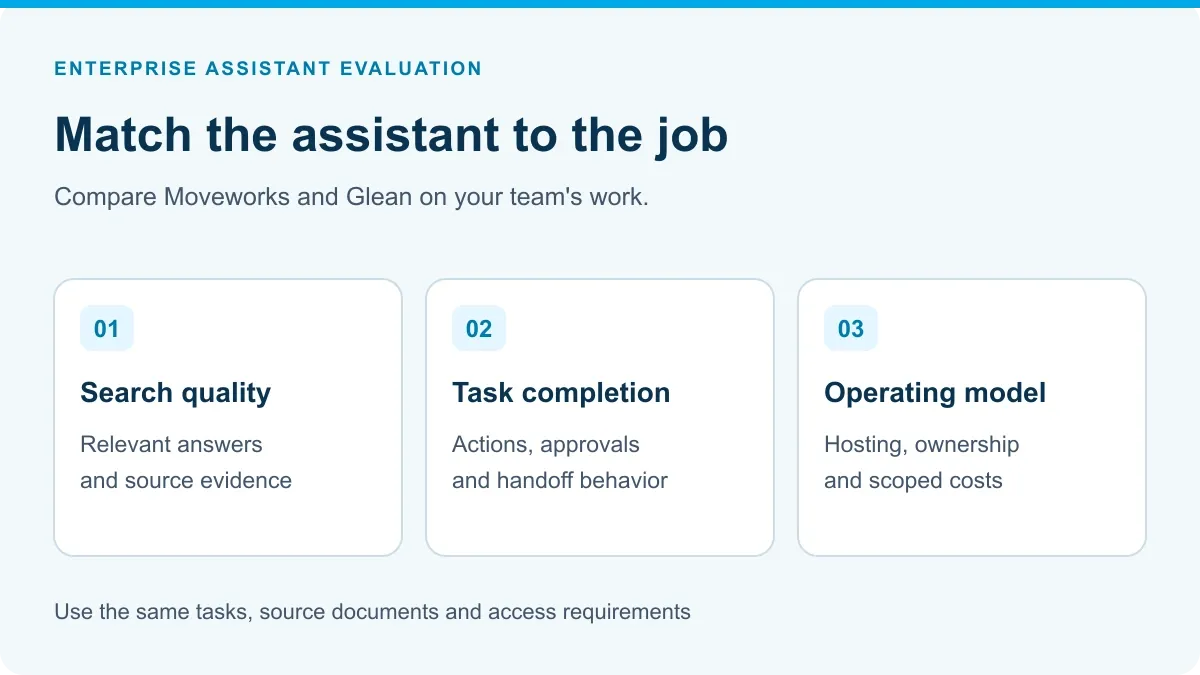
TL;DR — the comparison in 2 sentences. Moveworks and Glean both offer enterprise search and employee assistance; ServiceNow’s acquisition of Moveworks adds product-packaging and integration questions to the comparison. Use the 6 dimensions below to test your actual sources, workflows, permissions and deployment requirements, then compare scoped quotes rather than assumed annual price floors.
ServiceNow completed its acquisition of Moveworks on December 15, 2025. Buyers comparing the platforms should revisit current packaging and integration options without assuming that ownership determines which product will perform better on their work.
The practical question remains: which platform can answer employees’ questions and complete the required tasks within your access, operating and budget boundaries?
What the Acquisition Changes for Your Evaluation
In May 2026, ServiceNow introduced ServiceNow Otto, an AI experience combining Now Assist, Moveworks and AI Experience. That is more specific than saying Moveworks has simply been renamed ServiceNow AI Agents.
At the acquisition close, Moveworks said independent customers would retain the capabilities of its AI Assistant. For a new purchase, ask which product and licenses the proposal includes, which integrations are available now and how support will work. Existing ServiceNow customers should also check whether their agreement affects the offer; do not assume a mandatory renewal date or automatic implementation savings.
Ownership has changed. The resulting commercial and technical benefits still need to be demonstrated for your configuration.
The 6-Dimension Scorecard
| Dimension | Moveworks / ServiceNow offering | Glean |
|---|---|---|
| Enterprise search | Enterprise Search and AI Assistant; test your required sources | Permissions-aware search and Assistant; test your required sources |
| Employee assistance and actions | Agent Studio workflows and connected-system actions | Agents and connected-system actions |
| Commercial scope | Request a quote specifying product, users, usage and implementation | Request a quote specifying plan, users, usage and implementation |
| ServiceNow integration | Existing integration and ServiceNow ownership; confirm the offered configuration | Documented ServiceNow connector; confirm supported objects and actions |
| MCP integration | MCP Workspace connects external servers; Controlled Availability as of October 1, 2026 | Documented MCP server exposes Glean capabilities to external clients |
| Deployment fit | Confirm hosting, model-processing and operational boundaries in the proposal | Glean Hosted and Customer Hosted options; confirm cloud and model configuration |
This is an evaluation checklist, not a benchmark ranking. The product sources below describe capabilities; your proof of fit should use the same employee questions and tasks in both systems.
Test Search and Task Completion Separately
Search quality and task completion are useful evaluation axes, but neither product is limited to one of them.
For scattered company knowledge, test retrieval and permissions first. Glean’s developer platform documents search, chat and agents grounded in connected company data. Use representative questions across your important sources, including material a test user must not be able to retrieve.
For service requests, test completion rather than answer quality alone. Moveworks documents assistance and automation across employee systems. Glean also documents a ServiceNow integration, so do not exclude it solely because of its search origins. Ask both vendors to demonstrate a request, the required approval, an action and a failure handoff using your systems.
Score the results against your dominant problem: knowledge sprawl, ticket load or both. A product’s history is useful context, not evidence that it will outperform the other on your workload.
Compare Pricing for the Same Scope
Request a current, scoped quote from each vendor. Include users, usage allowances, model consumption, implementation, required connectors, support and renewal terms. This review does not establish a universal minimum annual price for either vendor.
Two practical checks:
- Ask about existing agreements. If you already buy ServiceNow, ask whether the proposed package changes your current contract, included capabilities or renewal obligations. Confirm any discount in the written offer.
- Compare equivalent deployment scope. Jarvis’s AWS Marketplace listing shows a $18,000 Basic Plan for 12 months covering Agent Flow with one LLM integration, with higher plans adding capabilities. Additional AWS infrastructure costs may apply. That is a published package price, not an equivalent enterprise-search implementation or evidence of what other vendors should charge.
The Protocol Question Most Evaluations Skip
The Model Context Protocol connects AI applications with tools and data. “Supports MCP” is not enough detail for a procurement decision: identify whether you need the assistant to call an external server, or an external client to call the platform’s capabilities.
Glean documents a hosted MCP server for access to its search, assistant and agents. Moveworks’ MCP Workspace lets its assistant call connected MCP servers and is explicitly in Controlled Availability as checked October 1, 2026. Those are different integration directions; they are not a complete feature-parity comparison. Confirm availability for your account, authentication, required tools and failure handling in a working test. If the assistant will call your own MCP servers, inventory the ones teams already run. Then compare gateways that enforce per-tool access before connecting them.
A Decision Framework, Not a Ranking
We prefer frameworks over verdicts, because verdicts go stale and your situation changes. These 5 situations cover most buyers:
- Already a ServiceNow shop, ITSM is the pain → include the Moveworks/ServiceNow offer and test its fit with your existing workflows, licenses and support model.
- Heterogeneous SaaS sprawl, knowledge scattered everywhere → include Glean and test retrieval quality, source coverage and permission handling against the same questions in other candidates.
- Ticket volume dominates your employee assistance spend → ask both vendors to complete representative requests, including approvals, exceptions and service-desk handoff.
- MCP is a required integration path → specify client or server needs, then verify the exact tools, access controls and availability. Do not treat roadmap access as a production commitment.
- Customer-cloud deployment with specific model and workflow requirements → compare the operating model, not just the hosting label. Glean offers Customer Hosted deployment in AWS and GCP, with Glean managing the service, and model choice depends on the enabled providers and configuration. Include Jarvis when evaluating a customer-hosted workspace, governed retrieval and agent workflows; verify the deployment, model data path and integration scope for each candidate. Use our customer-hosted Glean comparison to structure that review.
Healthcare buyers should also separate employee assistance from patient-intake operations. Use the AI insurance eligibility verification workflow to define payer evidence and review gates, the voice AI for payer calls comparison to evaluate a separate calling service, and the insurance verification automation cost model to include exception labor. Those requirements need their own demonstration; this assistant comparison does not establish either vendor’s payer-verification capabilities.
If your main requirement is a general employee workspace for research, writing and analysis, use the separate ChatGPT Enterprise vs Claude Enterprise comparison. It covers a different shortlist and provides a same-task pilot for access, output quality and operating cost. Before evaluating any shortlist, the AI readiness checklist helps establish the workflow, data owner and acceptance criteria.
What We’d Tell a Buyer This Quarter
Rebuild the comparison from current vendor documentation, marketplace listings and scoped proposals. Test each candidate against the same employee questions, actions and permission boundaries. Ask for an implementation plan and total cost for the same workload before choosing.
The acquisition changes what buyers need to ask about ownership, packaging and integration. It does not establish a universal winner or a guaranteed cost advantage.
For a separate comparison, see Explore Agentic. Verify current product and commercial details against the vendor sources.
Sources
- ServiceNow acquisition completion, December 15, 2025
- ServiceNow Otto announcement, May 5, 2026
- Moveworks acquisition update for customers
- Moveworks MCP Workspace
- Glean developer platform, ServiceNow connector and MCP server announcement
- Glean deployment options and model choice
- Jarvis AWS Marketplace listing
FAQ — Moveworks vs Glean Questions Buyers Ask
What changed in Moveworks vs Glean after the ServiceNow acquisition?
ServiceNow completed the acquisition on December 15, 2025. In May 2026 it introduced ServiceNow Otto, combining Moveworks, Now Assist and AI Experience. Ask which product, integrations and commercial terms are included in your proposal; the acquisition alone does not establish your implementation cost or renewal terms.
Is Glean or Moveworks better for enterprise search?
Both provide enterprise search and employee assistance. Test them against the same sources, permissions and employee questions. If ticket resolution matters, also test the complete action, approval and handoff workflow rather than choosing from search results alone.
How much do Moveworks and Glean cost per year?
Request a scoped quote from each vendor. Jarvis has a published AWS Marketplace Basic Plan of $18,000 for 12 months, covering Agent Flow with one LLM integration; additional AWS infrastructure costs may apply. This is not an equivalent enterprise-search deployment or a market-wide price floor.
Which platform supports MCP today, Moveworks or Glean?
Both document MCP capabilities, but compare the direction and scope. Glean documents an MCP server for exposing its capabilities to external clients. As checked October 1, 2026, Moveworks MCP Workspace is in Controlled Availability and lets its assistant call connected MCP servers. Confirm access and required tools before buying.
When should a buyer look past both Moveworks and Glean?
Extend the shortlist when you need a different operating model or a specific knowledge-to-workflow integration. Private cloud hosting alone does not exclude Glean: its Customer Hosted option runs in AWS or GCP. Compare supported models, access boundaries and integration scope against Jarvis and other options.